




Introduction
The best AC unit for an RV is the one that fits the vehicle, climate, installation, and available electrical supply. A large rooftop unit may cool a fifth wheel effectively but be wasteful in a camper van. A portable unit may be convenient, yet its exhaust arrangement can reduce efficiency. A highly efficient DC model may be ideal for boondocking, but only when the wiring and battery bank can support its current.
This guide explains how to compare cooling capacity, running power, compressor startup, noise, installation, and battery runtime. It also matches common RV cooling loads with suitable OUPES products without treating any power station as a substitute for checking the air conditioner’s actual specifications.
Quick Decision Guide
| RV or Travel Style | Best AC Starting Point | Why | Watch For |
|---|---|---|---|
| Camper van or Class B | Variable-speed DC AC or compact dual-hose portable AC | Efficient zoned cooling and manageable size | High-current DC wiring, venting, and limited battery capacity |
| Small travel trailer | Compact rooftop or efficient portable AC | Balanced cooling without excessive capacity | Compressor startup surge and roof load |
| Class C motorhome | Properly sized rooftop RV AC | Good whole-cabin air distribution | Duct condition, generator compatibility, and noise |
| Fifth wheel or Class A | Zoned rooftop system or professionally installed mini-split | Handles larger volume and separate living zones | Multiple simultaneous loads and higher total energy use |
| Frequent boondocking | Variable-speed unit with low measured watt-hour consumption | Better part-load efficiency and easier solar integration | Daily energy budget matters more than maximum BTU alone |
| Mostly campground hookups | Rooftop AC matched to shore-power service | Runtime is less constrained by stored energy | Campground circuit limits and voltage quality |
Types of RV Air Conditioners
| AC Type | Best Use | Advantages | Limitations |
|---|---|---|---|
| Rooftop RV AC | Travel trailers and motorhomes needing whole-cabin cooling | Preserves floor space and may connect to existing ducts | Roof weight, wind exposure, compressor surge, and installation work |
| 12 V or 24 V DC AC | Purpose-built vans and serious off-grid systems | Avoids an AC inverter conversion stage and often supports variable speed | High-current wiring, permanent installation, and higher upfront cost |
| Portable AC | Renters, occasional travelers, and temporary installations | Flexible placement and minimal vehicle modification | Floor-space use, exhaust routing, condensate, and storage while driving |
| Mini-split | Custom full-time builds and stationary RVs | Quiet operation and strong part-load efficiency | Complex mounting, refrigerant lines, drainage, and vibration protection |
| Window-style AC | Stationary trailers and budget projects | Low purchase cost and familiar service | Custom opening, weather sealing, security, and travel durability |
Choose the Right Cooling Capacity
The ENERGY STAR air-conditioner sizing guide emphasizes matching cooling capacity to the space. Oversizing can cause short cycling and weak humidity removal, while undersizing can leave the compressor running continuously.
The figures below are a room-AC baseline rather than an RV prescription. RV roofs, windows, insulation, air leakage, direct sun, occupants, and cooking loads may justify additional capacity. Follow the RV AC manufacturer’s sizing instructions before purchase.
| Area | ENERGY STAR Baseline | RV-Specific Adjustments |
|---|---|---|
| 100–150 sq. ft. | 5,000 BTU/h | Check windshield heat, roof exposure, and sleeping-zone isolation |
| 150–250 sq. ft. | 6,000 BTU/h | Check window area, insulation, occupants, and door openings |
| 250–300 sq. ft. | 7,000 BTU/h | Check slide-outs, cooking heat, and duct losses |
| 300–350 sq. ft. | 8,000 BTU/h | Check climate, ceiling height, and multi-zone airflow |
| 350–450 sq. ft. | 9,000–10,000 BTU/h | Large RVs may require zoned cooling rather than one oversized unit |
| 450–550 sq. ft. | 12,000 BTU/h | Confirm manufacturer guidance for rooftop exposure and vehicle construction |
Variable-speed technology is valuable when power is limited. ENERGY STAR notes that variable-speed compressors can adjust output to the cooling demand instead of operating only at full power or off, improving comfort and reducing unnecessary cycling.
Understand Electrical Requirements
| Specification | Meaning | Buying Test |
|---|---|---|
| Rated voltage | The electrical supply required by the AC | Match the RV circuit, outlet, inverter, and appliance voltage |
| Running watts or amps | Normal compressor demand after startup | Add all loads that may operate simultaneously |
| Startup or locked-rotor demand | Short spike when a fixed-speed compressor starts | Compare with inverter surge rating and duration |
| Daily watt-hours | Total energy consumed across thermostat cycles | Use measured data to size batteries and solar charging |
| Efficiency rating | Cooling delivered per unit of electricity | Compare CEER, EER, SEER2, or the manufacturer’s applicable metric |
| Soft-start compatibility | Whether startup current can be reduced with approved hardware | Confirm with both equipment manufacturers and use qualified installation |
A soft starter may help an inverter start a compressor, but it does not create extra battery energy. Runtime remains a function of watt-hour consumption.
Compare RV AC Power Sources
| Power Source | Strength | Limitation | Best Role |
|---|---|---|---|
| Shore power | Long cooling sessions without depleting a battery | Requires a compatible campground hookup | Primary power at developed campsites |
| Fuel generator | Sustained high output with refueling | Noise, fuel, maintenance, exhaust, and campground restrictions | Remote high-load backup when safely operated outdoors |
| Battery power station | Quiet, portable, and exhaust-free at the point of use | Finite stored energy | Boondocking, quiet hours, and flexible backup |
| Solar plus battery | Can replace part of the daily cooling energy | Weather, shade, roof area, and charge-input limits | Extending off-grid runtime rather than guaranteeing unlimited AC |
| Alternator charging | Recharges while driving when correctly installed | Vehicle alternator and wiring limits | Travel-day energy recovery |
OUPES Recommendations for RV Air Conditioning
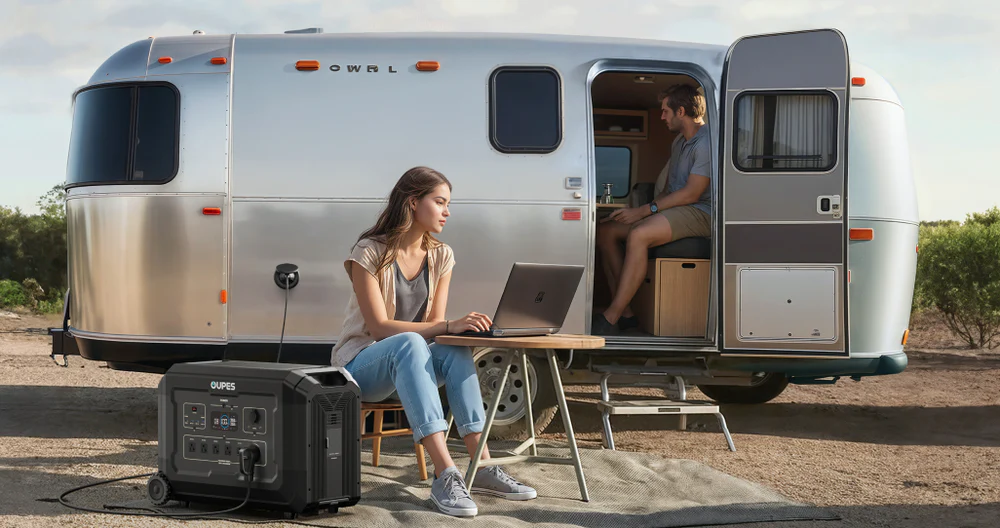
An OUPES portable power station can run a compatible RV AC without combustion exhaust. Choose from measured AC demand, not the cooling label alone.
| Model | Capacity | Output | Battery Life | Key Interfaces | Recommended Role |
|---|---|---|---|---|---|
| Mega 1 Lite | 1,024 Wh | 2,000 W rated; 4,500 W surge | LiFePO4; 3,500+ cycles to 80% | 4 AC outlets, 2 USB-A, 2 USB-C, 1 car socket | Verified low-draw portable AC for short sessions |
| Mega 2 Pro | 2,048 Wh | 2,500 W rated; 3,600 W boost | LiFePO4; 4,000+ cycles to 80% | 4 NEMA 5-20R, 1 TT-30R, 2 USB-A, 2 USB-C, 2 car sockets | Efficient compact or medium 120 V AC with confirmed startup compatibility |
| Mega 3 | 3,072 Wh | 3,600 W rated; 7,000 W surge | LiFePO4; 3,500+ cycles to 80% | 5 NEMA 5-20R, 1 TT-30R, 4 USB-A, 2 USB-C, DC5521, Anderson, and car outputs | Best overall choice for one compatible conventional 120 V rooftop AC |
| Guardian 6000 V2 | 4,608 Wh | 6,000 W at 240 V; 3,600 W at 120 V; 9,000 W surge | LiFePO4; 4,000+ cycles to 80% | L14-30R, 14-50R, 6-20R, 4 NEMA 5-20R, USB-A, and USB-C | Large motorhomes, dual-voltage systems, or RV-plus-home backup |
Mega 3 offers the best balance for a high-power RV cooling scenario. Mega 2 Pro is easier to move and may be sufficient for an efficient unit. Guardian 6000 V2 should be selected only when its dual-voltage capability, higher output, or expansion potential solves a real requirement.
Estimated RV AC Runtime
These estimates use the OUPES planning formula shown on the Mega 3 product page. They assume one continuous load and no solar input.
| Model | 700 W Efficient AC | 1,000 W Mid-Draw AC | 1,500 W High-Draw AC |
|---|---|---|---|
| Mega 1 Lite | About 1.2 hours | About 0.9 hour | About 0.6 hour |
| Mega 2 Pro | About 2.5 hours | About 1.7 hours | About 1.2 hours |
| Mega 3 | About 3.7 hours | About 2.6 hours | About 1.7 hours |
| Guardian 6000 V2 | About 5.6 hours | About 3.9 hours | About 2.6 hours |
| Formula | Capacity × 0.85 ÷ operating watts |
| Actual runtime may be longer | The compressor cycles or modulates below the example load |
| Actual runtime may be shorter | Extreme heat, poor insulation, other appliances, battery aging, or larger conversion losses |
| Compatibility warning | Runtime does not prove that the inverter can start the compressor |
A compatible solar generator package may extend runtime, but daily solar energy must be modeled for the route, season, shade, and available panel area.
Battery Life and LiFePO4 Safety
Repeated air-conditioner use can cycle a battery frequently. OUPES uses LiFePO4 cells in all four models. A Sandia and Los Alamos battery thermal-stability study found the LFP cathode stable at high temperature, supporting its physical safety advantage over many ternary chemistries.
| Comparison | OUPES LiFePO4 Models | Generic Ternary-Lithium Benchmark |
|---|---|---|
| Cycle life | 3,500–4,000+ cycles to 80%, depending on model | 500–800 cycles as a general brand-planning benchmark |
| Potential service life | Selected product guidance describes approximately a decade or more under suitable use | Lower cycle count can mean earlier replacement under frequent cycling |
| Thermal behavior | Stable phosphate cathode; highly resistant to severe thermal-runaway behavior | High-nickel ternary chemistry can show more severe thermal response |
| Safety requirements | BMS, ventilation, correct charging, dry placement, and secure mounting | The same system-level protection remains essential |
Improve Cooling Efficiency
- Park in shade when possible while keeping charging panels exposed to sun.
- Use reflective window covers and insulated vent cushions.
- Seal air leaks around doors, windows, slide-outs, and cable entries.
- Clean filters and condenser surfaces according to the AC manual.
- Pre-cool on shore power before leaving a campground.
- Cool the occupied zone instead of the entire RV when practical.
- Use circulation fans to reduce temperature stratification.
- Avoid starting a microwave or electric water heater while the compressor starts.
RV AC Buying Checklist
- Measure the conditioned floor area and assess insulation, windows, and climate.
- Confirm cooling capacity using the manufacturer’s RV-specific guide.
- Record voltage, running watts, and compressor startup demand.
- Check roof opening, structure, weight, drainage, ducts, and clearance.
- Compare efficiency, variable-speed operation, noise, and serviceability.
- Calculate daily watt-hours rather than relying only on maximum power.
- Include all simultaneous RV loads in the electrical budget.
- Verify inverter, outlet, cable, breaker, and solar-input compatibility.
Final Verdict
| Need | Best Starting Choice | Reason |
|---|---|---|
| Small van and maximum efficiency | Variable-speed DC or compact dual-hose AC | Efficient zoned cooling with a manageable load |
| Typical travel trailer or Class C | Properly sized rooftop AC plus OUPES Mega 3 | Strong cooling with useful inverter and surge headroom |
| Efficient AC and shorter off-grid sessions | OUPES Mega 2 Pro | Good portability, TT-30R connection, and expandable storage |
| Large or dual-voltage system | OUPES Guardian 6000 V2 | Higher simultaneous output and broader voltage support |
Frequently Asked Questions
1. What is the best type of AC for a small RV?
A variable-speed DC or compact dual-hose unit is often the best starting point. Confirm cooling capacity, venting, wiring, and measured energy use.
2. Is a rooftop AC better than a portable AC?
Rooftop units preserve floor space and cool the whole RV, while portable units are easier to add. The better choice depends on installation freedom and power availability.
3. Can OUPES Mega 3 run an RV air conditioner?
It can run a compatible unit whose voltage, continuous power, and startup surge remain within its limits. Check the exact AC specifications first.
4. How long can a battery run an RV AC?
Divide usable battery watt-hours by the AC’s operating watts. Weather, cycling, insulation, solar input, and other loads change real runtime.
5. Do I need a soft starter?
A compatible soft starter may reduce compressor startup demand. It does not increase battery capacity or guarantee compatibility.
6. Is a 12 V RV AC always more efficient?
Not always. It avoids one conversion stage, but compressor design, controls, wiring losses, and operating conditions determine total efficiency.
7. How much solar is needed for RV air conditioning?
Calculate daily AC watt-hours, add other loads and losses, then model seasonal solar production. Stay within the power station’s input limits.