




Table of Contents
- Introduction
- Understanding Pumping Machine Power Requirements
- Can a Solar Generator Run a Pumping Machine?
- Best Practices When Powering Pumps With Solar Generators
- Recommended OUPES Solar Generators for Pumping Machines
- FAQ
Introduction
Water pumping machines are essential tools in households, agriculture, construction sites, and emergency situations. Traditionally powered by grid electricity or fuel generators, many users now ask: Can a solar generator power a pumping machine?
As solar generators become more powerful—featuring large-capacity LiFePO4 batteries, high-wattage inverters, and efficient solar charging—the possibility of running pumping machines has become more realistic.
This article explores how solar generators work with water pumps, what factors determine compatibility, and which OUPES power stations are best suited for different pump types. By the end, you’ll know exactly what size solar generator you need and how to use it safely and efficiently.
Understanding Pumping Machine Power Requirements
1. Types of Pumping Machines
Different pumps require different amounts of power. Common categories include:
- Submersible pumps (used for wells and boreholes)
- Surface water pumps (shallow wells, tanks, and ponds)
- Pressure booster pumps (household water pressure)
- Agricultural irrigation pumps
Each pump type has unique startup power (surge power) needs because motors draw more electricity at startup than during continuous operation.
2. How Much Power Does a Pump Need?
Most pumps fall within these ranges:
| Pump Type | Running Wattage | Surge Wattage |
|---|---|---|
| Small household pump (0.5 HP) | 370–500W | 900–1500W |
| Medium pump (1 HP) | 750–1100W | 2000–3000W |
| Submersible well pump (1.5 HP) | 1200–2000W | 3000–5000W |
| Large irrigation pump | 2000–4000W | 5000–7500W |
The surge wattage is the most important factor when choosing a solar generator because the inverter must handle the peak power load when the pump motor starts.
3. Additional Factors Affecting Power Requirements
- Pumping depth — deeper wells require more force
- Water volume — higher flow rates need higher wattage
- Motor efficiency — older pumps draw more energy
- Continuous runtime — determines required battery capacity (Wh)
Can a Solar Generator Run a Pumping Machine?
1. Yes—If the Generator Matches the Pump’s Watt Requirements
Solar generators can power pumping machines effectively when the inverter output and battery capacity meet the needs of the pump. For example:
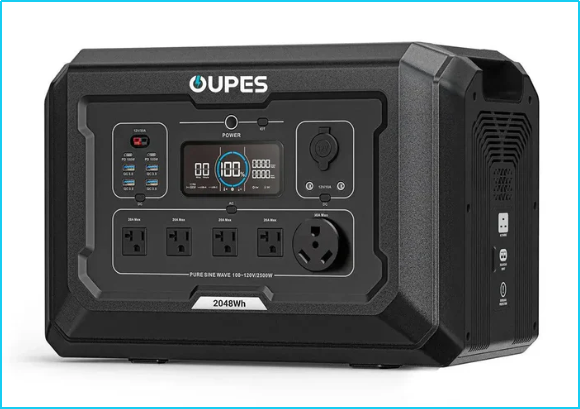
- Small pumps (0.5 HP) can run on mid-sized solar generators like the OUPES Mega 2.
- Medium pumps (1 HP) typically require stronger systems like the OUPES Mega 3.
- Large pumps (1.5 HP+) need high-output systems such as the OUPES Mega 5.
Solar energy is safe, quiet, and economical—making it a great option for off-grid pumping, emergency water supply, and farming applications.
2. Benefits of Using Solar Generators for Pumps
- No fuel cost — solar panels provide renewable energy
- Low noise — ideal for households
- Zero emissions — eco-friendly
- Indoor safe — no fumes or carbon monoxide
- Reliable backup — works during grid outages
3. Limitations to Consider
- High-power pumps require high-wattage inverters
- Pump motor startup surge must be accounted for
- Battery capacity determines how long the pump can run
- Continuous heavy loads drain batteries quickly
The key is matching pump wattage to generator capability—covered in detail below.
Best Practices When Powering Pumps with Solar Generators
1. Calculate Required Running Time
If your pump uses 1000W and you expect to run it for 2 hours:
1000W × 2 hours = 2000Wh required
You need at least a 2000Wh battery—plus additional capacity if you want reserve energy.
2. Ensure the Inverter Supports Pump Surge Wattage
Most pumps require 2×–3× their running wattage at startup. Always select a generator with an inverter that exceeds the pump's surge watt rating.
3. Use High-Efficiency Solar Panels for Recharging
Pumps drain batteries quickly; solar panels help maintain charging during operation. OUPES foldable panels are recommended for fast outdoor charging.
4. Avoid Continuous Long Runtime on Small Generators
Running a pump continuously on a small generator can deplete the battery rapidly and shorten system lifespan. Always match generator size to pump demand.
5. Consider Expandable Systems for Agricultural Use
Agricultural pumping demands high energy over long hours. Expandable systems like the OUPES Mega 5 with additional batteries provide reliable off-grid pumping.
Recommended OUPES Solar Generators for Pumping Machines
Here is a comparison of OUPES power stations and the pump types they can support:
| OUPES Model | Capacity | AC Output | Compatible Pump Type |
|---|---|---|---|
| OUPES Mega 2 | 2048Wh | 2500W | Small household pumps (0.5 HP) |
| OUPES Mega 3 | 3072Wh | 3600W | Medium pumps (1 HP) |
| OUPES Mega 5 | 5040Wh | 4000W | Large submersible pumps (1.5 HP) |
For deeper wells, high-surge motors, or long-hour usage, the Mega 5 is the strongest option due to its powerful inverter and expandable energy storage.
FAQ
1. Can a solar generator run a borehole pump?
Yes, but you need a high-output system like the Mega 5 to handle the surge wattage of deep well pumps.
2. How long can a solar generator power a pumping machine?
Runtime depends on battery capacity and pump wattage. Example: A 2000Wh generator running a 500W pump lasts about 4 hours.
3. What size solar generator do I need for a 1 HP pump?
A 1 HP pump typically needs 750–1100W running and 2000–3000W surge. The OUPES Mega 3 is recommended.
4. Can solar panels run the pump directly?
No. Solar panels must charge a battery in a solar generator; the inverter then powers the pump.
5. Do pumping machines damage solar generators?
No, as long as the inverter supports the surge load. If mismatch occurs, the generator will shut down for safety.
6. Are solar generators better than fuel generators for pumps?
For indoor, residential, or small agricultural use, yes — they are quieter, cheaper long-term, and emission-free.
7. Can I use solar generators for irrigation?
Yes. Pair a large-capacity model like the Mega 5 with additional batteries for extended pumping hours.