




Introduction
Portable power stations have become essential tools for home backup, camping, RV travel, construction sites, and emergency preparedness. But one of the most common questions people ask is: How long do these batteries actually last?
The answer depends on several factors—battery chemistry, depth of discharge, maintenance habits, usage scenarios, and even environmental temperature. This article breaks down everything you need to know so you can make informed decisions and select a portable power station that delivers long, reliable service.
We’ll also look at OUPES’s advanced LiFePO4-powered portable stations and why their cycle life far exceeds conventional lithium-ion models, making them a superior investment for long-term energy security.
Understanding Portable Power Station Battery Lifespan
Cycle Life Explained
The life expectancy of a portable power station’s battery is typically measured in charge cycles. One cycle refers to using the battery from 100% to 0% and recharging it fully. Depending on the model and chemistry, portable stations may last from 500 to over 6,000 cycles.
This means a high-quality LiFePO4 power station used once per day could last 8–15 years before dropping to around 80% battery health.
Typical Battery Lifespan Estimates
| Battery Type | Cycle Life | Estimated Years of Use |
|---|---|---|
| Lithium-ion (NMC) | 500–1,000 cycles | 2–5 years |
| LiFePO4 (LFP) | 3,000–6,500 cycles | 8–15 years |
| Lead-acid | 200–300 cycles | 1–3 years |
OUPES portable power stations use LiFePO4 batteries, which are among the longest-lasting and most stable battery chemistries available for portable energy storage.
Battery Chemistry and How It Impacts Longevity
Why LiFePO4 Is Now the Industry Standard
Most modern high-end portable power stations have transitioned from lithium-ion (NMC) to **LiFePO4 (LFP)** because of its superior safety, lifespan, and efficiency. OUPES models feature LFP batteries for maximum durability. Here's why this matters:
- Thermally stable—less risk of overheating
- Longer cycle life—up to 6x the lifespan of NMC batteries
- Safer chemistry—reduced risk of fire or thermal runaway
- More eco-friendly—non-toxic and longer-lasting
Example: OUPES Mega 5 LiFePO4 Lifecycle
The OUPES Mega 5 has up to 3,500+ cycles before the battery retains 80% capacity. This means even after many years of use, it continues providing reliable power for home backup or off-grid living.
Comparison Table: NMC vs. LiFePO4
| Feature | NMC Lithium-ion | LiFePO4 (Used by OUPES) |
|---|---|---|
| Cycle Life | 500–1,000 | 3,000–6,500 |
| Thermal Stability | Moderate | Excellent |
| Safety | Good | Exceptional |
| Cost | Lower | Higher |
| Recommended For | Light/occasional use | Home backup, off-grid, heavy-duty use |
In summary, battery chemistry is one of the strongest predictors of how long your portable power station will last and how reliable it will remain over time.
How Long a Portable Power Station Can Run Devices
Battery lifespan isn’t only about years—it’s also about runtime per charge. Knowing how long your station can power appliances helps you choose the right capacity.
Runtime Formula
Runtime (hours) = Battery Capacity (Wh) × 0.85 ÷ Device Load (W)
The 0.85 represents typical inverter efficiency.
Example: Running Common Appliances
| Appliance | Average Wattage | Runtime on 1,200Wh Station | Runtime on 5,000Wh Station |
|---|---|---|---|
| Mini fridge | 60W | ~17 hours | ~70 hours |
| CPAP machine | 40W | ~25 hours | ~106 hours |
| Portable heater | 1,500W | ~0.7 hours | ~3 hours |
| Wi-Fi router | 12W | ~85 hours | ~350 hours |
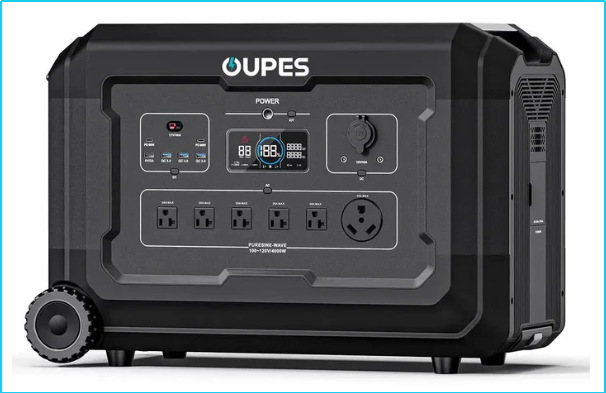
OUPES portable power stations such as the Exodus 1200, Mega 2, and Mega 5 provide a wide range of capacities suitable for both light and heavy-duty applications.
Key Factors That Influence Battery Lifespan
1. Depth of Discharge
Battery longevity improves when you avoid draining it completely. LiFePO4 is more tolerant of deep discharge than other chemistries.
2. Charging Habits
Keeping the station between 20% and 80% for daily use can extend battery health.
3. Storage Temperature
Extreme heat reduces battery lifespan. Ideally, store between 50°F–77°F (10°C–25°C).
4. Frequency of Use
Using the battery regularly helps maintain health. Long periods of inactivity can degrade performance.
5. Charging Sources
Using the included AC charger, regulated solar panels, and proper voltage ensures longevity.
Comparing OUPES Portable Power Station Batteries
Here is an overview of popular OUPES models and their battery lifespan:
| Model | Battery Type | Capacity | Cycle Life | Best Use Case |
|---|---|---|---|---|
| Exodus 1200 | LiFePO4 | 992Wh | 3,000+ cycles | Camping, CPAP, small appliances |
| Mega 2 | LiFePO4 | 2,048Wh | 3,500+ cycles | RV use, tools, home office |
| Mega 5 | LiFePO4 | 5,040Wh | 3,500–6,500 cycles | Whole-home emergency backup |
The combination of long cycle life, high power output, and expansion capability makes OUPES models ideal for long-term daily use or emergency reliability.
How to Extend the Life of a Portable Power Station Battery
- Keep stored at around 50% charge if unused for long periods
- Charge with approved chargers or solar inputs
- Avoid leaving it in hot cars or cold sheds
- Clean ports regularly to maintain output quality
- Use LiFePO4-based models for longer life
With proper maintenance, an OUPES power station can last more than a decade.
FAQ
1. How many years do portable power station batteries last?
LiFePO4 models typically last 8–15 years depending on usage frequency and storage.
2. Do portable power station batteries degrade over time?
Yes. Most batteries gradually lose capacity, typically reaching about 80% health after their rated cycle life.
3. Can I replace the battery in a portable power station?
Most are not user-replaceable, but long cycle life minimizes the need for replacement.
4. Do portable stations lose charge when stored?
LiFePO4 batteries have extremely low self-discharge, losing only about 2–3% per month.
5. How often should I recharge a stored power station?
Every 3–6 months is recommended.
6. Does cold weather affect battery life?
Yes. Batteries operate best above freezing; cold temperatures reduce performance temporarily.
7. Can I leave my portable power station plugged in?
Yes. OUPES stations use smart BMS protection to prevent overcharging.
Conclusion
The lifespan of a portable power station battery depends largely on its chemistry, quality, and how well it’s maintained. With LiFePO4 technology and proper care, an OUPES portable power station can provide reliable, high-capacity energy for well over a decade. Whether for home backup, camping, RV life, or daily work needs, choosing a long-lasting battery ensures dependable performance for years to come.
Investing in the right portable power station means security, independence, and sustainable energy wherever you need it.