




- Understanding home battery power needs
- Why battery storage matters for homes
- How much electricity does a house use?
- Battery capacity basics explained
- How to calculate how many batteries you need
- Partial home vs whole-home backup
- Real-world home power scenarios
- Combining solar panels with batteries
- Scalability and future expansion
- FAQ
Understanding home battery power needs
The question “how many batteries does it take to power a house?” does not have a single, universal answer. The number of batteries required depends on how much electricity your household uses, which appliances you want to power, and how long you need backup electricity.
Some homeowners want batteries only for short power outages, while others aim for full off-grid living. Understanding your specific scenario is the first step toward choosing the right battery setup.
Why battery storage matters for homes
Battery storage systems provide electricity when the grid is unavailable or unstable. They are increasingly popular due to rising energy costs, frequent power outages, and the growth of solar energy.
Home batteries can help with:
- Emergency backup during outages
- Reducing dependence on the utility grid
- Storing solar energy for nighttime use
- Improving household energy independence
How much electricity does a house use?
Before calculating the number of batteries needed, you must understand your household’s energy consumption. Electricity usage is typically measured in kilowatt-hours (kWh).
Average household electricity usage
In the U.S., an average home consumes between 20 and 35 kWh per day, but this varies widely based on home size, climate, and lifestyle.
| Home Type | Daily Energy Use | Monthly Energy Use |
|---|---|---|
| Small apartment | 10–15 kWh | 300–450 kWh |
| Average house | 20–30 kWh | 600–900 kWh |
| Large house | 35–50+ kWh | 1,050–1,500+ kWh |
Battery capacity basics explained
Batteries are rated by their energy storage capacity, usually measured in watt-hours (Wh) or kilowatt-hours (kWh). A 5 kWh battery can deliver 5 kilowatts for one hour, or 1 kilowatt for five hours.
Usable vs rated capacity
Not all of a battery’s rated capacity is usable. Most systems reserve a portion to protect battery health. This means real-world usable energy is slightly lower than the advertised capacity.
Power output vs energy storage
In addition to capacity, batteries also have a power output rating (watts). This determines which appliances can run simultaneously.
How to calculate how many batteries you need
To determine how many batteries are required, follow these steps:
Step 1: List essential appliances
Identify which devices you want to power during an outage. Common essentials include:
- Refrigerator
- Lights
- Internet router
- Medical equipment
- Heating or cooling (limited)
Step 2: Estimate daily energy usage
Add up the wattage of each device and estimate how many hours per day it runs.
Step 3: Decide backup duration
Determine how long you want battery power to last—hours, one day, or multiple days.
Example calculation
| Device | Power (W) | Hours/Day | Energy (Wh) |
|---|---|---|---|
| Refrigerator | 150 | 10 | 1,500 |
| Lighting | 100 | 6 | 600 |
| Wi-Fi router | 15 | 24 | 360 |
| Total | 2,460 Wh (≈2.5 kWh) | ||
If each battery provides 5 kWh of usable energy, one battery could cover this load for about two days.
Partial home vs whole-home backup
Partial home backup
Partial backup focuses only on essential circuits. This approach requires fewer batteries and is more cost-effective.
Whole-home backup
Whole-home systems aim to power nearly all appliances, including HVAC systems. These setups require significantly more batteries.
| Backup Type | Daily Energy | Estimated Batteries Needed |
|---|---|---|
| Essential loads | 5–10 kWh | 1–2 batteries |
| Partial home | 10–20 kWh | 2–4 batteries |
| Whole home | 25–40+ kWh | 5–8+ batteries |
Real-world home power scenarios
Short outages (2–8 hours)
One or two batteries are usually sufficient to keep essentials running.
Day-long outages
Homes may need multiple batteries, especially if refrigeration and electronics are used continuously.
Multi-day outages
Battery-only systems require large capacity, or they must be combined with solar recharging.
Combining solar panels with batteries
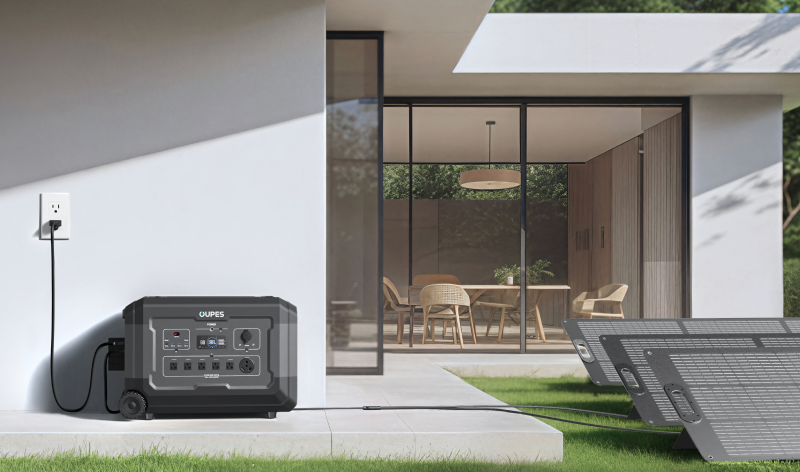
Solar panels dramatically reduce the number of batteries required by recharging them daily. In a solar-plus-battery system, batteries store excess daytime energy for nighttime use.
This combination is ideal for:
- Extended outages
- Remote or off-grid homes
- Reducing electricity bills
Scalability and future expansion
Many modern battery systems are modular, allowing homeowners to start small and add more batteries later as needs change.
Scalable systems are especially useful if you plan to add solar panels, electric vehicles, or additional appliances in the future.
FAQ
1. Can one battery power an entire house?
Usually not for long. One battery can handle essential loads, but whole-home power requires multiple batteries.
2. How many batteries are needed for 24 hours of backup?
This depends on daily energy use, but most homes need 2–5 batteries for a full day.
3. Do batteries replace generators?
Battery systems offer clean, quiet backup, but long outages may still require solar or additional charging sources.
4. Are batteries safe for indoor use?
Modern battery systems are designed for indoor installation and include multiple safety protections.
5. How long do home batteries last?
Most lithium-based batteries last 10 years or more with proper usage.
6. Can batteries power heating and air conditioning?
Yes, but HVAC systems consume large amounts of energy and require multiple batteries.
7. Is it possible to go fully off-grid with batteries?
Yes, but this requires careful system sizing and typically includes solar generation.
8. Should I oversize my battery system?
Oversizing provides flexibility and longer backup duration, especially for growing energy needs.