




Table of Contents
- Understanding Holiday Lighting Energy Use
- Types of Christmas Lights and Their Power Consumption
- How to Calculate Electricity Usage
- Real-World Usage Scenarios
- How Much Does It Cost to Run Christmas Lights?
- Can a Portable Power Station Run Christmas Lights?
- Choosing the Right Setup for Your Holiday Display
- FAQ
Understanding Holiday Lighting Energy Use
Christmas lights bring warmth, color, and festive cheer to homes during the holidays—but they also add to your electricity bill. To understand the actual impact, it’s important to look at wattage, daily runtime, and energy cost calculations. Modern lighting solutions such as LEDs significantly reduce power consumption compared to older incandescent bulbs, but large displays can still use substantial energy.
This guide breaks down everything you need to know about how much power Christmas lights require and how to estimate your seasonal energy use.
Types of Christmas Lights and Their Power Consumption
Different types of Christmas lights vary greatly in wattage. Understanding these differences is key to estimating electricity use.
Incandescent vs. LED Christmas Lights
Incandescent lights use heated filaments, consuming far more electricity. LED lights use semiconductor technology, producing the same brightness with drastically less power.
| Light Type | Typical Wattage per Bulb | Typical Wattage per 100-Bulb String |
|---|---|---|
| Incandescent Mini Lights | 0.4W | 40W |
| Incandescent C9 Bulbs | 7W | 700W per 100 bulbs |
| LED Mini Lights | 0.07W | 7W |
| LED C9 Bulbs | 0.5W | 50W per 100 bulbs |
Why LEDs Are More Efficient
- Up to 90% less electricity than incandescent lights
- Cooler temperature—safer for trees and indoor decor
- Longer lifespan and lower replacement cost
How to Calculate Electricity Usage
Use this simple formula:
Wattage × Hours Used per Day ÷ 1000 = Daily kWh Consumption
Then multiply the daily kWh by your electricity rate and number of holiday days to estimate monthly cost.
Example Formula
- String wattage: 40W
- Daily runtime: 6 hours
- 40 × 6 ÷ 1000 = 0.24 kWh per day
Real-World Usage Scenarios
Scenario 1: Small Indoor Tree
| Light Type | Bulb Count | Total Wattage |
|---|---|---|
| LED Mini Lights | 200 | 14W |
| Incandescent Mini Lights | 200 | 80W |
LEDs will barely change your electricity bill, while incandescent lights may cost 4–6 times more.
Scenario 2: Medium-Sized Outdoor Display
| Light Type | String Count | Total Wattage |
|---|---|---|
| LED Mini Lights | 10 strings | 70W |
| LED C9 Lights | 5 strings | 250W |
Scenario 3: Large Holiday Show
A fully decorated home with roofline lighting, yard trees, pathway LEDs, and large decorations may reach:
- LED display: 400–800W
- Incandescent display: 2,000–5,000W+
How Much Does It Cost to Run Christmas Lights?
Electricity cost varies depending on your local kWh rate, but here’s a general estimate assuming $0.15/kWh and 6 hours per day.
| Display Type | Wattage | Monthly Cost (30 days) |
|---|---|---|
| Small LED Display | 40–100W | $1–$3 |
| Medium LED Display | 150–300W | $4–$9 |
| Large LED Display | 400–800W | $11–$22 |
| Large Incandescent Display | 2,000–5,000W+ | $55–$135+ |
Can a Portable Power Station Run Christmas Lights?
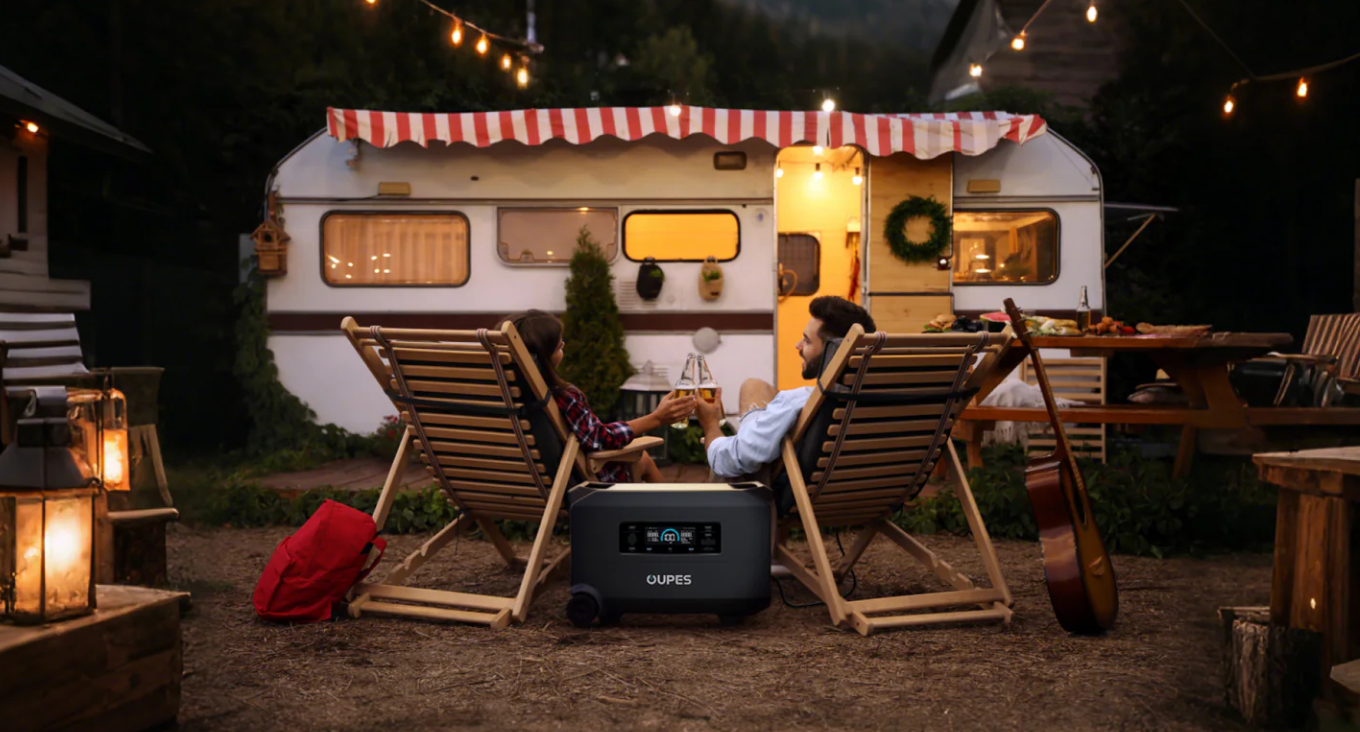
Yes—Christmas lights are one of the easiest loads for a portable power station to handle. Even large displays draw far less power than appliances like heaters or refrigerators.
Why Use a Portable Power Station for Holiday Lights?
- Eliminates outdoor extension-cord hazards
- Reduces demand on household circuits
- Perfect for remote yard decorations
- LED lighting maximizes battery runtime
How Long Can a Portable Power Station Run Christmas Lights?
Here are typical runtimes using OUPES solar generators (runtime assumes LED lights at 100W total load).
| Model | Battery Capacity | Approx. Runtime (100W Load) |
|---|---|---|
| Mega 1 | 1,024Wh | 8–10 hours |
| Mega 2 | 2,048Wh | 18–20 hours |
| Mega 3 | 3,072Wh | 27–30 hours |
| Mega 5 | 5,040Wh | 48+ hours |
Choosing the Right Setup for Your Holiday Display
If you want minimal electricity cost:
- Choose LED lights
- Use timers to avoid unnecessary nighttime operation
- Turn off displays after 10 PM
If you want maximum safety and flexibility:
- Use a portable power station for outdoor lighting
- Protect connectors from moisture
- Use low-voltage LEDs for yard features
If you want to power lights completely off-grid:
- Pair a portable power station with solar panels
- Recharge during the day and illuminate at night
FAQ
1. Do Christmas lights use a lot of electricity?
LED lights use very little power—often under 1W per bulb. Incandescent lights use significantly more.
2. How many watts are safe for one household outlet?
Most outlets handle up to 1,500W, but LED displays rarely exceed 300W.
3. How many light strings can I connect together?
LED strings can often connect 20–40 sets; incandescent strings may be limited to 3–5 due to heat and wattage.
4. Will Christmas lights raise my electricity bill?
LED lights increase bills by only a few dollars per month; incandescent displays cost much more.
5. Does running lights overnight waste energy?
Yes. A timer reduces unnecessary runtime and improves safety.
6. Can portable power stations be used outdoors?
Yes, but they must be kept dry using a protective enclosure or weather-resistant cover.
7. Are LED lights safer than incandescent lights?
Yes, they produce less heat and reduce fire risk—especially for Christmas trees.