




When people start thinking about backup power, travel charging, or emergency preparedness, two products are often confused with each other: small solar generators and power banks.
They both store electricity. They both charge devices. They’re both portable. But in real-world use, they serve very different purposes.
This guide breaks down the differences clearly and practically. Instead of focusing on marketing terms, we’ll look at real scenarios—power outages, camping, working remotely, and daily household needs—so you can decide which solution actually fits your life.
What Is a Power Bank and What Is a Small Solar Generator?
What Is a Power Bank?
A power bank is a compact battery designed primarily for charging small electronic devices.
- Typically used for phones, earbuds, tablets
- Low output power
- USB-based charging
Power banks are built for convenience and portability, not for powering appliances.
What Is a Small Solar Generator?
A small solar generator is an all-in-one portable power system that includes:
- A high-capacity battery
- An inverter for AC power
- Multiple output ports
- Solar charging capability
It is designed to power more than just personal electronics.
The Core Difference: Energy Scale
The most important difference between a power bank and a small solar generator is scale.
| Feature | Power Bank | Small Solar Generator |
|---|---|---|
| Energy capacity | Low (Wh) | High (hundreds to thousands Wh) |
| AC power | No | Yes |
| Device range | Small electronics | Electronics + appliances |
If your needs go beyond phones and tablets, a power bank quickly reaches its limits.
Typical Use Cases Compared
Power Bank Use Cases
- Daily commuting
- Short trips
- Emergency phone charging
Small Solar Generator Use Cases
- Home power outages
- Camping and RV trips
- Remote work setups
- Emergency preparedness
These products are not competitors—they serve different problem sizes.
Power Output and Device Compatibility
Output power determines what you can actually run.
| Device | Power Bank | Small Solar Generator |
|---|---|---|
| Smartphone | Yes | Yes |
| Laptop | Limited | Yes |
| Wi-Fi router | No | Yes |
| Refrigerator | No | Yes (short term) |
| Medical devices | No | Yes |
This is where many people realize a power bank is not enough.
Capacity and Runtime Expectations
Capacity is measured in watt-hours (Wh), and it directly affects runtime.
Typical Capacity Ranges
- Power bank: tens of Wh
- Small solar generator: hundreds to thousands of Wh
A power bank may recharge a phone a few times. A small solar generator can keep essential devices running for hours or days.
Charging Options and Flexibility
Power Bank Charging
- Wall outlet
- USB charging
Small Solar Generator Charging
- Wall outlet
- Vehicle charging
- Solar panels
More charging options mean more resilience in emergencies.
Can Both Use Solar Energy?
This is a common point of confusion.
Power Banks and Solar
Some power banks accept small solar inputs, but charging is slow and unreliable.
Small Solar Generators and Solar
Small solar generators are designed to efficiently capture and store solar energy, making them viable for extended off-grid use.
Solar charging is a backup feature for power banks, but a core function for solar generators.
Safety and Indoor Use
Both products are battery-based and safe for indoor use.
Key Safety Differences
- Small solar generators include battery management systems
- Overload and short-circuit protection
- Stable AC output
This makes solar generators suitable for powering sensitive equipment.
Emergency and Outage Scenarios
Scenario 1: Short Power Outage
A power bank may keep your phone alive, but nothing else.
Scenario 2: Overnight Outage
A small solar generator can power lights, communication, and essential devices.
Scenario 3: Multi-Day Emergency
Only a solar generator paired with solar panels offers sustainable power.
Which One Should You Choose?
The decision depends on one key question:
What Do You Need to Power?
- If it’s just phones → power bank
- If it includes appliances, internet, or medical devices → small solar generator
Many households eventually realize they need both—but for different roles.
How OUPES Small Solar Generators Fit Real Needs
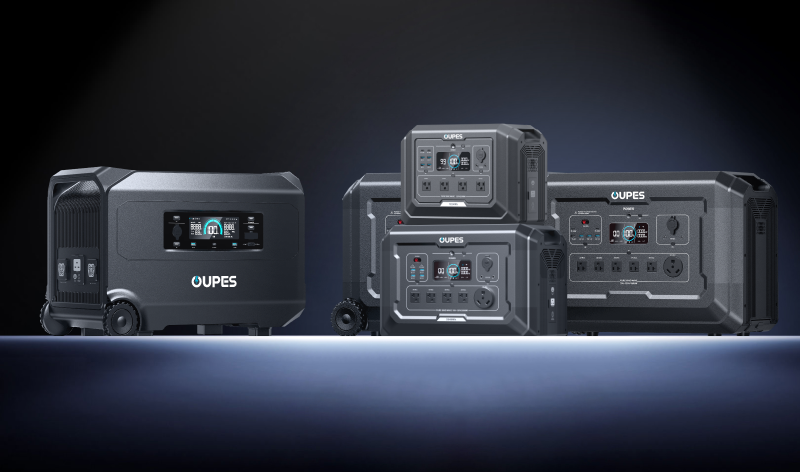
OUPES small solar generators are designed to bridge the gap between convenience and capability.
Design Focus
- Compact but powerful
- High-efficiency battery systems
- Reliable AC and DC outputs
| OUPES Model | Battery Capacity | Output Power | Best Fit Scenario |
|---|---|---|---|
| OUPES Mega 1 | 1024Wh | 2000W | Emergency essentials |
| OUPES Mega 2 | 2048Wh | 2500W | Overnight outages |
| OUPES Mega 3 | 3072Wh | 3600W | Extended backup |
These systems are for people who want more than just emergency phone charging.
Frequently Asked Questions
1. Can a power bank replace a solar generator?
No. They serve very different power needs.
2. Is a small solar generator overkill?
Not if you rely on power for work, safety, or comfort.
3. Can a solar generator charge phones?
Yes, and much more.
4. Are solar generators portable?
Yes, but they are larger than power banks.
5. Do I need solar panels?
Not required, but highly recommended for emergencies.
6. Are power banks safer?
Both are safe, but solar generators include more protection systems.
7. Can a solar generator be used daily?
Yes, many people use them regularly.
8. What’s the most common mistake?
Underestimating how much power you actually need.