




What is the 40–80 battery rule?
The rule suggests charging a lithium battery when it approaches roughly 40% and stopping near 80% during routine use. The idea is to reduce two common stressors: extended time at a high state of charge and very deep discharge cycles.
It is best understood as an optional longevity strategy—not a hard safety boundary. A battery management system, cell chemistry, charging controls, temperature, and the manufacturer’s specifications all matter.
Why can state of charge affect battery aging?
Lithium-ion batteries lose capacity through both cycle aging and calendar aging. Experimental research shows that storage temperature and state of charge influence calendar degradation, with high temperature and high state of charge often accelerating aging. Cycling research also shows that depth of discharge, temperature, and discharge rate affect cell life.
That does not mean charging to 100% once will damage a healthy battery. The concern is repeated or prolonged exposure to stressful conditions over months and years.
Does the rule apply equally to lithium-ion and LiFePO4?
| Question | Conventional lithium-ion | LiFePO4 |
|---|---|---|
| Can high temperature accelerate aging? | Yes | Yes |
| Can shallower cycles reduce cycling stress? | Often | Often, although LFP is usually rated for long cycle life |
| Must daily use stay strictly between 40% and 80%? | No; it is optional | No; follow the product manual and BMS guidance |
| Is 100% useful? | Yes, when maximum runtime is needed | Yes, when maximum runtime or balancing behavior specified by the manufacturer is needed |
| Best storage percentage? | Use the manufacturer’s storage recommendation; moderate charge and cool conditions are commonly preferred | |
When the 40–80 approach makes sense
- Your battery remains connected to power for long periods.
- You need only part of its capacity most days.
- You want to reduce time spent at extreme charge levels.
- The manufacturer offers a configurable charge limit.
When charging to 100% is reasonable
- A storm or outage is expected and maximum runtime matters.
- You are leaving for an off-grid trip.
- The manual calls for periodic full charging or calibration.
- The battery will be used soon rather than stored full in high heat.
Practical charging habits for portable power stations
- Avoid unnecessary heat. Do not charge or store the unit near heaters, inside a hot vehicle, or in direct sun.
- Use the supplied or approved charging equipment.
- Do not leave the battery empty for long periods. Recharge it according to the manual.
- For storage, follow the model-specific recommendation. Check charge periodically if instructed.
- Charge to 100% when you need the energy. Longevity advice should not prevent emergency readiness.
- Keep firmware and battery-management settings current.
What matters more than a perfect percentage?
Temperature, charging compatibility, long periods at extreme states of charge, depth of discharge, and overall usage pattern matter more than hitting exactly 40% or 80%. A user who stores a battery cool and follows the manual may achieve better results than someone who follows a percentage rule but repeatedly exposes the unit to high heat.
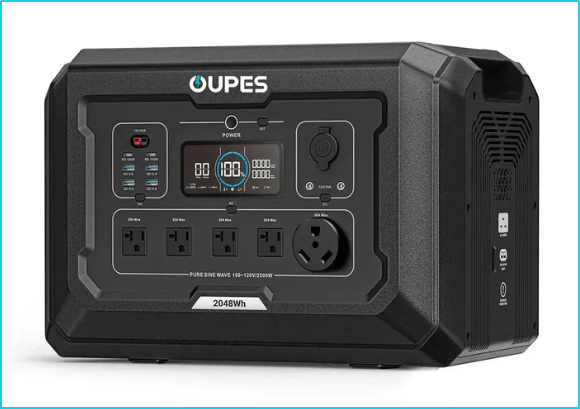
Explore OUPES portable power stations and compare capacity, output, and expansion options for home backup or off-grid use.
Frequently asked questions
Will charging to 100% ruin a lithium battery?
No. Charging to 100% is a normal supported use when performed with the approved charging system. Long-term aging is influenced by repeated exposure, storage conditions, temperature, and chemistry—not a single full charge.
Should a LiFePO4 power station always stop at 80%?
No. LiFePO4 systems are commonly designed to use a wide charge range. Use an 80% limit only if it fits your needs and the manufacturer supports it.
What charge level is best for an emergency?
If an outage is likely, practical readiness normally matters more than minimizing battery aging. Charge the unit as directed so the required energy is available.