




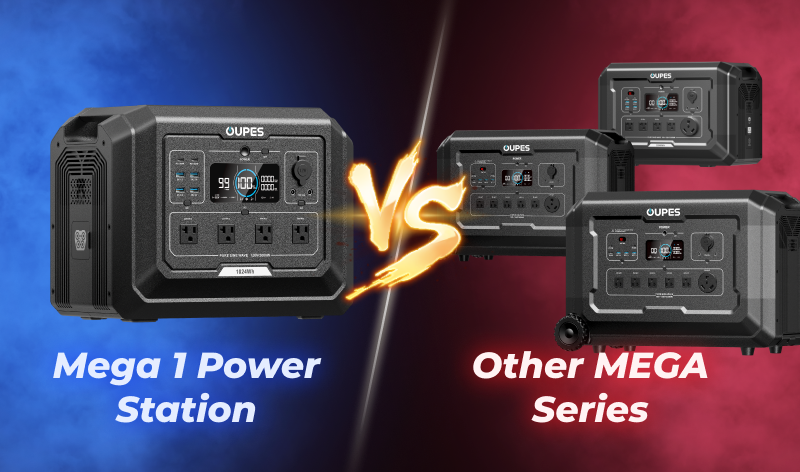
As home backup, outdoor camping, and RV travel become more popular, users’ expectations for power supply are shifting from “basic use” to “long-lasting, high-output, and stable.” OUPES MEGA Series is designed to cover every scenario—from light outdoor use to full home backup—and among them, the Mega 1 is often the first choice for beginners stepping into portable energy solutions.
But since Mega 2, Mega 3, and Mega 5 all belong to the same MEGA family, what exactly are the differences? Is upgrading worth it?
This article breaks down capacity, output, expandability, battery lifespan, and best-use scenarios to help you pick the perfect MEGA model.
MEGA Series Core Specification Overview (Quick Comparison)
| Item | Mega 1 | Mega 2 | Mega 3 | Mega 5 |
|---|---|---|---|---|
| Base Capacity | 1024Wh | 2048Wh | 3072Wh | 5040Wh |
| Max Expandability | 5120Wh (2×B2) | 10.24kWh (4×B2) | 15.36kWh (6×B2) | 45.36kWh (8×B5) |
| Rated Output | 2000W | 2500W | 3600W | 4000W |
| Surge | 4500W | 5400W | 7000W | 7000W |
| UPS <20ms | 2200W | 2500W | 2200W | 2200W |
| AC Charging | 1400W | 1600W | 1800W | 1800W |
| Max AC+Solar Input | 2200W | 3700W | 3900W | 3900W |
| Solar Input | 800W | 2100W | 2100W | 2100W |
| Ports | 13 | 15 | 16 | 16 |
| Wheels | × | × | √ | √ |
| Weight | 27.8 lb | 48.5 lb | 83.3 lb | 112.4 lb |
| Battery Life | LFP >3500 Cycles | LFP >3500 Cycles | LFP >3500 Cycles | LFP >3500 Cycles |
| Warranty | 6 Years | 6 Years | 6 Years | 6 Years |
Mega 1 — The Lightest in the MEGA Series, Perfect for Beginners & Outdoor Use

1024Wh + 2000W Output + 13 Ports
Ideal for camping, car fridges, outdoor entertainment, and small-scale home backup.
Highlights:
- Weighs only 27.8 lb — extremely portable
- Expandable to 5120Wh — enough for 1–3 days of outdoor usage
- Full port selection: Dual 100W PD, USB-A, DC, car socket
- 800W solar input — friendly for off-grid use
Best For:
- Light home backup (fridge / lights / router)
- Camping & weekend RV trips
- Mobile workstations, photography, filming crews
Mega 1 vs Mega 2 — A Solid Upgrade for Home Backup

| Dimension | Mega 1 | Mega 2 | Comment |
|---|---|---|---|
| Base Capacity | 1024Wh | 2048Wh | 2× runtime |
| Max Expansion | 5.12kWh | 10.24kWh | Better for home use |
| Rated Output | 2000W | 2500W | Supports more appliances |
| AC+PV Input | 2200W | 3700W | Faster charging |
| Ports | 13 | 15 (inc. Anderson) | Better for cars / RVs / DIY setups |
Conclusion:
If you need more than one-day camping supply and want real home emergency capability, Mega 2 is significantly more stable and long-lasting.
Upgrade Suggestion:
• Home-use focused → Mega 2
• Outdoor-first, lighter use → Mega 1
Mega 1 vs Mega 3 — A Leap Into Whole-Home Backup

| Dimension | Mega 1 | Mega 3 |
|---|---|---|
| Capacity | 1kWh | 3kWh |
| Expandability | 5.12kWh | 15.36kWh |
| Output | 2000W | 3600W |
| Wheels | × | √ |
| Ports | 13 | 16 |
Scenario Comparison:
| Scenario | Mega 1 | Mega 3 |
|---|---|---|
| Whole-home blackout | × Only emergency use | √ Supports AC, induction cookers, etc. |
| Long RV trips | Medium suitability | High suitability with more appliances |
| Disaster preparedness | Basic daily backup | Multi-day off-grid capability |
One-sentence summary: For living normally during a blackout, Mega 3 is the real turning point.
Mega 1 vs Mega 5 — True Disaster-Level Backup

| Dimension | Mega 1 | Mega 5 |
|---|---|---|
| Capacity & Expansion | 1024Wh → 5120Wh | 5040Wh → 45360Wh |
| Output Power | 2000W | 4000W |
| Solar Input | 800W | 2100W |
| Weight | 27.8 lb | 112 lb |
| Positioning | Light & portable | Disaster backup / engineering grade |
Mega 5 Is Ideal For:
- Multi-day blackouts / winter storms / hurricane prep
- Construction sites, large-scale filming equipment
- Long-term RV off-grid living
- Home backup alternative to gas generators
Mega 1 is flexible and lightweight, while Mega 5 is a long-duration power hub.
Final Buying Recommendations
| Your Priority | Recommended Model |
|---|---|
| Budget-friendly & outdoor-first | Mega 1 |
| Home emergency + longer runtime | Mega 2 |
| Want to live normally during blackout | Mega 3 |
| Disaster backup / professional use | Mega 5 |
Final Summary: Choosing a MEGA model comes down to the balance between capacity × output × expandability. Pick based on your power demands—not just your budget.

Leave a comment
This site is protected by hCaptcha and the hCaptcha Privacy Policy and Terms of Service apply.