




Yes, partial power outages can be dangerous. A partial outage does not mean “some outlets are inconveniently off.” In many homes, it can be a warning sign of a more serious electrical problem, including loose connections, overheated components, damaged service equipment, or a utility-side issue that leaves only part of the home energized. The Electrical Safety Foundation International warns that flickering or dimming lights, burning smells, discolored switches, and warm outlets can indicate a serious wiring problem, while the U.S. Consumer Product Safety Commission notes that flickering lights, circuits that do not work, hot faceplates, and the smell of burning plastic are signs of electrical system trouble and should be evaluated by a qualified electrician.[1][2]
The good news is that not every partial outage means your house is about to catch fire. Sometimes the cause is as simple as a tripped breaker or a blown fuse. But the key point is that you should not assume that a partial outage is harmless. If only part of the house has lost power, if lights are acting strangely, or if appliances suddenly behave abnormally, you should treat the situation as potentially unsafe until you have ruled out the serious causes.[1][3][4]
Table of Contents
- What is a partial power outage?
- Why partial outages can be dangerous
- Common causes of partial power outages
- What you can safely check first
- When to call the utility and when to call an electrician
- What not to do during a partial outage
- Why backup power matters during partial outages
- Detailed OUPES options for outage preparedness
- Bottom line
- References
- FAQ
What is a partial power outage?
A partial power outage means electricity is still working in some parts of the home, but not in others. You might notice that one group of rooms is dark while other rooms still have lights, or that some outlets work normally while others are dead. In some cases, appliances may run strangely, lights may dim or brighten unexpectedly, or 240-volt appliances may stop working while a few 120-volt circuits still appear normal. Jefferson County PUD describes this type of problem as power being out to one part of the house and not the other, sometimes with flickering lights or appliances that do not operate properly even though no breakers have tripped.[3]
That pattern matters because it often tells you the outage is not a normal full blackout. Instead, it may be linked to a specific circuit problem, a damaged connection, a failing breaker, a meter-base issue, or a utility-side service problem. In other words, the unevenness of the outage is exactly why you should pay attention to it.[3][4]
Why partial outages can be dangerous
Partial outages can be dangerous for two main reasons. First, the underlying cause may involve overheating, arcing, or loose electrical connections. The CPSC explains that increased resistance at bad electrical connections can cause overheating, sometimes at hazardous levels, and specifically warns that signs such as flickering lights, non-working circuits, hot faceplates, and the smell of burning plastic should not be ignored.[2] OSHA also notes that unsafe electrical installations can involve loose connections, defective parts, and improper grounding, all of which can create shock, arc, and fire hazards.[5]
Second, partial outages can create unstable or abnormal electrical conditions for the equipment that is still running. That can increase the risk of damage to sensitive electronics and household appliances. BC Hydro advises customers during outages to turn off major appliances and unplug sensitive electronics both to reduce load and to protect equipment from damage when conditions change or power returns.[4]
| Warning Sign | Why It Is Concerning |
|---|---|
| Lights flickering or dimming | May indicate loose wiring, overload, or unstable electrical supply[1][2] |
| Warm outlets or switch plates | Can signal overheating inside the electrical connection[1][2] |
| Burning smell or buzzing | May indicate arcing or failing wiring and should be treated as urgent[1][6] |
| Some circuits dead, others working | Can point to a service, breaker, meter-base, or connection problem[3] |
| Repeated breaker trips | Can be a sign of overload or a wiring problem, not just nuisance tripping[6] |
Common causes of partial power outages
A partial outage can come from either the house side or the utility side. Jefferson County PUD explains that if only part of the home loses power and breakers have not tripped, one possible cause is that one of the service conductors has become loose or disconnected. It says this can happen at the transformer, in the meter base, or at the connection to the main breaker in the panel, and that worn meter sockets can also lead to arcing, melting, burning, and partial loss of power.[3]
Inside the home, the cause may instead be a tripped breaker, a blown fuse, an overloaded circuit, or damaged wiring. BC Hydro advises homeowners to first inspect the circuit breaker panel or fuse box when an outage appears limited to the home.[4] ESFI adds that overloaded circuits often show themselves through flickering or dimming lights, frequently tripped breakers or blown fuses, warm or discolored wall plates, cracking or buzzing at receptacles, burning odors, or mild shocks and tingles from appliances or switches.[6]
That means the “fix” depends entirely on the cause. Some causes are simple and safe to check. Others are not safe for a homeowner to diagnose beyond the first basic steps.
What you can safely check first
If part of your home loses power, start with the simplest safe checks. First, look at the breaker panel or fuse box and see whether a breaker has clearly tripped or a fuse has blown. BC Hydro specifically recommends this as the first step when an outage appears limited to the home.[4] If you find one tripped breaker, you can reset it once. If it trips again, stop there and call a licensed electrician rather than repeatedly forcing it back on.
Next, identify the pattern. Is it only one room? Half the house? Are large appliances behaving strangely? Are lights dim or excessively bright? Are any outlets warm, buzzing, or discolored? The answers help determine whether the issue is a simple branch-circuit problem or something more serious involving the service connection or panel.[1][3][6]
You should also unplug sensitive electronics and turn off major appliances until the problem is resolved. BC Hydro recommends doing this during outages to protect equipment and reduce load on the system, and NWS outage guidance similarly advises unplugging sensitive electronics and turning off electric appliances that were on before the power loss.[4][7]
When to call the utility and when to call an electrician
If the issue appears to be limited to your home, start by checking breakers. If there are no tripped breakers and the outage looks like part of a larger issue, BC Hydro recommends checking the outage map or reporting the outage to the utility.[4] Jefferson County PUD goes further for true “half the house” cases: if part of the home loses power and the breakers remain untripped, it advises calling the utility so crews can inspect utility-owned equipment and alerting a licensed electrician at the same time, especially if repairs may involve shutting off power to work on the home side.[3]
You should skip the guesswork and call a qualified electrician immediately if you notice any of the following: warm outlets, discoloration, buzzing, burning odor, sizzling sounds, a tingling shock from a switch or appliance, repeated breaker trips, or flickering that does not stop.[1][2][6] The CPSC explicitly says not to try to diagnose or repair this kind of problem yourself because you could be electrocuted or make the problem worse.[2]
| Situation | Best Next Step |
|---|---|
| Single breaker clearly tripped once | Reset once and monitor |
| Breaker trips again | Call a licensed electrician[6] |
| No breakers tripped, but half the house is out | Call the utility and a licensed electrician[3] |
| Burning smell, heat, buzzing, discoloration | Treat as urgent and call an electrician immediately[1][2] |
| Storm damage, meter box damage, flooded electrical area | Call the utility and do not re-energize anything until cleared[8][9] |
What not to do during a partial outage
Do not keep resetting breakers over and over. Do not open up the panel to tighten wires or probe around unless you are qualified to do that work. Do not keep running sensitive electronics on unstable circuits. And do not use improvised generator hookups as a shortcut. Ready.gov says generators and fuel should always be used outdoors and at least 20 feet away from windows, doors, and attached garages, while NWS outage safety warns never to plug a portable generator into a standard household outlet.[10][11]
If flooding or storm damage is involved, be even more cautious. The NWS warns that gas leaks and live power lines may not be obvious after flooding, and says not to enter a flood-damaged building until given the all clear and until the electrical system has been turned off and repaired by the power company or a qualified electrician.[9]
Why backup power matters during partial outages
A partial outage is often shorter than a full blackout, but it still creates the same practical problems: lights may be out where you need them, routers may fail, refrigerators may be on vulnerable circuits, and phone charging may suddenly matter more than usual. That is why backup power is useful not only for large disasters, but also for smaller electrical disruptions. Ready.gov’s outage guidance highlights the importance of generator safety, preserving refrigerated food, and having alternate plans for medical devices and refrigerated medicines during outages.[10]
For some households, backup power only needs to cover phones, a router, and a few lights. For others, it may need to support work-from-home equipment, sump-pump contingency, refrigerated medication support, or a stronger home-backup role during storm season. The right size depends on the loads you care about and how long you want to cover them.
Detailed OUPES options for outage preparedness
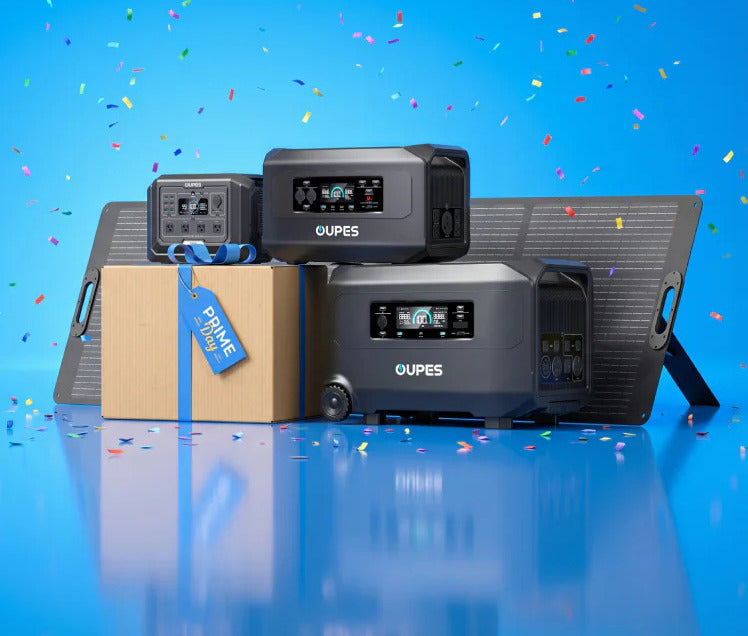
If you want a portable backup solution for partial outages, it helps to think in tiers: compact essentials backup, stronger mid-range outage support, and serious home-backup capacity.
| Model | Rated Capacity | Rated Output | Best Fit During Partial Outages |
|---|---|---|---|
| OUPES Mega 1 Lite | 1,024Wh | 2,000W | Phones, lights, router, laptop, compact essentials backup |
| OUPES Mega 2 Pro | 2,048Wh | 2,500W | Longer outage support, RV use, broader essential-load backup |
| OUPES Exodus 2400 | 2,232Wh | 2,400W | Balanced larger-backup role with more runtime margin |
| OUPES Guardian 6000 | 4,608Wh | 6,000W | High-demand home backup and longer outage planning |
OUPES Mega 1 Lite: light, fast, and practical for essentials
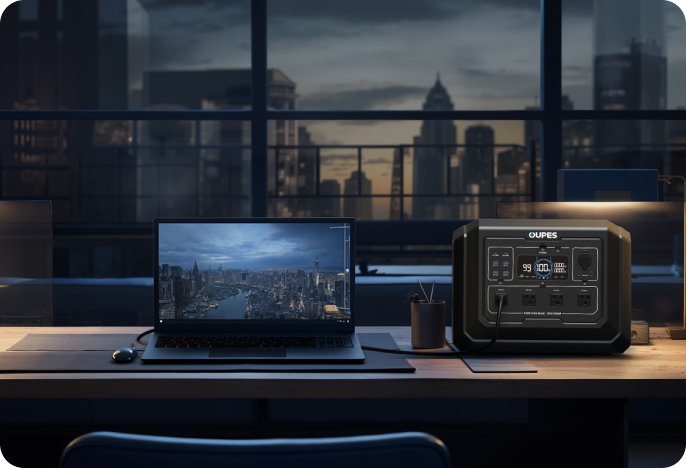
The Mega 1 Lite is the most portable model in this group. OUPES lists it at 1,024Wh with a 2,000W pure sine wave inverter, 4,500W surge, 1,400W fast AC charging, 800W solar charging, 2,200W max AC + solar charging, 9 outputs, and a listed weight of 26.8 lbs. The page also lists an EV-grade LiFePO4 battery with more than 3,500 cycles to 80%.[12][13][14]
For partial outages, this is a strong “keep the basics alive” option. It is especially suitable for communication, lighting, routers, laptop work, and a compact emergency setup that is easy to move room to room.
OUPES Mega 2 Pro: the flexible middle tier
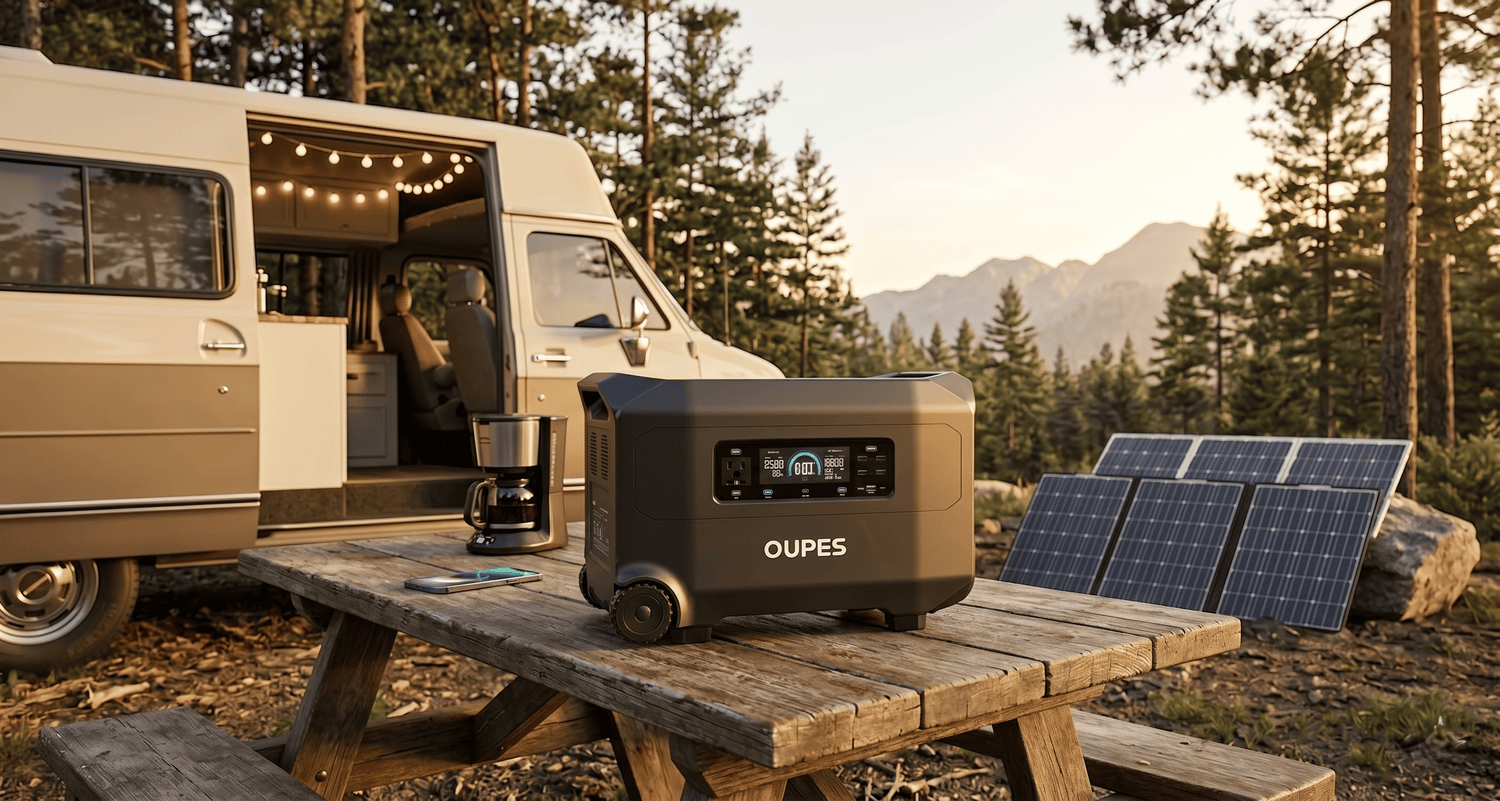
The Mega 2 Pro steps up to 2,048Wh and 2,500W AC output with 3,600W Boost. OUPES also lists 1,800W fast AC charging, 1,000W max solar charging, 2,800W max AC + solar charging, a TT-30R RV outlet, WiFi/Bluetooth app control, a listed weight of 48.8 lbs, and more than 3,500 cycles to 80% on the battery specification section.[15]
This model makes sense when your idea of “essentials” includes more than just phones and lights. It is better suited to longer outages, broader work-from-home support, and users who want one unit that can cover both home and travel backup roles.
OUPES Exodus 2400: balanced capacity and runtime
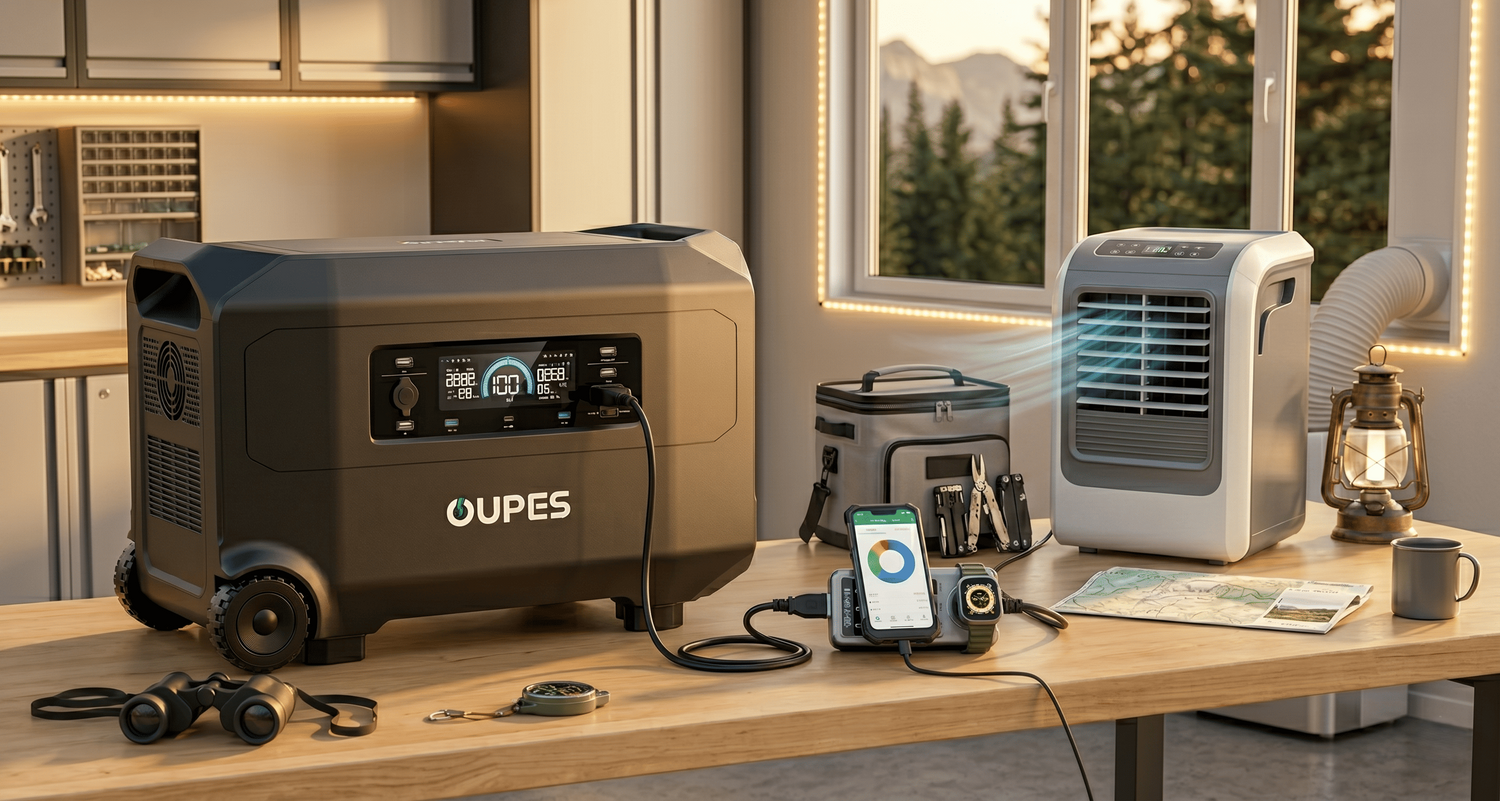
The Exodus 2400 is listed at 2,232Wh capacity, 2,400W AC pure sine wave output, 2,600W Boost Mode, more than 3,500 cycles to 80%, 13 outputs, 2,200W max input charging speed, and a listed weight of 45.2 lbs. OUPES also lists 1,400W fast AC charging and 800W solar charging in the input specifications.[16]
In outage planning terms, Exodus 2400 is a strong “more breathing room” option. It suits homes that want more runtime than a 1kWh-class unit offers, without stepping all the way into a large 240V platform.
OUPES Guardian 6000: the serious home-backup platform
The Guardian 6000 is designed for a much bigger role. OUPES lists it at 4,608Wh basic capacity, expandable to 41.4kWh, with 6,000W output, dual-voltage 240V and 120V in one unit, more than 4,000 cycles to 80%, and a listed weight of 111.3 lbs. The product page also says it can fully recharge 4,608Wh in 84 minutes using 240V 3,600W AC input.[17]
This is the choice for people who want outage preparedness to overlap with true home-backup ambition. If your concern is not only charging a phone and running a router, but handling larger loads or planning for longer disruptions, Guardian 6000 is the model in this set that moves into that category.
Bottom line
Partial power outages can absolutely be dangerous, especially when they come with flickering lights, warm outlets, buzzing sounds, burning smells, or circuits that stop working without a clear breaker trip. Those are classic warning signs of electrical trouble and should never be ignored.[1][2]
The safe response is straightforward: check the breaker panel once, unplug sensitive electronics, turn off major appliances, and then escalate intelligently. If the breaker has tripped repeatedly, call an electrician. If half the house is out and no breakers are tripped, call the utility and a licensed electrician. If there is heat, smell, buzzing, or visible damage, stop treating it like a nuisance outage and treat it like an electrical emergency.[3][4][6]
References
- Electrical Safety Foundation International — Electrical Warning Signs
- U.S. Consumer Product Safety Commission — Repairing Aluminum Wiring (warning signs and overheating risk)
- Jefferson County PUD — Why is Half of the Power Out to My House?
- BC Hydro — What to Do During a Power Outage
- OSHA — Electrical Standard; Proposed Rule (unsafe electrical installations and loose connections)
- Electrical Safety Foundation International — Don’t Overload Your Home
- National Weather Service — Monsoon and Power Outage Safety
- Duke Energy — Meter and Service Connection Damage
- National Weather Service — After a Flood
- Ready.gov — Power Outages
- National Weather Service — Power Outage Preparedness
- OUPES Mega 1 Lite Official Product Page
- OUPES Mega 2 Pro Official Product Page
- OUPES Exodus 2400 Official Product Page
- OUPES Guardian 6000 Official Product Page
FAQ
1. Is a partial power outage always dangerous?
Not always, but it should always be taken seriously until you know the cause. Sometimes it is a simple breaker problem. Other times it can point to loose connections, overheating, or service damage.[1][3]
2. Can I fix a partial outage myself?
You can safely check for a tripped breaker or blown fuse and unplug electronics, but repairs beyond that generally belong to a licensed electrician or the utility. The CPSC specifically says not to attempt dangerous electrical repairs yourself.[2][4]
3. Why does only half my house have power?
One possible reason is that only part of the electrical service is reaching the house, or that a connection has failed at the transformer, meter base, or main breaker connection. It can also be caused by internal wiring or panel issues.[3]
4. Should I keep resetting a breaker if it keeps tripping?
No. Repeated tripping can be a warning sign of overload or wiring trouble. Reset once at most, then call a licensed electrician if it trips again.[6]
5. What warning signs mean I should stop using the affected circuit immediately?
Burning smell, buzzing, warm outlets or switches, discolored wall plates, flickering or dimming lights, and mild shocks or tingles are all warning signs that call for immediate caution and professional inspection.[1][6]
6. Why unplug electronics during a partial outage?
Because unstable power conditions and restoration surges can damage sensitive equipment. Utility outage guidance commonly recommends unplugging sensitive electronics and turning off major appliances.[4][7]
7. Which OUPES model is best for partial-outage preparedness?
That depends on the role you want it to fill. Mega 1 Lite is a strong essentials-backup option, Mega 2 Pro and Exodus 2400 are better for broader outage support, and Guardian 6000 is the most capable choice for larger home-backup planning.[12][13][14][15]

Leave a comment
This site is protected by hCaptcha and the hCaptcha Privacy Policy and Terms of Service apply.