




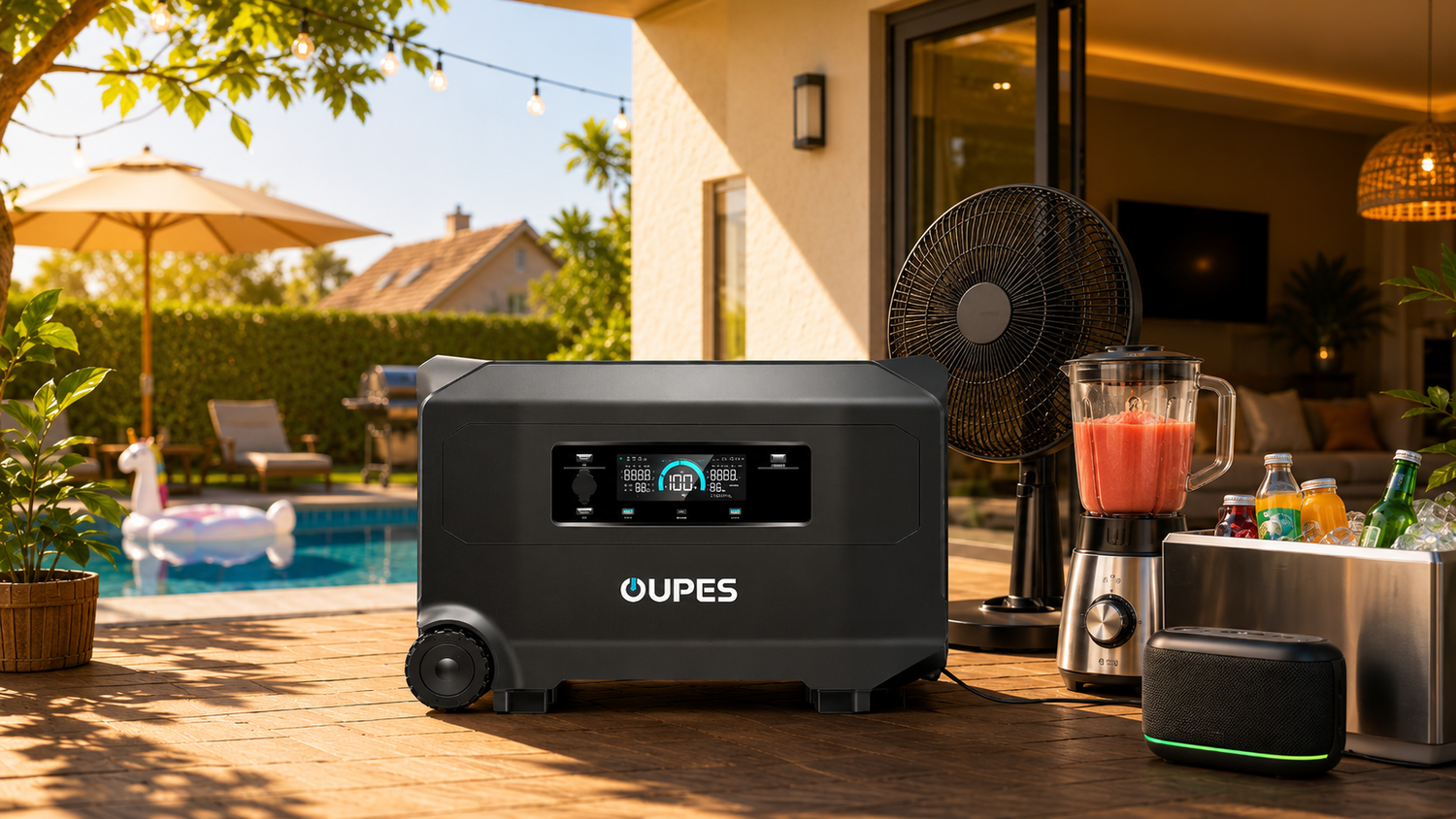
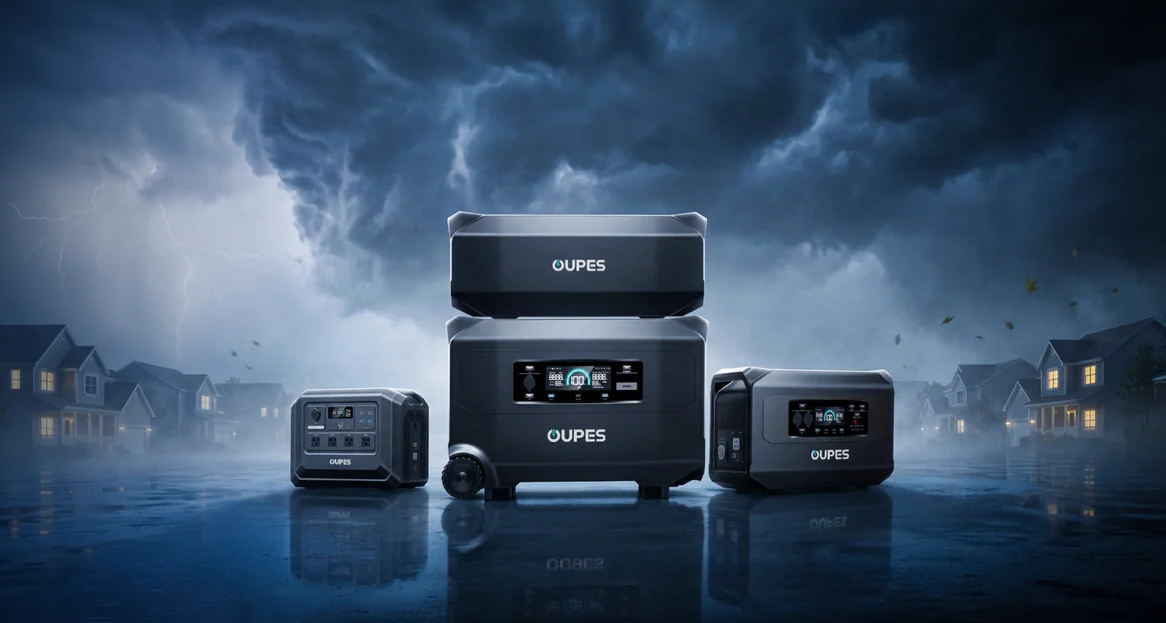
Summer household electricity challenges are not limited to higher utility bills. During a heatwave, air conditioners, refrigerators, fans, and pool equipment may operate at the same time. When a backyard party or pool party is held on the weekend, electric grills, blenders, speakers, and projectors can further increase the instantaneous load. If a thunderstorm, strong winds, a wildfire-related preventive outage, or a regional grid failure occurs at the same time, the cooling equipment a household needs most may lose power.
The U.S. Energy Information Administration notes that residential electricity consumption peaks during summer in most areas of the United States, with air-conditioning demand being one of the primary causes. Summer electricity demand generally rises rapidly as daytime temperatures increase and often reaches a higher level around 5:00 p.m. to 6:00 p.m. Nearly 90% of U.S. households use air conditioning, so concentrated cooling demand during a heatwave can significantly increase pressure on the power grid. Source: U.S. Energy Information Administration
The purpose of a home backup power system is not to keep every appliance operating normally during an outage. Its purpose is to maintain cooling, food preservation, communication, and basic household comfort with a limited amount of available energy.
Why Is Home Backup Power More Important in Summer?
High Temperatures Turn Cooling Equipment From a Comfort Appliance Into an Essential Load
In normal weather, a fan or air conditioner may simply improve comfort. During a prolonged heatwave, however, cooling may directly affect the health of household members.
The National Weather Service recommends staying in an air-conditioned indoor environment whenever possible during extreme heat and reducing outdoor activities around midday and in the afternoon. Children, older adults, pregnant people, people with chronic illnesses, and those who cannot regulate their own environment are more vulnerable to heat-related illness. Source: National Weather Service
It is also important to understand that a fan cannot completely replace an air conditioner. The National Weather Service warns that when the heat index reaches a high level, continuously circulating hot air may not provide effective cooling and may even cause the body to absorb additional heat. Source: National Weather Service
For this reason, a summer backup power plan should generally follow this priority order:
- Room air conditioner or another effective cooling device;
- Refrigerator and freezer;
- Fan;
- Router, mobile phones, and emergency communication equipment;
- Basic lighting;
- Entertainment and cooking appliances.
A Power Outage Can Quickly Affect Food Safety
The U.S. Department of Agriculture states that refrigerated food will generally remain safe for only about four hours during a power outage if the refrigerator door remains closed. A full freezer can maintain a safe temperature for approximately 48 hours, while a half-full freezer can maintain it for about 24 hours. Source: USDA Food Safety and Inspection Service
Food-safety requirements are even stricter during outdoor gatherings. If the ambient temperature is above 90°F, perishable food should not remain unrefrigerated for more than one hour. Source: USDA Food Safety and Inspection Service
This means that during a summer outage or outdoor gathering, powering a refrigerator or portable freezer will often take priority over a projector, speaker, or decorative lighting.
How to Calculate Summer Appliance Electricity Needs
When choosing a backup power system, two specifications must be considered separately:
- Output power in watts: Determines whether an appliance can start and whether multiple appliances can operate at the same time.
- Battery capacity in watt-hours: Determines how long an appliance can operate.
This article uses the simplified OUPES runtime formula:
Estimated Runtime = Battery Capacity × 80% ÷ Appliance Power
The 80% factor allows for inverter losses, ambient temperature, variations in appliance power consumption, and other system losses.
To calculate an entire scenario, use:
Scenario Energy Consumption = Appliance Power × Actual Operating Time
The appliance wattages below are common examples used for scenario planning and do not represent every product model. Before publishing or applying these calculations, users should check the nameplate information on their own appliances, especially the rated and starting wattage of air conditioners, refrigerators, pumps, and electric grills.
Summer Backyard Party: How Much Electricity Does a Four-Hour Gathering Need?
Assume that a family backyard party lasts four hours, from the afternoon into the evening, and uses the following equipment:
| Appliance | Calculated Power | Actual Operating Time | Estimated Energy Consumption |
|---|---|---|---|
| Electric grill | 1,500W | 0.5 hour | 750Wh |
| Blender | 500W | 6 minutes | 50Wh |
| Projector | 100W | 3 hours | 300Wh |
| Outdoor speaker | 50W | 4 hours | 200Wh |
| Decorative lights | 20W | 4 hours | 80Wh |
| Cooling fan | 60W | 4 hours | 240Wh |
| Portable refrigerator | Average 70W | 4 hours | 280Wh |
| Total | 1,900Wh |
If the electric grill and blender are used at different times, the peak load for the scenario is approximately 1,800W. If they are switched on at the same time, the short-term total load may reach approximately 2,300W.
This shows why a backyard party cannot be evaluated by looking only at the 1,500W electric grill. The speaker, projector, fan, and refrigerator will continue consuming energy throughout the event.
For this scenario:
- The capacity of the MEGA 1 LITE is relatively limited;
- The Mega 2 Pro can support the peak load, but its estimated usable energy of approximately 1,638Wh is not enough to fully cover the 1,900Wh scenario;
- The MEGA 3 provides approximately 2,458Wh of estimated usable energy and is more suitable for covering the complete four-hour party;
- The Guardian 6000 V2 provides more reserve capacity.
If the user already has a gas grill and only needs to power the projector, refrigerator, fan, lighting, and speaker, total energy consumption falls to approximately 1,150Wh. In that case, the Mega 2 Pro becomes a more suitable option.
Pool Party: Power Is Not the Only Concern—Electrical Safety Also Matters
Assume that a pool party lasts five hours and the pool circulation pump is powered by the backup system for two hours:
| Appliance | Calculated Power | Actual Operating Time | Estimated Energy Consumption |
|---|---|---|---|
| Pool circulation pump | 700W | 2 hours | 1,400Wh |
| Portable refrigerator | Average 70W | 5 hours | 350Wh |
| Blender | 500W | 6 minutes | 50Wh |
| Outdoor speaker | 50W | 5 hours | 250Wh |
| Cooling fan | 60W | 5 hours | 300Wh |
| Decorative lights | 20W | 2 hours | 40Wh |
| Mobile phone and device charging | — | — | 40Wh |
| Total | 2,430Wh |
The MEGA 3 provides approximately 2,458Wh of estimated usable capacity. In theory, this is close to the required amount, but it leaves almost no reserve for starting power, changes in inverter losses, or additional temporary appliances.
Therefore:
- If the pool pump remains connected to the household electrical system, the Mega 2 Pro can support the party equipment;
- If the pool pump must also be powered by the backup system, the MEGA 3 is only a relatively tight solution;
- If users want to operate pool equipment, cooling equipment, and entertainment devices at the same time, the Guardian 6000 V2 is the more reasonable choice.
Electrical shock prevention must also be the highest priority around a pool. The U.S. Consumer Product Safety Commission notes that wet skin, wet grass, and pool decks increase the risk of electric shock. Appliances and outlets near a pool should use properly functioning ground-fault circuit interrupter protection, and equipment, plugs, and extension connections should remain dry. Source: U.S. Consumer Product Safety Commission
A portable power station should be placed in a dry, well-ventilated location away from the edge of the pool and protected from splashing. It should not be placed directly on wet grass or in an area where water can collect.
Indoor Summer Power Outage: Which Appliances Actually Need Backup Power?
Assume that a six-hour summer outage occurs and the household prioritizes a window or U-shaped air conditioner, refrigerator, fan, and communication equipment:
| Appliance | Calculated Power | Actual Operating Time | Estimated Energy Consumption |
|---|---|---|---|
| Room air conditioner | 1,200W | 2 hours | 2,400Wh |
| Refrigerator | Average 70W | 6 hours | 420Wh |
| Fan | 60W | 6 hours | 360Wh |
| Router | 10W | 6 hours | 60Wh |
| LED lighting | 20W | 4 hours | 80Wh |
| Mobile phones and laptop | — | — | 100Wh |
| Total | 3,420Wh |
The Guardian 6000 V2 has a base capacity of 4,608Wh. Using the 80% calculation, it provides approximately 3,686Wh of estimated usable energy, which can cover this controlled six-hour scenario.
However, this does not mean that the air conditioner can run continuously for six hours. A more reasonable strategy is to:
- Operate the air conditioner for limited periods during the hottest part of the day;
- Close the doors and windows of rooms that are not in use;
- Close curtains and blackout shades;
- Use a fan to maintain air circulation after the air conditioner is switched off;
- Always reserve energy for the refrigerator, communication equipment, and lighting.
Ready.gov recommends that households identify in advance which devices depend on electricity and prepare backup plans for medical equipment, communication equipment, refrigerators, and cooling needs. After an outage begins, refrigerator and freezer doors should be opened as little as possible. Source: Ready.gov
If a central air conditioner needs to be operated, the 1,200W example above should not be applied directly. Central air conditioners vary significantly in voltage, running wattage, and compressor starting power. Users should check the appliance nameplate and have a qualified electrician confirm the correct connection method.
Which OUPES Product Should You Choose for Different Summer Power Needs?
| Product | Battery Capacity | Continuous Output | Estimated Usable Energy | Best Summer Applications |
|---|---|---|---|---|
| MEGA 1 LITE | 1,024Wh | 2,000W | About 819Wh | Short outages, refrigerators, fans, routers, and basic lighting |
| Mega 2 Pro | 2,048Wh | 2,500W | About 1,638Wh | Light backyard gatherings, pool entertainment equipment, and medium-duration essential loads |
| MEGA 3 | 3,072Wh | 3,600W | About 2,458Wh | Complete backyard parties, short-term room air-conditioning, and multiple simultaneous appliances |
| Guardian 6000 V2 | 4,608Wh | 6,000W | About 3,686Wh | Pool pumps, high-power party equipment, summer outages, and 120V/240V household loads |
The capacities and continuous output ratings above are based on the current OUPES official product pages.
MEGA 1 LITE: A Basic Summer Emergency Power Solution
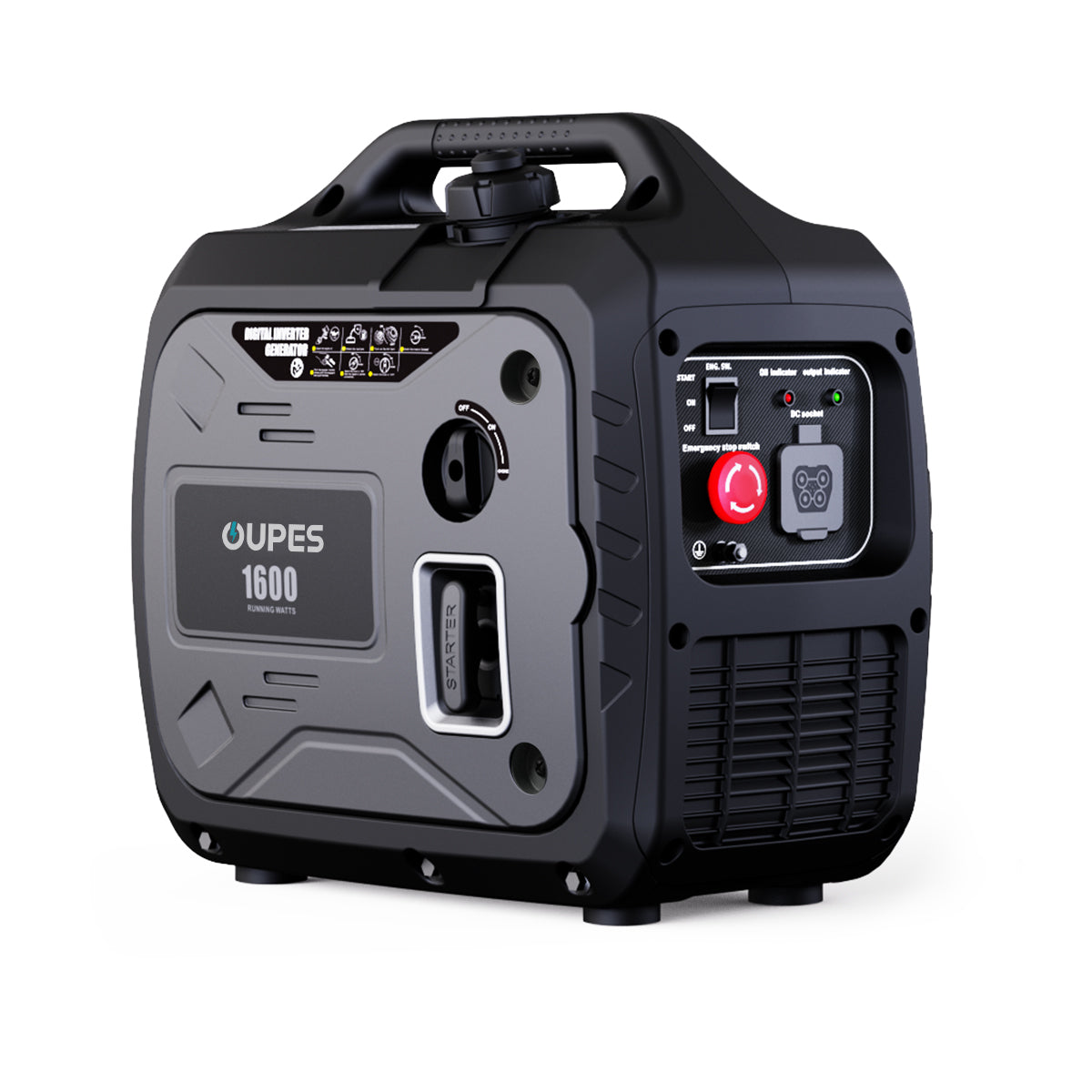
The MEGA 1 LITE has a 1,024Wh capacity, 2,000W continuous output, and supports up to 4,500W surge power. It is suitable for operating a refrigerator, fan, router, lighting, and electronic devices during a short outage. It can also support a blender or another kitchen appliance for a short period.
If the continuous load includes a 70W refrigerator, 60W fan, 10W router, and 20W lighting, the total load is approximately 160W:
1,024Wh × 80% ÷ 160W ≈ 5.1 hours
For this reason, it is better suited to essential backup loads than to long-term air-conditioning.
Mega 2 Pro: For Gatherings and Medium-Scale Backup Power
The Mega 2 Pro provides 2,048Wh of capacity, 2,500W of base output, and a 3,600W Boost Mode. Its capacity can be expanded to as much as 10.24kWh.
It is suitable for a backyard gathering that uses a gas grill. It can also operate a refrigerator, fan, router, and lighting for approximately 10 hours during a short outage. If an electric grill is required, cooking time should be controlled and the grill should not be started at the same time as another high-power appliance such as a blender.
MEGA 3: A Complete Summer Backyard Party Solution
The MEGA 3 has a 3,072Wh capacity, 3,600W continuous output, and 7,000W surge power. Its capacity can be expanded to as much as 15.36kWh.
Its approximately 2,458Wh of estimated usable energy can cover the 1,900Wh backyard party scenario described above while reserving some capacity for equipment starting power and additional charging. It is also suitable for a short outage in which a room air conditioner and refrigerator are operated at different times.
Guardian 6000 V2: Designed for Essential Summer Household Loads
The Guardian 6000 V2 has a 4,608Wh capacity and provides 240V/6,000W and 120V/3,600W dual-voltage output. Its base capacity can be expanded to approximately 41.4kWh, and it supports up to 3,600W of solar charging.
It is better suited to the following needs:
- Operating a pool circulation pump and party equipment at the same time;
- Backing up a room air conditioner, refrigerator, and communication equipment;
- Supporting selected household equipment that requires 240V;
- Using expansion batteries to prepare for an overnight or multi-day outage;
- Using one system for household backup power, RV travel, and outdoor activities.
Central air conditioners, pumps, and other equipment with high starting power must still be checked individually based on their nameplate specifications. Compatibility cannot be determined solely from the 6,000W output rating.
How to Choose a Product During the OUPES Summer Sale
A summer promotion should not be evaluated only by the size of the discount. Users should first determine their intended application and then select the appropriate capacity and bundle.
- Basic essential loads: Choose the MEGA 1 LITE;
- Light gatherings or medium-duration outages: Choose the Mega 2 Pro;
- A complete backyard party: Choose the MEGA 3;
- Pool equipment, air-conditioning, and essential household backup power: Choose the Guardian 6000 V2.
Current OUPES product pages offer Summer Sale and Summer Flash Sale promotions, along with different combinations that may include solar panels and expansion batteries. Specific prices, discounts, and inventory should be confirmed on the product pages during the promotion period.
For outdoor gatherings, a solar-panel bundle can replenish part of the energy used during the day. However, users should not assume that a solar panel will continuously produce its rated power. Tree shade, cloud cover, panel angle, and ambient temperature can all affect actual solar input.
Five Practical Principles for Summer Home Backup Power
Do Not Connect Every Appliance at the Same Time
Sufficient battery capacity does not necessarily mean that instantaneous output is also sufficient. High-power appliances such as electric grills, blenders, microwave ovens, and air conditioners should be operated at different times whenever possible.
Allow Reserve Capacity for Starting Power
Refrigerators, air conditioners, pumps, and compressor-based equipment may briefly require more power during startup than during normal operation. The total load should not remain close to the power station's maximum output for long periods.
Always Reserve Energy for Refrigeration and Communication
Outdoor entertainment equipment can be switched off early, but refrigerators, mobile phones, routers, and essential medical equipment should usually receive higher priority.
Do Not Expose the Backup Power System to Heat or Rain
The system should be placed in a shaded, ventilated, and dry location. Avoid prolonged exposure to direct sunlight, and do not cover the ventilation openings with blankets, tablecloths, or enclosed containers.
A Backup Power System Cannot Replace a Heat Emergency Plan
If the indoor temperature continues to rise and a household member develops dizziness, nausea, confusion, or unusually hot skin, move immediately to an air-conditioned location and seek medical assistance instead of relying only on a fan or limited battery runtime. Source: National Weather Service
Frequently Asked Questions
Can a 1,000Wh Power Station Run an Air Conditioner?
It depends on the air conditioner's power requirements. The MEGA 1 LITE's 2,000W output may support certain room air conditioners, but its 1,024Wh battery provides only approximately 0.68 hours of continuous operation for a 1,200W air conditioner when calculated using the 80% formula. It is more suitable for short-term cooling than for all-night air-conditioning.
Can the MEGA 3 Support a Complete Backyard Party?
Based on the four-hour, approximately 1,900Wh scenario in this article, the MEGA 3's estimated usable energy of approximately 2,458Wh can cover the requirement and leave some reserve capacity. Actual results will still depend on the operating time of the electric grill and the duty cycle of the refrigerator.
Which Product Should Be Used for a Pool Pump?
If a pool pump consumes approximately 700W and operates for only one to two hours, the MEGA 3 may meet the requirement. If a refrigerator, fan, speaker, and blender must also operate at the same time, the Guardian 6000 V2 is more suitable.
Does a Refrigerator Need Continuous Power During an Outage?
A refrigerator compressor normally cycles on and off instead of continuously operating at its maximum nameplate power. However, energy consumption may increase in hot conditions, when the door is opened frequently, or when warm food is placed inside. Runtime calculations should use measured average power whenever possible.
Can a Backup Power Station Be Used Beside a Pool?
It should not be used directly beside the pool. The equipment must remain dry and be kept away from splashing and standing water. Relevant outlets and electrical circuits should have properly functioning GFCI protection. Source: U.S. Consumer Product Safety Commission
Can the Guardian 6000 V2 Base Battery Run an Air Conditioner All Night?
It is generally not appropriate to interpret the specification this way. Based on continuous operation of a 1,200W air conditioner, the base battery provides an estimated runtime of approximately 3.1 hours. Runtime may be longer if the air conditioner cycles on and off. Overnight operation would require reducing other loads, adding expansion batteries, or recharging during the day.
Conclusion
Summer home backup power must address three categories of demand: everyday outdoor entertainment, pool and backyard activities, and essential household loads during a high-temperature power outage.
The MEGA 1 LITE is suitable for short-term essential backup power. The Mega 2 Pro is suitable for light gatherings and medium electricity demand. The MEGA 3 can cover a more complete backyard party. The Guardian 6000 V2 is better suited to pool equipment, room air conditioners, and household backup applications that require 120V/240V capability.
A reasonable summer power solution is not simply the product with the highest output. Households should list their appliances in advance, calculate operating time, control simultaneous loads, and reserve sufficient energy for refrigeration, cooling, and communication equipment. With this approach, even when a heatwave, a party-related demand peak, and a power outage occur at the same time, a household can allocate its limited electricity more effectively.

Leave a comment
This site is protected by hCaptcha and the hCaptcha Privacy Policy and Terms of Service apply.