




There is no single answer to how many lithium batteries it takes to power a house. The right number depends on how much electricity your home uses, which appliances you want to run, how long you want backup power to last, and how much usable energy each battery actually provides. That is why some homes can get by with one battery for critical backup, while others may need several batteries for whole-home coverage.[1][2]
A better way to think about the question is this: are you trying to keep the essentials on during a short outage, run a large part of the home overnight, or power the whole house for a full day or longer? Those are three very different design goals, and they lead to three very different battery counts.
Table of Contents
- The short answer
- Start with your home’s energy use
- Capacity vs. power: the two numbers that matter
- The battery-sizing formula
- Example battery counts for different backup goals
- Why “whole-home backup” is harder than it sounds
- How solar changes the battery count
- How OUPES systems fit different home backup needs
- Common sizing mistakes
- References
- FAQ
The short answer
For many households, one lithium battery is enough for essential backup, two to three batteries can support more of the home, and whole-home or off-grid operation usually requires far more storage.[2] A consumer battery-sizing guide notes that a typical home battery is around 10 kWh, and that one battery is often enough for basic outage backup, while much larger systems are needed for self-sufficient or off-grid use.[2]
But averages can be misleading. The U.S. Energy Information Administration says the average U.S. residential customer bought 10,791 kWh of electricity in a year, or about 899 kWh per month.[1] That works out to roughly 29.6 kWh per day. If you tried to cover that full daily load with 10 kWh-class batteries using a conservative 80% usable-energy planning rule, you would be closer to four batteries for one day, not one.
Start with your home’s energy use
The first step is to decide whether you are designing for critical loads, partial-home backup, or whole-home backup.
| Backup Goal | What It Usually Includes | Typical Daily Energy Range |
|---|---|---|
| Critical loads | Refrigerator, Wi-Fi, lights, phone charging, a few outlets, maybe a fan or medical device | 4-8 kWh/day |
| Partial-home backup | Critical loads plus TV, microwave use, some kitchen use, more lighting, maybe a sump pump or home office gear | 10-20 kWh/day |
| Whole-home backup | Most circuits, longer appliance use, and possibly larger loads depending on the house | 20-35+ kWh/day |
| Off-grid or multi-day autonomy | Whole-home operation plus weather reserve and recharge gaps | Often 40+ kWh of planned storage need |
These ranges are not fixed rules, but they are more useful than relying only on national averages. A small, efficient home with gas heating may need much less battery storage than a large all-electric house. In real projects, your utility bills and your must-run loads matter more than a generic average.
That said, national averages are still useful as a reality check. If your goal is to truly power “the house” rather than just a few essentials, the EIA’s roughly 30 kWh-per-day average shows why single-battery marketing often does not match real whole-home expectations.[1]
Capacity vs. power: the two numbers that matter
When people ask how many lithium batteries they need, they are usually thinking about capacity. Capacity is measured in kilowatt-hours (kWh) and tells you how much energy the battery can store. But you also need to think about power, measured in kilowatts (kW), which tells you how much electricity the battery can deliver at one time.[3]
That distinction matters because a battery can have enough total energy to run your house for hours, but still not have enough output power to start or run several large appliances at once. A consumer storage guide explains this clearly: high capacity with low power means long duration but weaker simultaneous output, while high power with low capacity can run more appliances at once but for less time.[3]
| Metric | Unit | What It Answers |
|---|---|---|
| Capacity | kWh | How long can the battery keep loads running? |
| Power output | kW | How many appliances can it run at the same time? |
| Expandable capacity | kWh | Can the system grow if your backup needs increase? |
| Voltage / outlet type | 120V / 240V | Can it support larger household circuits and appliances? |
This is the reason battery count is never just a storage question. It is also a load-management question.
The battery-sizing formula
A simple planning formula is:
Number of batteries = (daily energy use × backup days) ÷ usable battery capacity
For a conservative estimate, this article uses an 80% usable-capacity rule. That means a nominal 10 kWh lithium battery is treated as providing 8 kWh of planning energy. This is a practical field method that leaves room for inverter losses, conversion losses, battery-management overhead, and the fact that real outages are rarely ideal.
Example:
If your critical loads use 6 kWh per day, and you want 1 day of backup, then:
Battery count = 6 ÷ 8 = 0.75
In practice, that means one 10 kWh-class lithium battery would usually be enough.
If your home uses 24 kWh per day and you want 1 day of backup:
24 ÷ 8 = 3
That means you would plan around three 10 kWh-class batteries.
If your house is closer to the U.S. average daily electricity use of about 29.6 kWh/day, then:
29.6 ÷ 8 = 3.7
So a more conservative design would be four 10 kWh-class batteries for about one day of whole-home energy at that usage level.[1]
Example battery counts for different backup goals
| Scenario | Daily Load | Backup Duration | Usable Energy Needed | Approx. 10 kWh Lithium Batteries Needed (using 80% rule) |
|---|---|---|---|---|
| Essentials only | 5 kWh/day | 1 day | 5 kWh | 1 battery |
| Essentials + extra outlets | 8 kWh/day | 1 day | 8 kWh | 1 battery |
| Partial-home backup | 15 kWh/day | 1 day | 15 kWh | 2 batteries |
| Large partial-home backup | 20 kWh/day | 1 day | 20 kWh | 3 batteries |
| Whole-home, lean use | 24 kWh/day | 1 day | 24 kWh | 3 batteries |
| Whole-home, near U.S. average | 29.6 kWh/day | 1 day | 29.6 kWh | 4 batteries |
| Whole-home, two days | 29.6 kWh/day | 2 days | 59.2 kWh | 8 batteries |
These examples explain why a common consumer guide says one battery is often enough for outage backup, while off-grid living may require eight to twelve or more batteries.[2] The difference is not marketing language. It is simply the math of daily energy demand and desired autonomy.
Why “whole-home backup” is harder than it sounds
Whole-home backup usually fails on one of two points: not enough stored energy, or not enough output power. Even if the battery bank has enough kWh, large loads such as central air conditioning, electric dryers, ovens, resistance heat, well pumps, or multiple appliances running together can push the inverter beyond what the system can deliver at one moment.
This is why lithium battery sizing should start with a load list, not a battery advertisement. If your plan is to keep only the refrigerator, lights, internet, and some outlets running, the battery count stays manageable. If your plan is to keep the entire home feeling “normal,” the battery count rises quickly.
There is also a resilience planning difference between backing up critical loads and serving the whole house. The Department of Energy notes that solar and storage can provide backup power during electrical disruptions and keep critical facilities operating.[4] The same logic applies at home: critical-load backup is much easier and more affordable than building for full-house independence.
How solar changes the battery count
Solar does not eliminate the need for battery storage, but it can reduce how many batteries you need for a given outage duration. During the day, solar can recharge batteries and support some of the home’s active load at the same time. The DOE explains that solar plus storage improves resilience by keeping loads powered during disruptions and helping manage changing generation and demand.[4]
In practice, this means a house with daytime solar production may be able to achieve the same backup goal with fewer batteries than a battery-only setup, especially if outage loads are disciplined and major appliances are managed carefully. But the battery still has to carry nighttime use, cloudy periods, and surge loads. Solar helps. It does not replace storage planning.
How OUPES systems fit different home backup needs
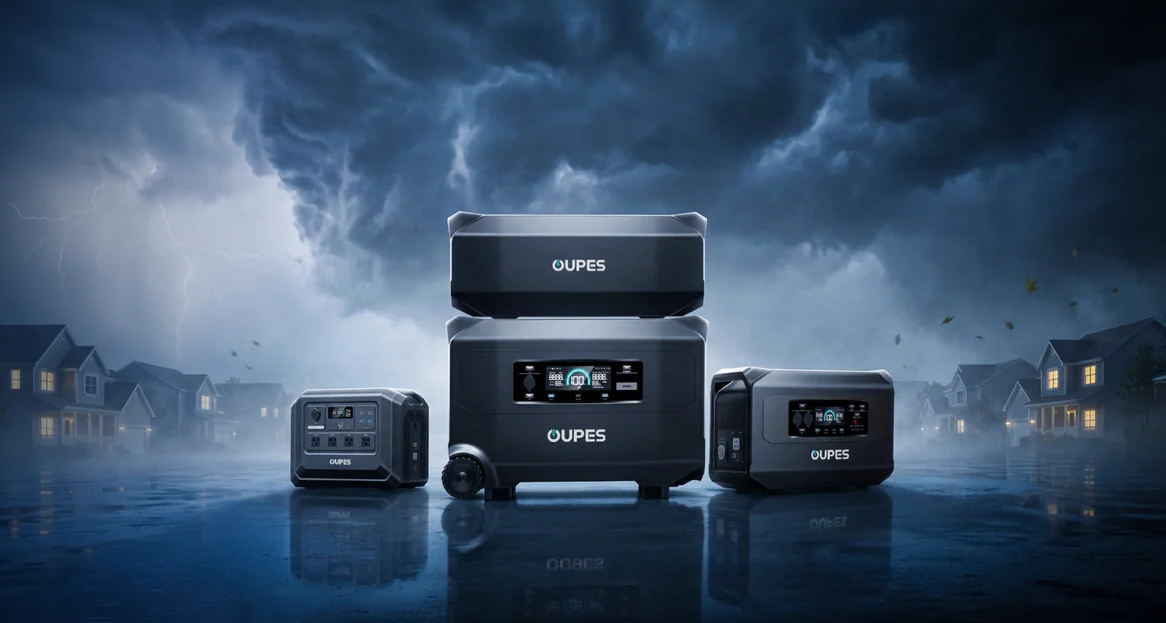
If your goal is flexible home backup rather than a permanently installed whole-home battery wall, OUPES offers several capacity tiers that illustrate how lithium battery planning scales.
The OUPES Mega 3 is rated at 3072Wh capacity with 3600W AC output and can expand up to 15.36kWh.[5] That places it in a useful zone for essential-load backup, short outages, and modular expansion.
The OUPES Mega 5 steps up to 5040Wh capacity, 4000W output, and expansion up to 45.36kWh.[6] That makes it more realistic for larger backup windows or higher daily household use, especially when paired with extra batteries.
The OUPES Guardian 6000 is aimed even more directly at serious home backup, with 4.6-41.4kWh expandable capacity and 240V/6000W dual-voltage output.[7] That matters because larger homes often need not only more stored energy, but also more output headroom and 240V capability for heavier loads.
The important lesson is not that one model “powers a house” by itself. It is that the number of lithium batteries you need depends on how much energy storage and output power you build into the system.
Common sizing mistakes
- Using national averages instead of your own utility bill: average household consumption is only a starting point.[1]
- Ignoring output power: kWh alone does not tell you whether the system can run multiple appliances at once.[3]
- Planning for “the whole house” without defining loads: critical-load backup and whole-home backup are not the same project.
- Assuming rated capacity is fully usable: conservative planning avoids disappointment during real outages.
- Undersizing for multi-day outages: one day of storage and two days of storage are very different battery counts.
References
- U.S. Energy Information Administration — How much electricity does an American home use?
- Consumer battery-sizing guide — how many batteries are typically needed for backup, bill savings, or off-grid use
- Consumer battery guide — capacity vs. power, efficiency, and storage sizing basics
- U.S. Department of Energy — solar and storage basics for resilience and backup power
- OUPES Mega 3 official product page
- OUPES Mega 5 official product page
- OUPES Guardian 6000 official product page
FAQ
1. How many lithium batteries do I need for basic home backup?
If you only want to keep essentials running, one 10 kWh-class battery is often enough for short outages. The exact answer depends on your critical-load list and how conservatively you size usable capacity.[2]
2. How many batteries does it take to run a whole house for one day?
Using the U.S. average household electricity use of about 29.6 kWh per day, a conservative design with 10 kWh batteries planned at 80% usable capacity comes out to about four batteries for one day.[1]
3. Why is battery count different from house to house?
Because homes do not use electricity the same way. House size, climate, major appliances, HVAC type, and whether you are backing up only essentials or the entire house all change the battery requirement.
4. What matters more, kWh or kW?
Both matter. kWh tells you how long the system can run, while kW tells you how much the system can run at one time.[3]
5. Can solar reduce the number of lithium batteries I need?
Yes. Solar can recharge the batteries and support daytime loads, which can reduce the amount of storage needed for a given backup goal. But it does not eliminate the need for battery capacity, especially at night or during poor weather.[4]
6. Is one portable power station enough to power a house?
Usually only for limited backup, not for full-house expectations. Whether one unit is enough depends on both its stored energy and its output power, as well as how much of the house you plan to run.
7. What is the safest way to estimate battery count?
Start with your own utility bills, list your must-run loads, decide how many backup hours or days you want, and size the system with a conservative usable-capacity assumption instead of relying only on headline battery numbers.


Leave a comment
This site is protected by hCaptcha and the hCaptcha Privacy Policy and Terms of Service apply.