




A portable air conditioner can use a surprisingly wide amount of electricity, and the real answer depends on more than the headline BTU number on the box. In practice, electricity use is shaped by the unit’s cooling capacity, efficiency rating, operating mode, room conditions, and how long the compressor actually runs. That is why two portable air conditioners with similar marketing claims can still have very different real-world power demands.
The most useful way to understand portable AC electricity use is to stop asking only, “How many BTUs is it?” and start asking, “What is its effective cooling capacity, what is its efficiency, and how many hours will it actually run?” U.S. Department of Energy rules for portable air conditioners use two important terms here: SACC, or seasonally adjusted cooling capacity, measured in Btu/h, and CEER, or combined energy efficiency ratio, measured in Btu per watt-hour.[1][2][3] Once you understand those two numbers, portable AC electricity use becomes much easier to estimate.
Table of Contents
- The short answer
- What changes a portable AC’s electricity use?
- Why SACC and CEER matter more than marketing BTU alone
- How to estimate portable AC wattage
- Why real-world electricity use is not constant
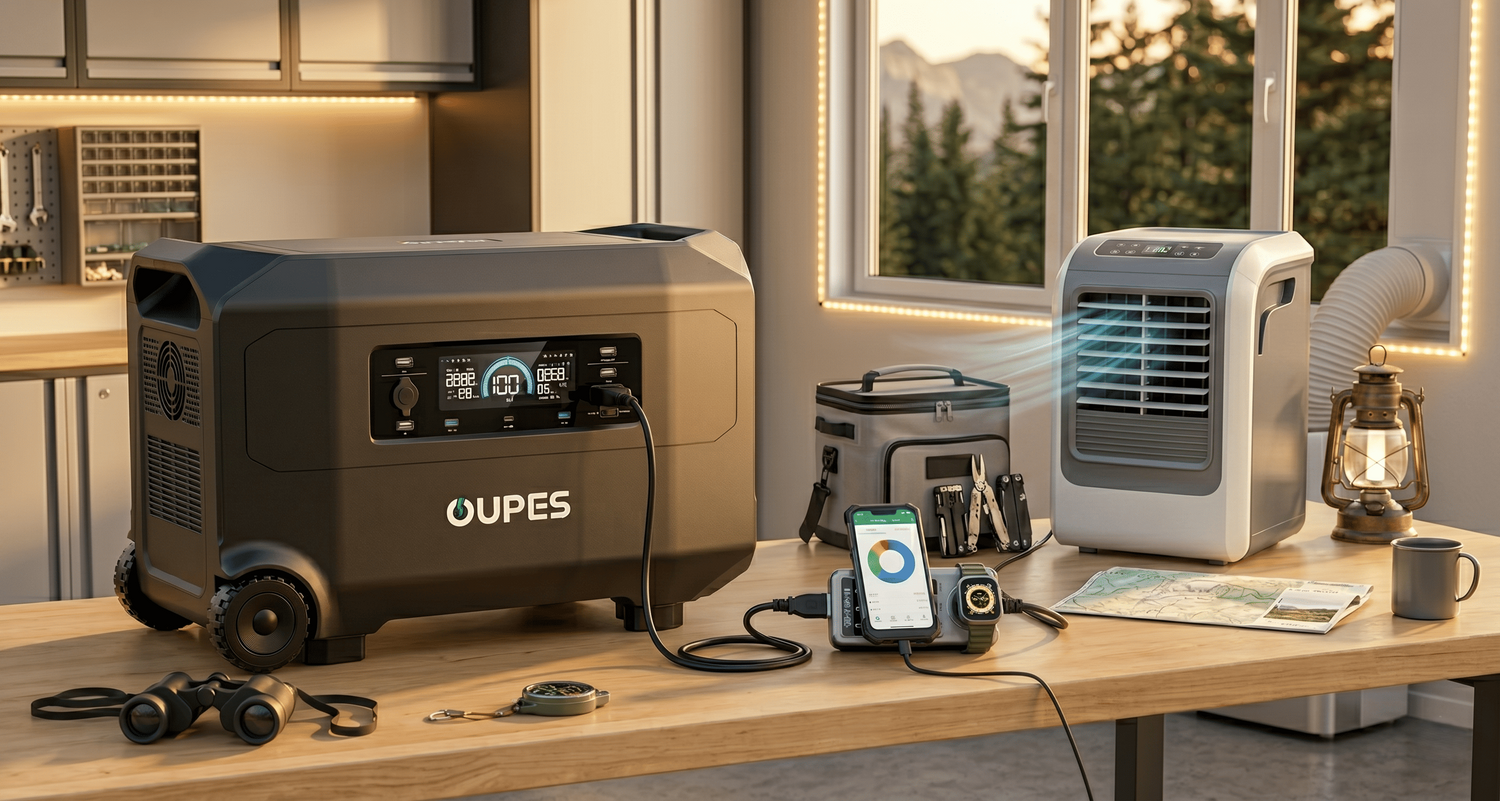
- Can a portable power station run a portable AC?
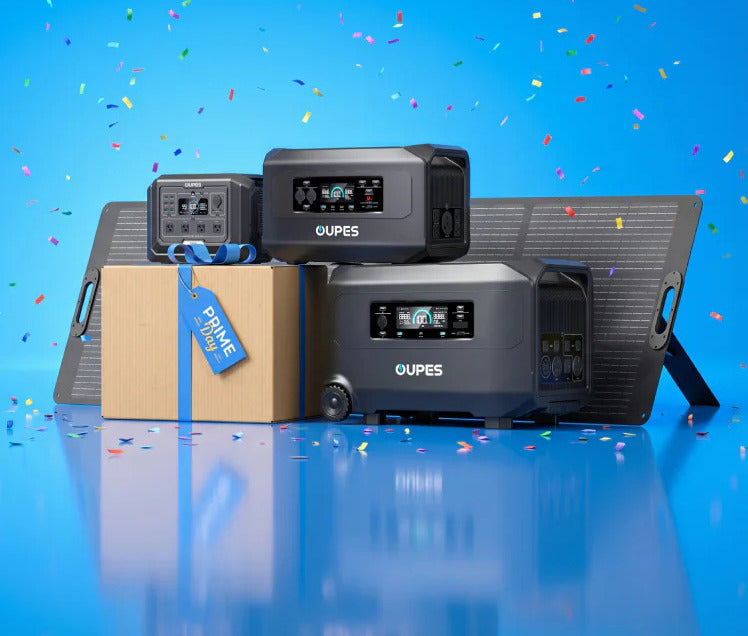
- Detailed OUPES options for portable AC backup
- Bottom line
- References
- FAQ
The short answer
Most portable air conditioners use a lot more electricity than small electronics and a lot less than whole-home central AC. In practical off-grid or backup-power planning, many portable AC setups end up landing somewhere in the high-hundreds to mid-thousands of watts while actively cooling, depending on size and efficiency. But the exact number depends on the unit’s SACC, its CEER, and how hard it has to work in your room.
That is why there is no single honest “portable air conditioners use X watts” answer. The better answer is: portable AC electricity use is a range, and the right estimate comes from capacity plus efficiency, not capacity alone.
What changes a portable AC’s electricity use?
Five things matter most:
| Factor | Why It Matters |
|---|---|
| Cooling capacity | Larger-capacity units generally need more electrical input when actively cooling |
| Efficiency | A more efficient unit can deliver the same cooling with less power input |
| Operating mode | Cooling mode uses more power than fan-only mode, while dehumidify mode may behave differently depending on the unit |
| Room conditions | Hotter rooms, poor insulation, direct sun, and frequent door opening all increase runtime and power use |
| Duty cycle | The compressor does not always run continuously, so actual average power is often lower than peak running power |
That last point is especially important. A portable AC may draw a high wattage when the compressor is actively cooling, but once the room reaches the target temperature, the unit may cycle off and on. So the running wattage and the average daily electricity use are not the same thing.
Why SACC and CEER matter more than marketing BTU alone
DOE rules for portable air conditioners are built around two measurements. SACC is the seasonally adjusted cooling capacity in Btu/h, and CEER is the combined energy efficiency ratio in Btu per watt-hour.[2][3] In simple terms:
- SACC tells you how much cooling the unit is effectively delivering
- CEER tells you how efficiently it turns electricity into that cooling
This matters because portable AC labels and marketing often make cooling size look simpler than it is. But from an electricity-use standpoint, the more useful planning question is not just “How many BTUs?” It is “How many Btu per watt-hour?” If two units have similar cooling capacity, the one with the better CEER will generally use less electricity for the same cooling job.
DOE’s portable AC test method also makes clear that portable AC energy performance includes not only cooling mode, but also off-cycle and inactive or off-mode energy use, which is one reason real consumer usage is more complex than reading a single number from a product page.[2]
How to estimate portable AC wattage
A useful approximation is:
Estimated cooling-mode watts ≈ SACC ÷ CEER
Because CEER is measured in Btu per watt-hour, dividing cooling capacity by CEER gives you a reasonable way to estimate electrical input while the unit is actively cooling.
Below are illustrative examples using simple SACC and CEER combinations. These are not brand-specific measurements. They are math examples to show how the relationship works.
| Illustrative SACC | Illustrative CEER | Estimated Running Watts |
|---|---|---|
| 8,000 Btu/h | 6.5 | ~1,231W |
| 8,000 Btu/h | 7.5 | ~1,067W |
| 10,000 Btu/h | 6.5 | ~1,538W |
| 10,000 Btu/h | 7.5 | ~1,333W |
| 12,000 Btu/h | 6.5 | ~1,846W |
| 12,000 Btu/h | 7.5 | ~1,600W |
This is why portable ACs often feel power-hungry in battery-based setups. Even before you account for startup surge and cycling behavior, the active cooling wattage can be much higher than many people expect.
Why real-world electricity use is not constant
Portable AC electricity use is not just about the wattage when the compressor is on. It is about how long that compressor stays on. In a cooler room, or after the room reaches the set temperature, the compressor may run only part of the time. In a hot room with poor sealing, it may run almost continuously.
A practical planning formula for daily energy use is:
Daily energy use (kWh) = running watts × hours used × duty cycle
Example:
If a portable AC draws 1,200W while actively cooling, runs for 8 hours, and the compressor is active about 60% of that time, then:
1,200 × 8 × 0.6 = 5,760Wh
= 5.76kWh per day
That is a far better planning method than assuming the nameplate wattage applies every minute of the day.
DOE’s test framework also uses annual cooling-mode hours in its calculations, which shows that appliance energy use is not treated as a simple fixed-watt, always-on number even in formal regulatory analysis.[2]
Can a portable power station run a portable AC?
Yes, sometimes—but not every portable power station is a good fit for every portable AC. The key checks are:
- Running output: Can the power station sustain the AC’s running watts?
- Startup surge: Can it handle compressor startup demand?
- Battery capacity: How long will it run the unit before recharging?
A useful off-grid planning formula is:
Estimated runtime (hours) = battery capacity × 0.8 ÷ air-conditioner watts
The 80% factor is a practical real-world planning buffer for inverter losses, temperature effects, and other system overhead.
Below is a runtime comparison using the four OUPES models you linked and three simple portable-AC load examples:
| Model | Rated Capacity | Usable Capacity (80%) | Runtime at 700W | Runtime at 1000W | Runtime at 1400W |
|---|---|---|---|---|---|
| Mega 1 Lite | 1024Wh | 819Wh | 1.17 hours | 0.82 hours | 0.59 hours |
| Mega 2 Pro | 2048Wh | 1638Wh | 2.34 hours | 1.64 hours | 1.17 hours |
| Exodus 2400 | 2232Wh | 1786Wh | 2.55 hours | 1.79 hours | 1.28 hours |
| Guardian 6000 | 4608Wh | 3686Wh | 5.27 hours | 3.69 hours | 2.63 hours |
These figures assume the AC is drawing those watts continuously. In real life, runtime may be longer if the compressor cycles down after the room cools, but hot weather, poor insulation, and direct sunlight can also keep runtime closer to the continuous-use scenario.
Detailed OUPES options for portable AC backup
If you want to match a power station to portable AC use, the easiest way is to think in tiers: compact backup, mid-range air-conditioner support, and serious home-backup cooling support.
| OUPES Model | Rated Capacity | Rated Output | Best Portable-AC Role |
|---|---|---|---|
| OUPES Mega 1 Lite | 1,024Wh | 2,000W | Short cooling support, small rooms, quick backup |
| OUPES Mega 2 Pro | 2,048Wh | 2,500W | Mid-size portable ACs, stronger off-grid comfort |
| OUPES Exodus 2400 | 2,232Wh | 2,400W | Balanced longer cooling runtime |
| OUPES Guardian 6000 | 4,608Wh | 6,000W at 240V / 3,600W at 120V | Largest cooling loads and broader home-backup planning |
OUPES Mega 1 Lite: portable backup for lighter cooling tasks
The Mega 1 Lite is designed around a 1,024Wh LiFePO4 battery and a 2,000W pure sine wave inverter, with 800W solar input, 9 outputs, and a listed weight of just 26.8 lbs.[4][5] OUPES also highlights more than 3,500 charge cycles to 80% on the product page.[5]
This model makes sense when your portable AC use is short-duration or supplemental. It is the kind of station you choose when you want quick cooling during a short outage, or when you are pairing the AC with a very controlled, smaller-space use case rather than trying to cool for half a day straight.
OUPES Mega 2 Pro: the stronger middle ground
The Mega 2 Pro steps up to 2,048Wh and 2,500W AC output with 3,600W Boost. OUPES also lists 1,000W max solar charging, 2,800W AC + solar charging, WiFi/Bluetooth connectivity, and a listed net weight of 48.8 lbs.[6]
For portable AC users, this is where battery-powered cooling becomes more realistic instead of just possible. Mega 2 Pro suits users who want a stronger balance between mobility, inverter headroom, and enough battery to support meaningful cooling sessions rather than only emergency bursts.
OUPES Exodus 2400: a balanced runtime-first option
The Exodus 2400 offers 2,232Wh capacity, a 2,400W AC pure sine wave inverter, 2,600W Boost Mode, 2,200W max AC + solar input charging speed, and a listed weight of 45.2 lbs. OUPES also lists 3,500+ cycles to 80% and 13 outputs on the product page.[7]
This makes Exodus 2400 an excellent fit when you care more about runtime cushion than about having the lightest possible unit. If your portable AC is in the mid-range of actual draw, Exodus 2400 gives you one of the better balances between output and stored energy in this group.
OUPES Guardian 6000: the serious cooling and backup platform
The Guardian 6000 is a different class of system. OUPES lists it at 4.6–41.4kWh expandable capacity, with 240V/6,000W dual-voltage output, 120V/3,600W output, up to 2,100W solar input, 3,600W max 240V AC charging, and a listed weight of 111.3 lbs.[8] The same page also lists more than 4,000 cycles to 80% and multiple high-load outlet types.[8]
Guardian 6000 is the unit in this set that starts to make portable AC backup feel like part of a wider home resilience strategy rather than a small off-grid experiment. It is the natural choice when you want longer cooling windows, larger loads, or a serious backup-power platform that can do much more than run one room appliance.
Bottom line
A portable air conditioner can use a significant amount of electricity, but the honest answer depends on both cooling capacity and efficiency. DOE’s portable AC framework is based on SACC and CEER, and those two numbers tell you much more about likely electricity use than marketing BTU alone.[1][2][3]
If you are trying to estimate real usage, start with watts in active cooling mode, then factor in runtime and compressor cycling. And if you want to run a portable AC from battery backup, focus on three things: inverter output, startup headroom, and usable battery capacity. Once you do that, it becomes much easier to decide whether a compact unit like Mega 1 Lite is enough, or whether a larger platform such as Mega 2 Pro, Exodus 2400, or Guardian 6000 makes more sense.
References
- U.S. Department of Energy — Portable Air Conditioners
- eCFR — Uniform Test Method for Measuring the Energy Consumption of Portable Air Conditioners
- Federal Register / DOE — Energy Conservation Standards for Portable Air Conditioners
- OUPES Mega 1 Lite Official Product Page
- OUPES Mega 1 Lite — solar input, weight, and battery-cycle details
- OUPES Mega 2 Pro Official Product Page
- OUPES Exodus 2400 Official Product Page
- OUPES Guardian 6000 Official Product Page
FAQ
1. How many watts does a portable air conditioner usually use?
There is no single number that fits all units. A useful estimate comes from dividing SACC by CEER, then adjusting for real-world runtime and compressor cycling.
2. Is BTU enough to tell me electricity use?
No. BTU or SACC tells you cooling capacity, but efficiency matters too. Two units with similar cooling capacity can use different amounts of electricity if their CEER differs.[2][3]
3. Why does my portable AC not draw full power all day?
Because the compressor cycles. Once the room cools down, the unit may reduce active cooling time, so the average daily electricity use can be much lower than continuous running wattage.
4. Can a portable power station run a portable AC overnight?
Sometimes, but it depends on the AC’s wattage, the duty cycle, and the battery size. Continuous cooling loads drain batteries much faster than many people expect.
5. Is startup surge important for portable ACs?
Yes. Compressor-based appliances can need more power at startup than while running steadily, so inverter headroom matters when pairing a portable AC with a power station.
6. Which OUPES model is best for portable AC use?
Mega 1 Lite is best for shorter or lighter-use cooling support, Mega 2 Pro and Exodus 2400 are stronger middle-tier options, and Guardian 6000 is the most capable for larger cooling loads and broader backup planning.[4][6][7][8]
7. What is the biggest mistake when estimating portable AC electricity use?
Treating the unit like a constant-watt device. Real electricity use depends on compressor cycling, room conditions, and operating mode, not just the number printed in the product headline.

Leave a comment
This site is protected by hCaptcha and the hCaptcha Privacy Policy and Terms of Service apply.