




Running an RV air conditioner from a portable solar generator is possible, but it is also one of the easiest ways to buy the wrong power station. Many buyers focus only on battery capacity, while the real decision depends on three separate questions: Can the power station start the air conditioner? Can it keep it running steadily? And can solar input recover enough energy to make the setup practical?
That is why choosing a portable solar generator for RV air conditioning should never start with watt-hours alone. RV rooftop air conditioners are heavy AC loads. Official RV air-conditioner documentation shows that most rooftop units are 115V systems, and one common manufacturer guideline says startup planning should begin by taking the unit’s running amp draw and multiplying it by 2.5 to estimate maximum startup demand.
Table of Contents
- Why RV air conditioners are hard to run
- Step 1: Check startup power first
- Step 2: Then check continuous running power
- Step 3: Calculate runtime with the 80% battery rule
- Step 4: Size solar input realistically
- Recommended OUPES options
- Common buying mistakes
- References
- FAQ
Why RV air conditioners are hard to run
An RV air conditioner is very different from a phone charger, fridge, or coffee maker. It has a compressor load, and compressor loads are defined by two moments: the short but demanding startup moment, and the longer running phase after the compressor is already spinning. If the portable power station cannot handle the startup moment, the air conditioner may never turn on. If it can start the unit but the battery is too small, runtime will still be disappointing.
Representative official RV AC manuals show why. One official 13,500 BTU rooftop unit manual lists 12.5A cooling FLA, while a 15,000 BTU version in the same series lists 13.0A cooling FLA. Another official 15,000 BTU rooftop manual lists 13.3A compressor rated load amps, 2.0A fan motor rated load amps, and a 3.5 kW minimum generator size for one unit. That tells you two things: first, RV air conditioners often need around the mid-1,000-watt range once running; second, they need considerably more overhead at startup.
| What You Need to Check | Why It Matters | What to Look For |
|---|---|---|
| Startup power | Compressor loads spike when starting | Enough surge or startup headroom |
| Running power | The AC must keep operating after startup | Stable continuous inverter output |
| Battery capacity | Determines how long cooling lasts | Enough usable watt-hours, not just headline capacity |
| Solar input | Determines how fast you can recover energy | High enough solar charging to slow or offset battery drain |
| RV-ready outlets | Makes connection simpler | TT-30R or other suitable RV outputs |
Step 1: Check startup power first
The safest first step is to look at your air conditioner’s own data tag or manual. One official RV AC FAQ states that startup planning should be based on the unit’s running amp draw multiplied by 2.5. That is not a perfect prediction for every unit, but it is a very useful field rule because it immediately shows why a power station that seems “big enough” on paper can still fail at compressor startup.
Here is a practical example:
If your RV air conditioner runs at 13A on 115V, then the running load is roughly:
13 × 115 = 1,495W
Using the 2.5x startup rule:
13A × 2.5 = 32.5A startup planning load
32.5A × 115V ≈ 3,738W
That means a 2,000W-class power station may be able to handle some lighter RV loads, but it is not the first thing you should trust for a rooftop AC unless your actual unit has unusually low startup demand or you have already verified a lower starting requirement in practice. By contrast, a 3,600W-class unit or larger is much closer to the right starting zone for many single rooftop RV air conditioners.
| AC Scenario | Typical Planning Logic | Portable Solar Generator Class |
|---|---|---|
| Smaller / lower-start 13.5K class unit | May work if startup demand is controlled and running watts stay modest | 2.5kW class can be possible, but not the safest default |
| Typical single rooftop 13.5K–15K unit | Needs stronger startup headroom and stable running output | 3.6kW class is a safer starting point |
| Hot weather + more RV loads + longer cooling windows | Requires both more inverter headroom and more battery | 4.6kWh / 6kW class is more realistic |
Step 2: Then check continuous running power
After startup, the next question is simpler: can the power station continuously support the running load? Official documentation for representative 13.5K and 15K rooftop units places running current in roughly the low-teens amp range at 115V–120V, which usually translates to about 1,400W to 1,800W+ depending on model and conditions. That is why output rating matters just as much as battery size.
It also explains why RV air-conditioning performance changes so much in real use. One official RV AC FAQ notes that design temperatures for many RV air conditioners are based on 95°F outdoor temperature, 80°F indoor temperature, and 50% relative humidity. In other words, hotter campsites, more sun exposure, poorer insulation, and frequent door openings all make the system work harder.
Another official RV air-conditioner manual recommends parking in shade, using window shades, keeping windows and doors shut, avoiding heat-producing appliances, and starting the AC early in the morning so the unit gets a head start before peak heat arrives. Those are not small tips. They directly reduce power demand and improve how long a portable power station can keep up.
Step 3: Calculate runtime with the 80% battery rule
For planning runtime, I strongly recommend using a conservative method rather than the advertised battery capacity. The practical formula is:
Usable battery capacity = rated capacity × 80%
This 80% rule is a better outdoor planning method because it leaves room for conversion losses, temperature effects, cable losses, BMS overhead, and the fact that real RV use is rarely as clean as a lab test. It also fits your actual decision better: not “How big is the battery?” but “How much of that battery can I reasonably plan around?”
Below is a simple runtime model using three representative OUPES options and a 1,500W AC running load.
| OUPES Model | Rated Capacity | Usable Capacity (80%) | Runtime at 1500W Continuous | Runtime at 900W Average Load | Runtime at 600W Average Load |
|---|---|---|---|---|---|
| Mega 2 | 2048Wh | 1638.4Wh | 1.09 hours | 1.82 hours | 2.73 hours |
| Mega 3 | 3072Wh | 2457.6Wh | 1.64 hours | 2.73 hours | 4.10 hours |
| Guardian 6000 | 4608Wh | 3686.4Wh | 2.46 hours | 4.10 hours | 6.14 hours |
The three runtime columns above represent three different realities. 1500W continuous means the compressor is effectively working the entire time, which can happen in very hot conditions or while the RV is initially being pulled down from a high internal temperature. 900W average and 600W average assume compressor cycling. That is much closer to real use after the cabin cools down, but it still shows an important truth: for RV air conditioning, battery capacity disappears fast. If you want meaningful cooling windows instead of just “proof that it runs,” capacity matters a lot.
Step 4: Size solar input realistically
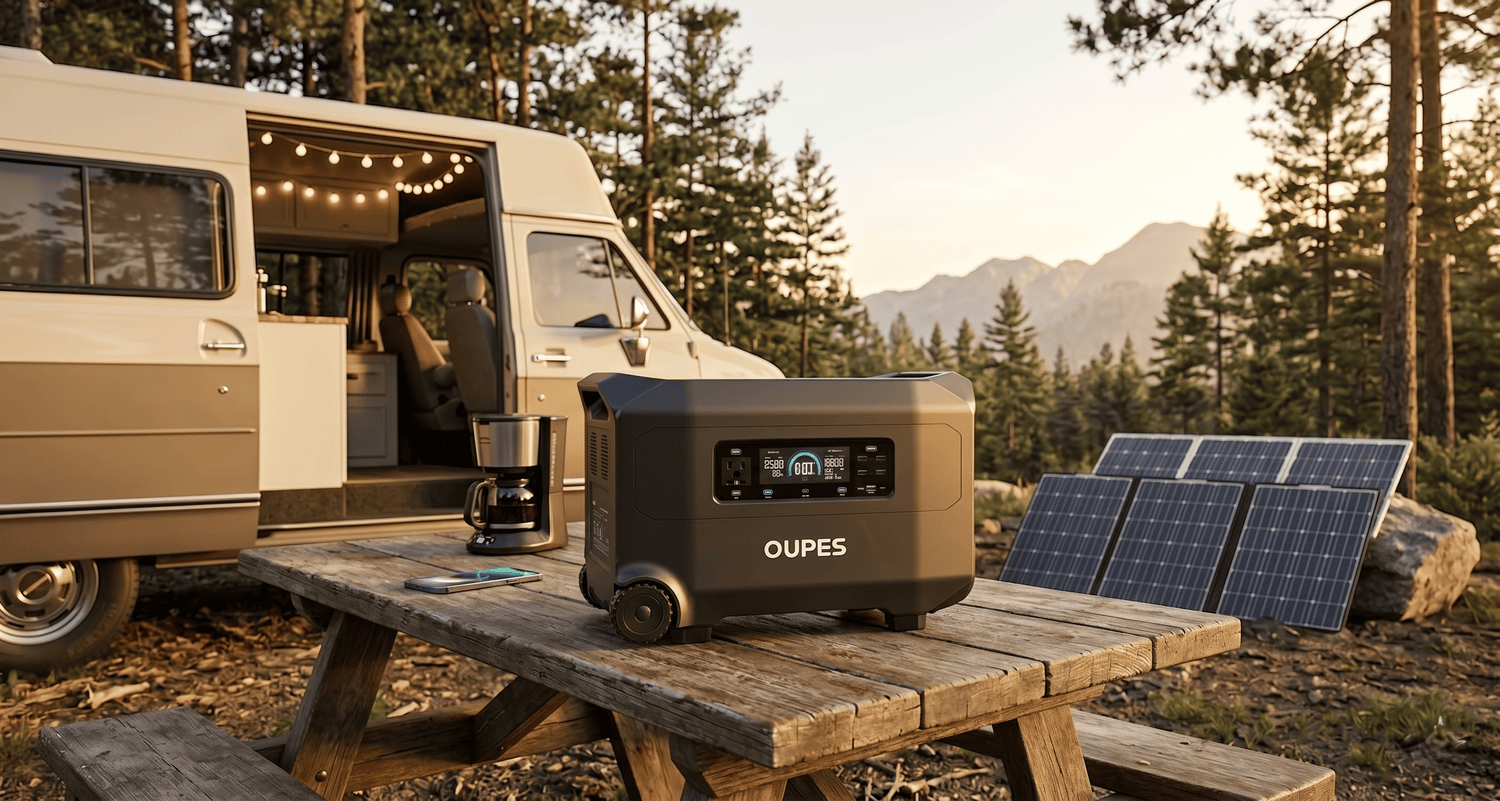
The word “solar generator” often causes unrealistic expectations. Solar is extremely useful for RV travel, but it does not magically turn a 2kWh power station into an all-day air-conditioning system. Solar helps by slowing battery depletion, recovering energy between compressor cycles, and refilling the station when the AC load is lighter or intermittent.
Using OUPES 240W panels as an example, here is a simple daily recovery estimate based on 5 peak-sun-hours and a 75% practical derate:
Daily solar recovery = panel watts × sun hours × 0.75
| Panel Setup | Nameplate Solar | Practical Daily Recovery | What It Means for RV AC |
|---|---|---|---|
| 1 × 240W panel | 240W | ~900Wh/day | Helpful, but not enough to sustain heavy AC use by itself |
| 2 × 240W panels | 480W | ~1800Wh/day | Good support for partial cooling windows and other RV loads |
| 4 × 240W panels | 960W | ~3600Wh/day | Much more realistic for offsetting meaningful AC consumption on sunny days |
That is also why high solar input on the power station matters. OUPES lists the Mega 2 with up to 2100W solar input, the Mega 3 with up to 2100W solar input, and the Guardian 6000 with combined high-speed charging options. High solar input does not guarantee full AC self-sufficiency, but it gives the system far more ability to recover during the day.
Recommended OUPES options
OUPES Mega 2: The edge case option
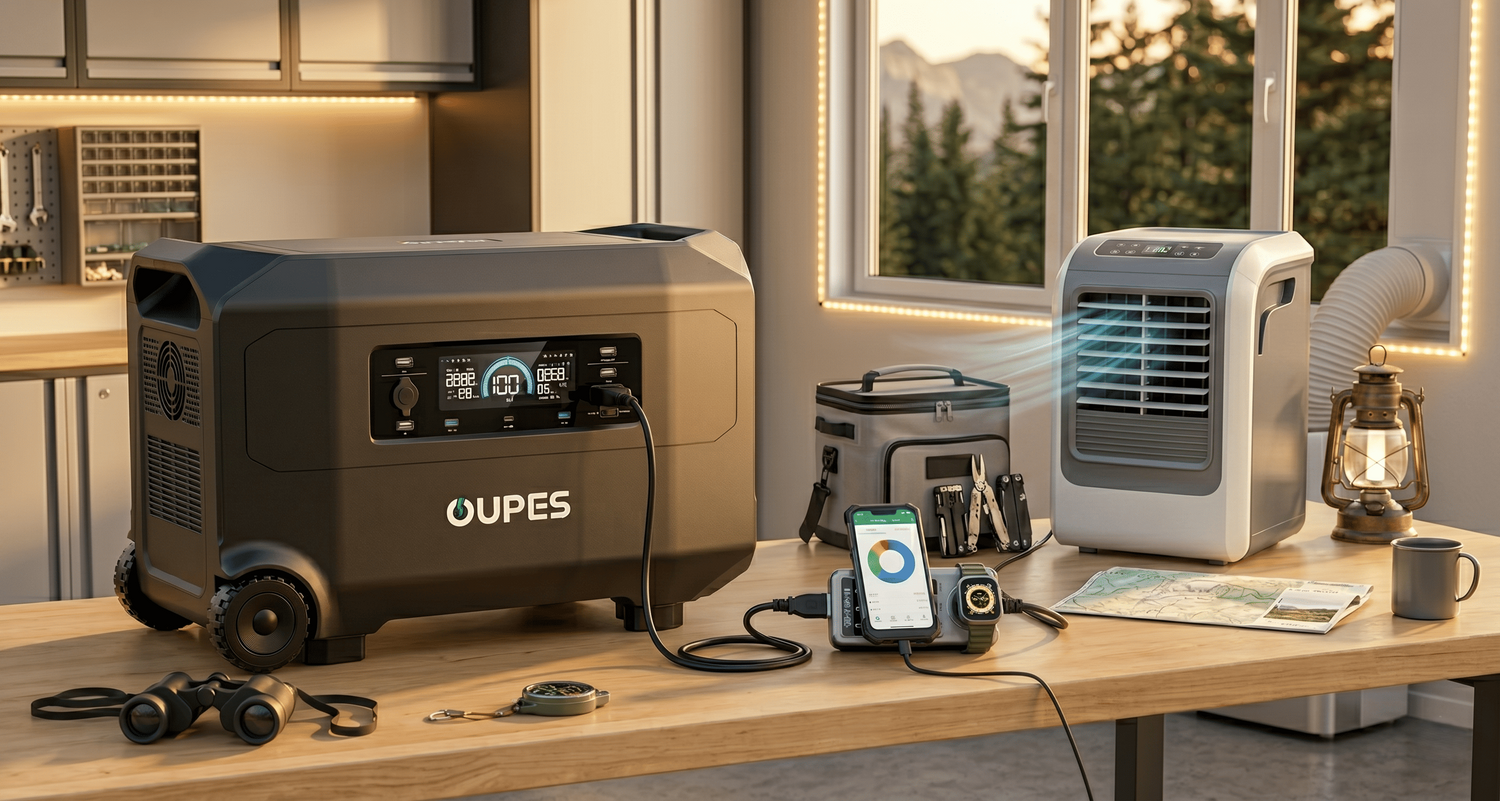
The OUPES Mega 2 gives you 2048Wh capacity, 2500W AC output, TT-30R 120V/30A outlet, and strong solar charging capability. That makes it much more RV-friendly than many smaller power stations in the same capacity band. But for RV air conditioning specifically, it should be viewed as a conditional choice rather than the automatic answer. It can make sense for smaller or better-behaved air conditioners, lighter-duty cooling sessions, or users who already know their unit’s startup demand is manageable.
OUPES Mega 3: The better single-AC starting point
The OUPES Mega 3 is a more natural fit for RV air-conditioning use because it steps up to 3072Wh capacity, 3600W AC output, 7000W surge, a TT-30R 120V/30A outlet, and strong solar input. It also supports expansion up to 15.36kWh. That combination matters: the inverter is stronger for startup, the battery is larger for runtime, and the RV-ready outlet simplifies connection for many setups.
OUPES Guardian 6000: The most comfortable choice for serious RV cooling
The OUPES Guardian 6000 is the strongest option of the three for RV air-conditioning because OUPES lists it at 4608Wh capacity, 6000W output, dual-voltage capability, multiple RV-ready outputs including TT-30R, and expansion up to 41.4kWh. If your target is not just “Can it start my AC?” but “Can it run longer, recharge faster, and leave headroom for the rest of the RV?” then the Guardian 6000 is the most practical fit in the current OUPES lineup.
Common buying mistakes
- Buying by capacity only: A big battery without enough startup headroom still fails.
- Ignoring RV heat gain: Shade, insulation, door openings, and cabin temperature all change runtime.
- Assuming solar panels will fully replace AC draw in real time: Sometimes they help a lot, but they rarely erase heavy compressor loads by themselves.
- Using rated battery capacity as if all of it is available: For real planning, use the 80% rule.
- Ignoring the outlet layout: RV-ready outputs like TT-30R make the setup more practical.
References
- Coleman-Mach FAQ — operating voltage, design conditions, and startup sizing guidance
- Dometic AirCommand Rooftop Air Conditioner Manual — 13,500 BTU / 15,000 BTU specifications
- Dometic Brisk II Evolution 15,000 BTU Manual — rated amps, generator sizing, and usage guidance
- U.S. Department of Energy — Understanding Solar Photovoltaic System Performance
- NREL — PVWatts Version 5 Manual
- OUPES Mega 2 Official Product Page
- OUPES Mega 3 Official Product Page
- OUPES Guardian 6000 Official Product Page
FAQ
1. Can a portable solar generator run an RV air conditioner?
Yes, but the correct answer depends on startup power, continuous output, and battery capacity. For many single rooftop RV air conditioners, a 3.6kW-class unit is a safer starting point than a smaller 2kW-class unit.
2. Is battery capacity or output more important?
Both matter, but in sequence. Output matters first because the air conditioner must start. Capacity matters second because even a successful startup means little if runtime is too short.
3. Why do you use only 80% of battery capacity in the calculations?
Because it gives a more realistic field estimate. It builds in room for real-world losses and avoids overpromising runtime.
4. Can solar panels keep an RV air conditioner running all day?
Sometimes they can offset part of the consumption, but heavy AC loads are demanding. In most portable setups, solar slows depletion and helps recharge rather than making the battery irrelevant.
5. Which OUPES model is the safest choice for RV AC?
Among the current OUPES options discussed here, the Guardian 6000 is the most comfortable choice for serious RV AC use, while the Mega 3 is the stronger single-AC starting point for users who want something smaller.
6. Is a TT-30 outlet important?
It often is for RV users because it simplifies connection to RV-style loads. OUPES lists TT-30R on the Mega 2, Mega 3, and Guardian 6000 product pages.
7. What is the biggest mistake buyers make?
They assume that if a portable power station can theoretically start the AC once, it is automatically the right system. In practice, runtime, solar recovery, and high-heat conditions matter just as much.

Leave a comment
This site is protected by hCaptcha and the hCaptcha Privacy Policy and Terms of Service apply.