




Table of Contents
- Core Positioning Differences
- Detailed Specifications Comparison
- Power and Load Capacity Analysis
- Charging Methods and Charging Speed Comparison
- Runtime Comparison (Based on 80% Usable Capacity)
- Ports and Expandability Analysis
- Use Case Scenario Analysis
- How to Choose the Right Model
- FAQ
Core Positioning Differences
Although Mega 1 Lite and Mega 1 have identical core specifications (2000W output and 1024Wh capacity), their product design logic has fundamental differences.
The design goal of Mega 1 Lite is to provide a simple and direct power solution. It emphasizes “plug-and-play” and a low learning curve, making it suitable for users who do not want to spend time studying system configurations. Users only need to charge it before use, without considering expansion or complex setup.
In contrast, Mega 1 is a product built around a “power system.” It is not only a power device but also an expandable energy platform. Through external battery expansion, solar input, and UPS functionality, Mega 1 can gradually upgrade from a basic power source into a complete home backup power system.
From a usage cycle perspective, Mega 1 Lite is more suitable for short-term or light use, while Mega 1 is more suitable for long-term planning and high-frequency usage scenarios.
Detailed Specifications Comparison
From the hardware specifications perspective, both maintain consistency in core performance, but there are obvious differences in system capability and structural design.
| Item | Mega 1 Lite | Mega 1 |
|---|---|---|
| Battery Capacity | 1024Wh | 1024Wh |
| Rated Power | 2000W | 2000W |
| Surge Power | 4500W | 4500W |
| Battery Type | LiFePO4 | LiFePO4 |
| Cycle Life | 3500+ cycles | 3500+ cycles |
| AC Charging | 1400W (~46 minutes) | 1400W (~58 minutes) |
| Solar Input | 800W | 800W |
| AC + Solar | Supported (2200W) | Supported (2200W) |
| Total Output Ports | 9 | 13 |
| Expandability | Not supported | Supported (up to 5120Wh) |
| UPS | <20ms UPS | <20ms UPS |
| OTA Upgrade | Supported | Not supported |
| Weight | 26.8 lbs (12.0 kg) | 27.8 lbs (12.6 kg) |
It is important to emphasize that Mega 1 Lite and Mega 1 have completely identical core performance, but Lite is a lightweight standalone device, while Mega 1 is an expandable energy system. The difference between them is mainly reflected in long-term usability rather than instantaneous performance.

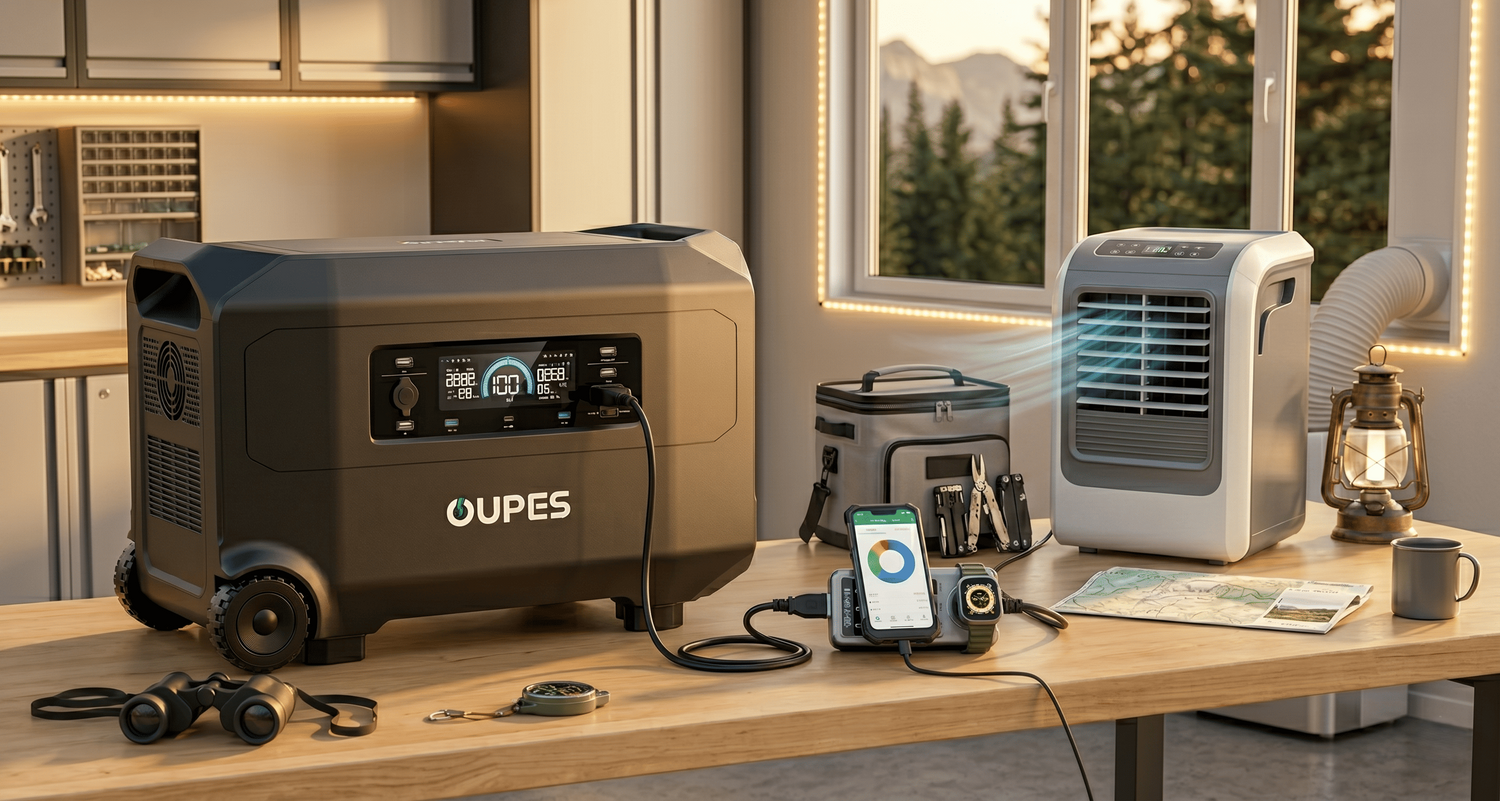
OUPES Mega 1 Power Station
- 1024Wh Capacity | 2000W AC Pure Sine Wave Inverter (4500W Surge)
- LiFePO4 Battery with 3,500+ Life Cycles to 80%
- Expandable Up to 5.12kWh with B2*2
- Supports fast charging up to 2200W (AC+PV), fully charging in just 36 minutes.
Power and Load Capacity Analysis
In terms of output capability, Mega 1 Lite and Mega 1 are completely identical, both providing 2000W rated power and 4500W surge power.
This power level has very important practical significance. 2000W already covers the usage needs of most household and outdoor devices, including but not limited to:
- Refrigerators (including compressor startup)
- Microwaves
- Coffee machines and electric kettles
- Fans, TVs, lighting systems
- CPAP medical devices
- Laptops and mobile devices
From a power system perspective, 2000W is a “universal-level power threshold.” When below this value, users need to frequently calculate whether devices can run; once reaching 2000W, most devices can be used directly without complex judgment.
Therefore, there is no difference between the two products in terms of “what devices they can run.” What truly affects the experience is runtime and power sustainability.
Charging Methods and Charging Speed Comparison
Charging Methods Comparison
| Item | Mega 1 Lite | Mega 1 |
|---|---|---|
| AC Charging | Supported (1400W) | Supported (1400W) |
| Solar Charging | Supported (800W) | Supported (800W) |
| AC + Solar Charging | Supported (2200W Max) | Supported (2200W Max) |
| Car Charging | Supported | Supported |
| Generator Charging | Not supported | Supported (compatible with OUPES Smart Generator) |
| Total Charging Methods | 4 | 5 |
Structurally, both are completely identical in the four mainstream charging methods: AC, Solar, AC + Solar, and car charging, and there is no difference in energy replenishment capability in daily use.
It is important to emphasize that Mega 1 Lite does not support generator charging and cannot be replenished through an external fuel generator; Mega 1 additionally supports connecting to OUPES Smart Generator, enabling continuous power recovery in long outages or no-sunlight environments.
Charging Speed Comparison (Core Experience Difference)
| Charging Method | Mega 1 Lite | Mega 1 | Difference |
|---|---|---|---|
| AC Fast Charging (1400W) | 46 minutes | 58 minutes | Lite is 12 minutes faster (~+20.6%) |
| Solar (800W) | 69 minutes | 78 minutes | Lite is 9 minutes faster |
| AC + Solar (2200W) | 34 minutes | 36 minutes | Lite slightly faster |
Real Usage Experience
AC fast charging scenario: At highway service areas or temporary charging scenarios, Mega 1 Lite can complete charging about 12 minutes earlier than Mega 1, which is equivalent to the time of a cup of coffee and can significantly improve usage rhythm.
Solar charging scenario: Under the same sunlight conditions, Mega 1 Lite charges faster, indicating optimized charging efficiency and the ability to extract more energy within limited sunlight windows.
Extreme dual-input scenario (AC + Solar): Both can reach 2200W input, already representing top-tier charging performance among 1kWh-class products, with Mega 1 Lite maintaining a slight advantage.
Conclusion
Mega 1 Lite and Mega 1 have no fundamental difference in charging capability, but Mega 1 Lite is faster in charging efficiency, while Mega 1 provides more replenishment methods through support for its own smart generator, making it more suitable for long-term power supply and complex environments.

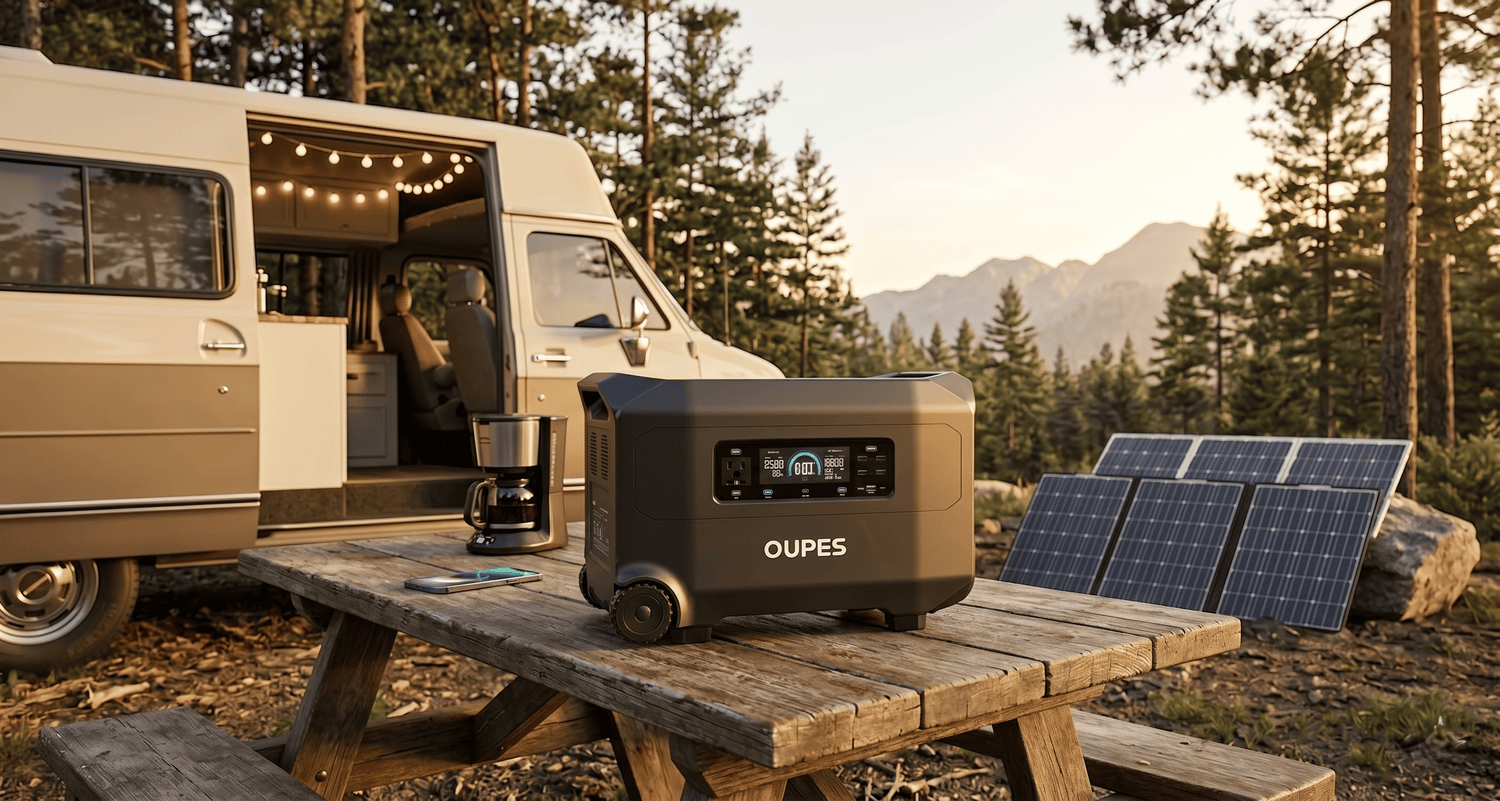
OUPES Mega 1 LITE Power Station
- Powerful Output: 2,000W AC (4,500W surge) via 9 ports; powers 99% of appliances.
- 46-Min AC Recharge: 0 to 100% in just 46 minutes via 1,400W input.
- Fast Solar Charging: Full charge in 69 minutes with 800W max solar input.
- OTA Updates: Remote firmware updates for optimized performance and new features.
Runtime Comparison (Based on 80% Usable Capacity)
In actual use, batteries are not fully discharged, so 80% is usually used as the effective capacity calculation standard.
Calculation method:
Usable energy = 1024Wh × 0.8 ≈ 819Wh
| Device | Power | Runtime |
|---|---|---|
| Router | 10W | ~81 hours |
| CPAP | 40W | ~20 hours |
| Laptop | 60W | ~13 hours |
| Mini Fridge | 100W | ~8 hours |
| Electric Kettle | 1500W | ~0.5 hours |
Although both have identical runtime performance, Mega 1 can increase runtime multiple times through battery expansion.
This means that in multi-day outages or continuous outdoor use scenarios, Mega 1 has significantly higher practical value.
Ports and Expandability Analysis
| Interface | Mega 1 Lite | Mega 1 | Description |
|---|---|---|---|
| AC Output | 4 × 120V / 20A | 4 × 120V / 20A | Supports high-power devices |
| DC 5521 | Not supported | 2 × 12V / 10A | For routers, monitoring devices |
| Car Lighter | 1 × 12V / 10A | 1 × 12V / 10A | Car appliances |
| USB-C | 2 × 100W | 2 × 100W | Laptops, drones |
| USB-A | 2 × 18W | 4 × 18W | Mobile devices |
| Total Ports | 9 | 13 | Multi-device capability |
Mega 1 Lite removes DC 5521 ports and reduces USB-A quantity, making it more streamlined for light usage scenarios such as personal camping or short-term backup.
Mega 1 retains a full DC output system and more USB-A ports, making it more efficient for multi-device power supply and 12V direct usage while reducing AC conversion losses.
Use Case Scenario Analysis
Different product designs determine different applicable scenarios.
In light usage scenarios such as weekend camping or short power outages, Mega 1 Lite can already provide sufficient power support and is easier to operate. At the same time, Mega 1 Lite supports OTA (Over-the-Air) upgrades, meaning the device can continue to be optimized through firmware updates, such as improving charging efficiency, optimizing charging curves, or fixing potential issues, thereby extending the product’s value lifecycle.
In medium to long-term scenarios such as continuous outages, RV living, or long outdoor stays, Mega 1’s expandability and charging flexibility can significantly improve user experience. With expansion batteries and multiple charging methods, Mega 1 is more suitable for building a stable long-term power system.
In emergency preparedness, Mega 1’s UPS function can quickly switch power when the grid fails, ensuring continuous operation of critical devices, which is especially important for home backup power. From a long-term maintenance perspective, Mega 1 Lite’s OTA capability provides another advantage, allowing the device to continue evolving over time, while non-upgradable devices remain fixed in functionality.
How to Choose the Right Model
When choosing a product, you should not only look at specifications but also consider usage cycle and scenario requirements.
If your needs are short-term, low-frequency, and simple usage such as camping or occasional backup, Mega 1 Lite is sufficient and more lightweight and easy to use.
If your needs involve long-term usage, energy planning, or home backup power, Mega 1 is more valuable. Its expandability and system design allow continuous upgrades as your needs grow.
From a long-term investment perspective, Mega 1 has a longer usage cycle and broader applicability.
FAQ
1. Do Mega 1 Lite and Mega 1 have the same power?
Yes, both have 2000W rated output and 4500W surge power.
2. Can they run a refrigerator?
Yes, both support refrigerators including startup surge.
3. Why is Mega 1 more expensive?
Mainly because it supports battery expansion, UPS function, dual-input charging, and more ports.
4. Does Mega 1 Lite support expansion?
No, it has fixed capacity.
5. Which is better for solar systems?
Mega 1, because it supports AC + Solar dual input and expandable capacity.
6. Which is better for beginners?
Mega 1 Lite, because it is simpler and requires no additional configuration.
7. Do they have the same battery lifespan?
Yes, both use LiFePO4 batteries with over 3500 cycles.

Leave a comment
This site is protected by hCaptcha and the hCaptcha Privacy Policy and Terms of Service apply.