




Table of Contents
- Introduction: Why a Severe Thunderstorm Warning Matters
- What a Severe Thunderstorm Warning Actually Means
- The Main Dangers You Need to Prepare For
- What to Do Immediately When the Warning Is Issued
- What to Do at Home, in a Car, or Outdoors
- Common Mistakes to Avoid
- Why Power Outages Are a Serious Part of Storm Safety
- OUPES Backup Power Options for Severe Thunderstorms
- Estimated Runtime for Essential Devices
- Reference Sources
- Final Thoughts
- FAQ
Introduction: Why a Severe Thunderstorm Warning Matters
A severe thunderstorm warning is easy to underestimate, especially for people who hear thunderstorm alerts often. But this is one of the most important mistakes homeowners can make. A severe thunderstorm warning is not simply a notice that rain is coming. It means a dangerous storm is already occurring or is strongly indicated and is capable of producing damaging winds, large hail, dangerous lightning, and in some cases flash flooding or tornadoes.
For most households, the danger is not only the storm itself but the chain of problems it can create. A single severe thunderstorm can knock down trees, shatter windows, damage roofs, block roads, and cut power for hours or even days. That is why a strong response needs to combine immediate safety actions with practical outage planning. This article explains what to do the moment a severe thunderstorm warning is issued, what risks matter most, and how to think about backup power in a more realistic and useful way.
What a Severe Thunderstorm Warning Actually Means
According to the National Weather Service, a severe thunderstorm warning is issued when a storm is producing or is expected to produce damaging winds and/or large hail, and the threat is either radar-indicated or observed. The Ready.gov emergency guidance also notes that a severe thunderstorm warning typically lasts about one hour, although impacts can continue longer if the storm causes damage or flooding.
In practical terms, the key point is simple: this is an action alert, not a wait-and-see alert. If a severe thunderstorm warning is issued for your location, you should move indoors, stay away from windows, monitor official updates, and prepare for rapid changes in conditions. Some storms intensify suddenly. Others arrive with little visual warning before wind or hail begins.
The Main Dangers You Need to Prepare For
Damaging Wind
High wind is often the most widespread cause of storm damage. It can bring down branches, trees, fences, signs, and power lines. Even if your home is not directly hit by lightning or hail, wind can still make the storm dangerous by turning loose objects into debris and damaging the local grid.
Large Hail
Large hail can break windows, damage roofs, and dent vehicles. More importantly, it can injure anyone caught outdoors. This is one reason why standing at a window to “watch the storm” is a bad idea during a severe warning.
Lightning
Lightning is dangerous even when you are indoors. The CDC advises people to avoid plumbing, wired electronics, corded devices, windows, doors, and concrete surfaces during a lightning storm because electrical current can travel through wiring, pipes, and building materials.
Flash Flooding
Some severe thunderstorms also produce heavy rainfall in a very short period. The National Weather Service’s flood safety campaign warns that more than half of flood-related drownings involve vehicles driven into hazardous flood water, and that even six inches of fast-moving water can knock an adult off their feet while most vehicles can begin to lose traction in as little as six inches of water.
Tornado Potential
Not every severe thunderstorm produces a tornado, but some do. This is why severe thunderstorm warnings deserve respect, especially if local weather coverage mentions rotation, destructive wind potential, or rapidly worsening conditions.
What to Do Immediately When the Warning Is Issued
1. Move Indoors Right Away
The first priority is to get inside a sturdy building. Do not stay on a porch, under a carport, in an open garage doorway, or under a temporary shelter. These do not provide real protection from wind-blown debris or lightning risk.
2. Move Away From Windows and Glass Doors
Go to an interior room if possible. Large hail and flying debris can shatter glass quickly. The National Weather Service recommends staying away from windows if damaging wind or large hail is approaching.
3. Stop Using Plumbing and Wired Electronics
During lightning storms, avoid showers, sinks, washing dishes, and using plugged-in electronics. This is one of the most overlooked but most important indoor safety steps.
4. Keep Your Phone Charged and Nearby
Your phone is often your weather alert device, flashlight, emergency contact tool, and update source all at once. If the storm is approaching but has not yet hit, top up your charge immediately.
5. Bring Pets Inside if Time Allows
Ready.gov and NWS guidance both emphasize protecting pets during severe weather. If it is still safe to do so, bring them inside before the worst conditions begin.
What to Do at Home, in a Car, or Outdoors
At Home
Stay in a central, enclosed room away from windows. Unplug sensitive electronics if there is still time before the worst part of the storm arrives. If the storm appears especially severe, keep flashlights ready and avoid unnecessary movement around the house.
In a Car
A hard-top vehicle is safer than being outside, but it is not better than a sturdy building. If you can safely reach a strong building before conditions worsen, do that. If not, stay in the vehicle, keep away from trees and power lines, and do not drive into flooded roads.
Outdoors
If you are outside when the warning is issued, seek sturdy shelter immediately. Do not take cover under isolated trees, in open fields, or near water. If thunder is audible, you are already close enough to be struck by lightning.
Common Mistakes to Avoid
| Mistake | Why It Is Dangerous | Better Action |
|---|---|---|
| Watching the storm through windows | Glass can shatter from hail or debris | Move to an interior room |
| Using sinks, showers, or corded devices | Lightning can travel through plumbing and wiring | Avoid plumbing and wired equipment |
| Driving through flooded roads | Fast-moving water can sweep vehicles away | Turn around and avoid flood water |
| Assuming thunderstorms only mean rain | Severe storms can produce wind, hail, outages, and tornadoes | Treat warnings as immediate safety alerts |
Why Power Outages Are a Serious Part of Storm Safety
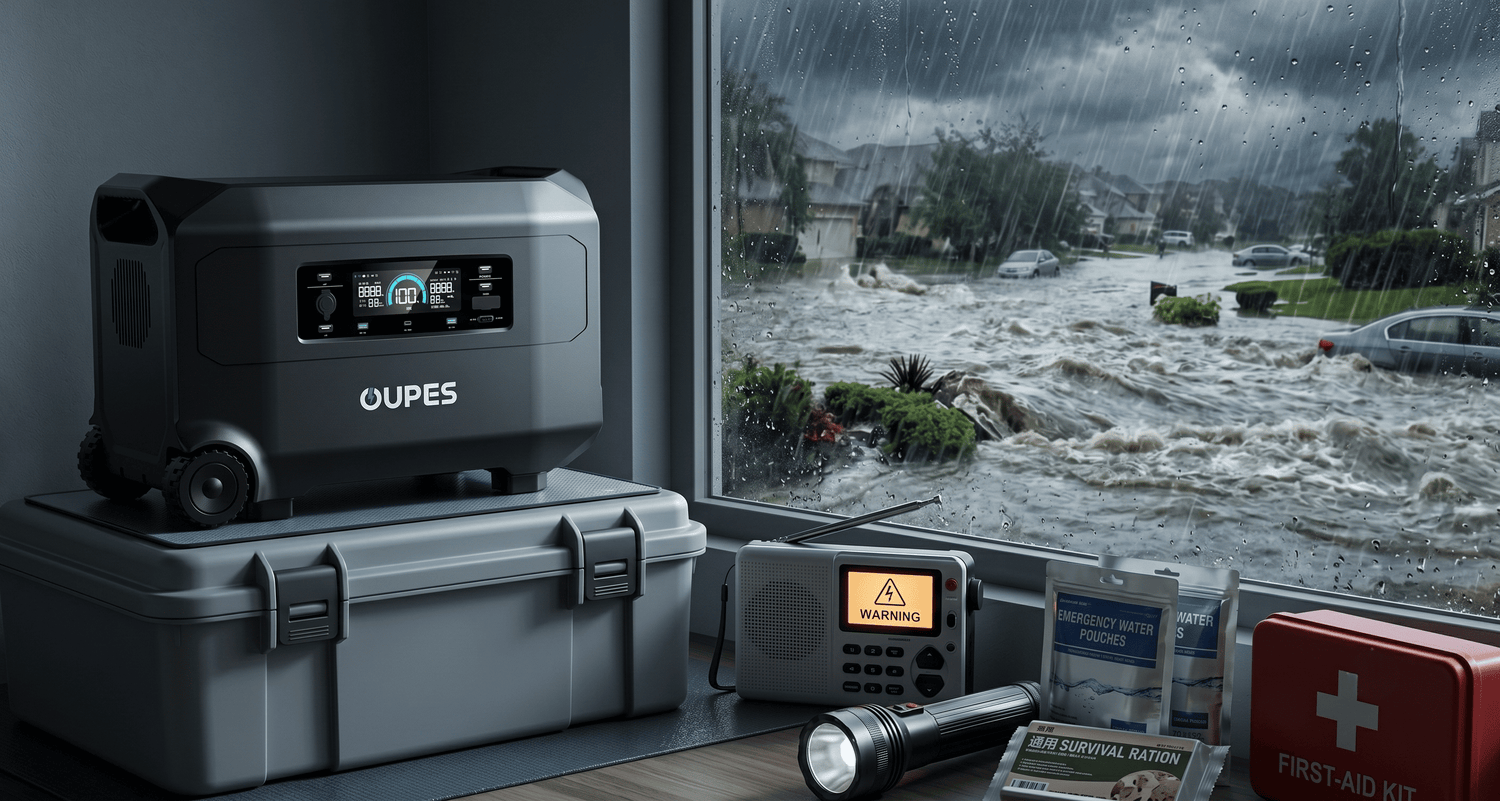
Many severe thunderstorm articles stop at shelter advice, but for homeowners, the real disruption often begins after the storm passes. Wind and lightning frequently damage distribution lines, transformers, and nearby trees. That means homes may lose refrigeration, lighting, communication, and internet access just when people most need updates and reassurance.
For families with children, older adults, or work-from-home needs, the outage may become the most disruptive part of the event. This is why modern storm preparedness should include not only flashlights and bottled water, but also a realistic backup power plan.
OUPES Backup Power Options for Severe Thunderstorms
For severe thunderstorms, backup power should match your real household priorities. Some homes only need communication and lighting support. Others want refrigeration, Wi-Fi, and a more stable daily routine during outages. In that context, the OUPES Exodus 1500, OUPES Mega 3, and OUPES Guardian 6000 fit three useful preparedness levels.
OUPES Exodus 1500: Essential Power for Immediate Storm Response
The OUPES Exodus 1500 provides 1488Wh capacity and 1500W output. This makes it a strong fit for the most urgent storm needs: phones, routers, flashlights, radios, laptops, and smaller safety devices.
Its main value is practicality. During a short thunderstorm outage, it can keep the communication layer of the home working. That means weather alerts, emergency messages, and a lit room rather than a dark and disconnected home.
OUPES Mega 3: Balanced Backup for Home Essentials
The OUPES Mega 3 offers 3072Wh capacity and 3600W output. This is a meaningful step up because it moves beyond communication-only support and into daily living support.
For many households, this is the most balanced severe-thunderstorm option. It is capable of keeping a refrigerator cycling, maintaining internet, powering lights, and supporting several devices at once. If your goal is not just to get through the warning, but to keep the home functional after the storm, this level of backup makes more sense.
OUPES Guardian 6000: Advanced Home Resilience for Longer Outages
The OUPES Guardian 6000 features 4608Wh capacity and 6000W output. This model is designed for households that want higher-capacity support and broader resilience planning.
Its strength is not just runtime, but system capability. It is suitable for homeowners who want to keep more of the home functioning during prolonged storm outages, especially where repeated severe weather or grid instability is a recurring problem.
Estimated Runtime for Essential Devices
The following estimates use 80% of rated battery capacity to reflect more realistic usable energy in practical scenarios.
| Device | Typical Load | Exodus 1500 (1488Wh × 80% = 1190Wh) |
Mega 3 (3072Wh × 80% = 2458Wh) |
Guardian 6000 (4608Wh × 80% = 3686Wh) |
|---|---|---|---|---|
| Phone charging / small device hub | 10W | ~119 hours | ~246 hours | ~369 hours |
| Wi-Fi router | 15W | ~79 hours | ~164 hours | ~246 hours |
| LED room lighting | 20W | ~59 hours | ~123 hours | ~184 hours |
| Refrigerator (average cycling estimate) | 150W | ~7.9 hours | ~16.4 hours | ~24.6 hours |
These figures are simplified estimates. Actual runtime will vary based on startup surges, ambient temperature, compressor cycling behavior, and whether multiple devices are connected at the same time.
Reference Sources
- Ready.gov — Thunderstorms & Lightning
- National Weather Service — What to Do During Severe Weather
- National Weather Service — Severe Thunderstorm Safety Rules
- National Weather Service — Turn Around Don’t Drown
- National Weather Service — Flood Water Safety Facts
- CDC — Lightning Safety Indoors
- CDC — Frequently Asked Questions About Lightning
Final Thoughts
A severe thunderstorm warning should be treated as an immediate safety message, not a routine weather update. The right response begins with getting indoors, moving away from windows, avoiding lightning pathways like plumbing and wired devices, and preparing for potential power loss.
For homeowners, that last step matters more than ever. A storm may pass in under an hour, but the outage it causes can affect the entire rest of the day or longer. That is why the strongest storm plan combines weather awareness with practical backup power planning. With the right response and the right preparation, a severe thunderstorm warning becomes something your household can handle more confidently and safely.
FAQ
1. What should I do first during a severe thunderstorm warning?
Go inside a sturdy building immediately and move away from windows and glass doors.
2. Is it safe to shower or wash dishes during a thunderstorm?
No. Lightning can travel through plumbing, so it is safer to avoid water use during the storm.
3. Can severe thunderstorms really cause long power outages?
Yes. Wind, lightning, and falling trees frequently damage power lines and local grid equipment.
4. Is a car safe during a severe thunderstorm warning?
A hard-top car is safer than being outside, but a sturdy building is the better choice whenever possible.
5. Why should I avoid windows during the warning?
Large hail and wind-driven debris can break glass and cause injury.
6. Is the OUPES Exodus 1500 enough for basic storm outages?
Yes. It is a practical option for phones, lighting, routers, and other smaller emergency devices.
7. When does a larger unit like the Mega 3 or Guardian 6000 make more sense?
These are better suited for households that want refrigeration, internet, and broader home functionality during longer outages.
8. Should I drive through a flooded road if the water looks shallow?
No. Flood water depth and force are often deceptive, and even shallow moving water can become dangerous very quickly.



Leave a comment
This site is protected by hCaptcha and the hCaptcha Privacy Policy and Terms of Service apply.