




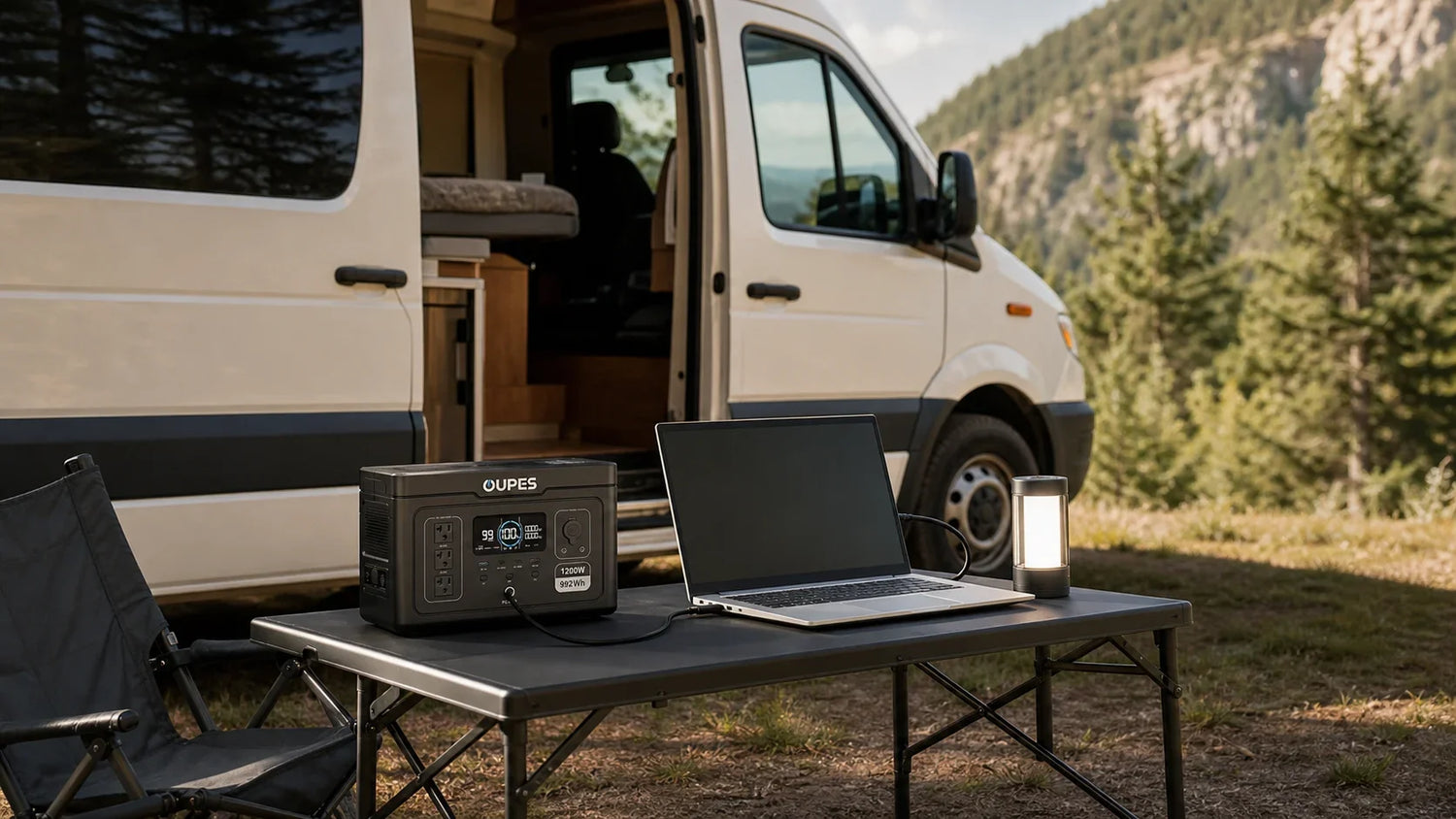
A portable power station for van life should cover the energy you use between drives or charges, support the highest combination of loads you run together, and fit a safe storage location. Start with refrigeration, lights, phones, laptop work, fans, and other daily essentials. Then consider short high-power appliances separately. A compact unit with disciplined use can outperform an oversized system that is difficult to store, lift, or recharge.
Van life is not the same as an RV shore-power setup. Do not assume a portable unit provides a 30A or 50A RV connection. This guide focuses on ordinary supported outlets and device loads, with no fixed vehicle wiring.
Map a Full Day of Van Energy
Build a load table with device, running watts, hours per day, and watt-hours. For a cycling refrigerator, measured daily energy is more useful than multiplying its maximum draw by 24 hours. Include lights, phones, cameras, router or hotspot, water pump, fan, laptop, and any cooking appliance you genuinely use.
Separate essential loads from optional ones. Refrigeration, communication, and basic lighting may stay on the first list. Entertainment and high-power cooking may be reduced when charging is limited. This priority system gives you a workable low-energy day when weather, traffic, or a change of campsite interrupts the normal charging plan.
For illustration, 450Wh of refrigeration, 250Wh of laptop work, 120Wh of lighting and phones, and 180Wh of fan or pump use total 1,000Wh before conversion losses. That does not mean a nominal 1,000Wh battery guarantees the full day. AC conversion, standby draw, temperature, battery condition, and unexpected use reduce available energy.
Check Running Watts and Startup Demand
Capacity tells you how long energy may last; rated output tells you what can operate at once. Add the watts of loads likely to overlap. Check startup demand for a refrigerator compressor, pump, or other motor. An appliance may fit the daily energy budget yet exceed the inverter rating at startup.
Schedule demanding loads instead of stacking them. If an electric kettle operates for only a few minutes, avoid running it while another major appliance starts. This reduces peak demand without changing daily comfort much. Never test an undocumented connection or exceed a product rating to see whether protection trips.
Travelers comparing general options can review the US portable power station collection. Choose from actual output and capacity figures rather than a label such as “small” or “van ready.”
Choose Capacity for Time Between Reliable Charges
Multiply the daily watt-hour budget by the longest normal interval between reliable charges. A traveler who drives and recharges most days has a different need from someone parked for a long weekend. Add reserve for a delayed departure, colder conditions, shade, or an extra work session.
Do not make every trip carry the worst conceivable load. A practical method is to model three days: normal, work-heavy, and conservation. The chosen capacity should comfortably support the normal day and protect essential loads during the conservative case. Optional appliances can be managed when conditions are poor.
More capacity adds size and weight. Measure the location before choosing hardware, leave airflow around vents, and ensure the unit can be secured for travel. A power station that blocks an exit, becomes loose cargo, or lives in a damp compartment is not a suitable installation regardless of its specifications.
Plan More Than One Charging Method
Wall charging is useful before departure. Vehicle charging can replenish energy while moving when supported and correctly connected. Portable solar helps while parked, but output varies with sun angle, shade, clouds, temperature, season, and campsite layout. Do not plan on nameplate panel watts for every daylight hour.
If solar is important, compare the portable solar panel range and confirm input voltage, current, connector, and the unit’s solar limit. Place panels without blocking trails or neighboring sites, and keep the power station dry. The outdoor power station page provides a broader use-case hub.
Charging diversity provides resilience. A realistic plan might use wall power before a trip, vehicle charging on travel days, and solar while stationary. No single method should be assumed available every day.
Plan Storage, Temperature, and Cable Routing
Keep the unit on a stable dry surface with ventilation and within its documented operating temperature range. Avoid direct rain, standing water, extreme heat behind glass, and blankets or gear against cooling vents. Secure the unit while driving and inspect cables for damage.
Route cords where they will not be crushed by doors or create a trip hazard. Use compatible cables and appliances. Permanent vehicle wiring, alternator changes, or integration with a van electrical panel is outside this portable-use guide and should be designed by a qualified professional.
For campsite-oriented planning, the solar generator for camping page is a relevant internal resource. For model-family navigation, see the Exodus Series collection.
Compare Two Locally Available OUPES Options
Simulate a parked day with no driving before you buy. Begin at a realistic state of charge, run refrigeration and communications continuously, schedule laptop work, and place cooking or entertainment in a separate block. Repeat the exercise with a conservation plan. This reveals whether the system depends too heavily on driving every day and whether one poor charging day would threaten essentials.
Climate changes the budget. Hot conditions can raise refrigeration and fan use; cold conditions can affect battery performance and create heating demands that are difficult for a compact system. Mountain campsites may offer shade, while urban parking may offer no safe panel area. Keep an energy reserve and identify a charging stop before the battery becomes critically low.
Accessories need storage too. Give cables labeled locations, protect connectors, and secure panels if added. Avoid loose components that can move under braking. Before departure, confirm the power station is restrained, unnecessary outputs are off, and no cable can interfere with doors, seats, or vehicle controls.
| Model | Capacity | Rated Output | Maximum Solar Input | Best Planning Signal |
|---|---|---|---|---|
| OUPES Exodus 1200 | 992Wh | 1,200W | 240W | Compact essentials and careful scheduling |
| OUPES Mega 1 Lite | 1,024Wh | 2,000W | 800W | Similar energy class with more output headroom |
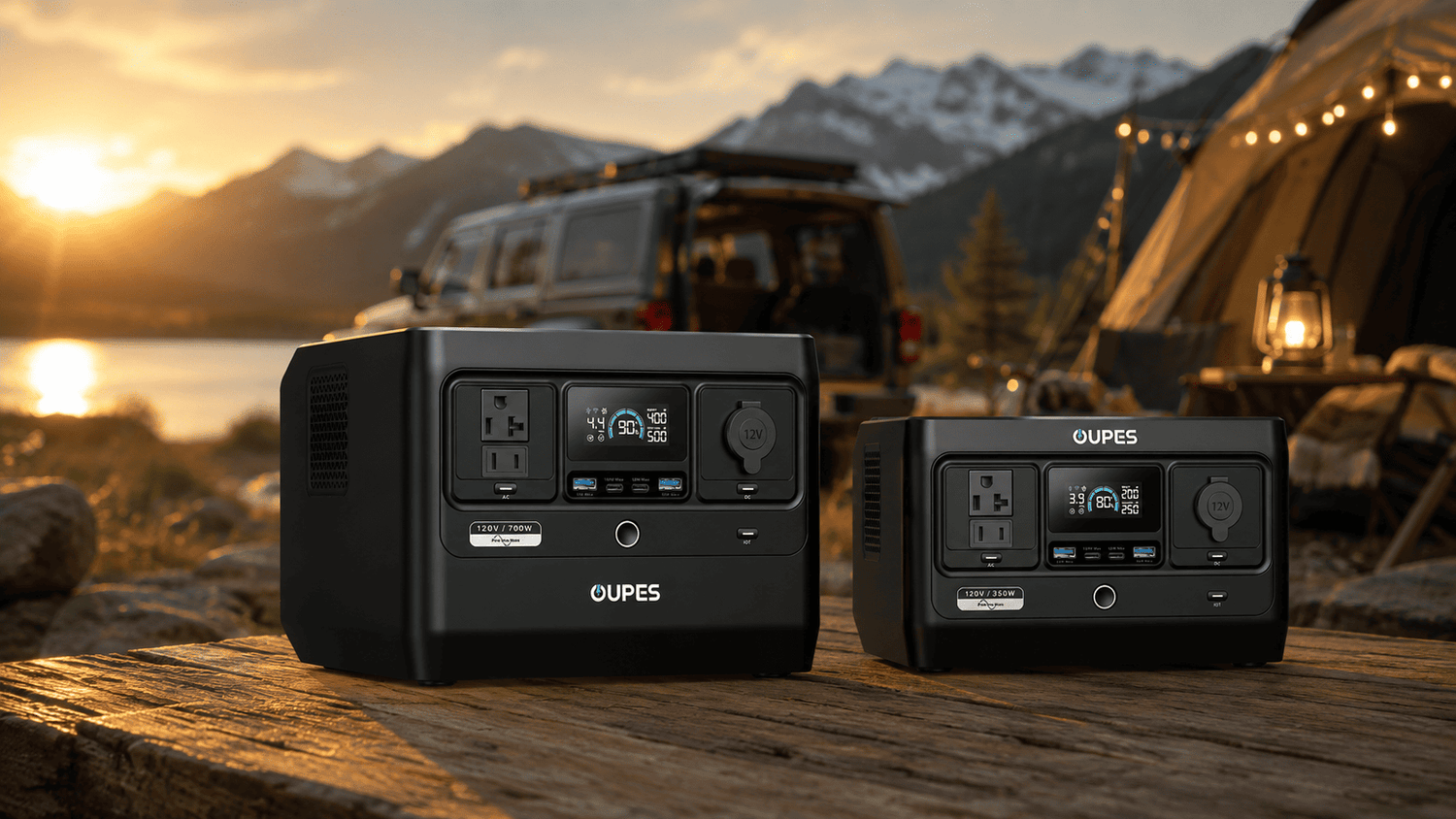
The Exodus 1200 is a compact 992Wh option for travelers whose daily budget and peak loads fit within 1,200W. The Mega 1 Lite has a similar 1,024Wh capacity but a 2,000W rated output and higher solar-input ceiling. That does not make its runtime dramatically longer at the same load; it primarily changes the loads and charging configurations the unit can support.
Choose Exodus when compact use and modest simultaneous demand define the trip. Choose Mega 1 Lite when the energy budget remains near 1kWh but short high-power loads require more output headroom. Neither includes a solar panel or extra battery in the standalone package.
Review the budget after each trip. Compare starting and ending charge, hours driven, solar conditions, and the loads that used more energy than expected. A few real travel days produce a better model than catalog estimates. Update the conservation list before the next remote stay, and avoid adding new appliances without recalculating both peak watts and daily watt-hours.
Keep a modest reserve for navigation, communication, and an unexpected night away from shore power. That reserve should not be casually assigned to cooking or entertainment. A clear minimum charge threshold makes the travel plan easier to follow.
Frequently Asked Questions
How many watt-hours does van life need?
It depends on refrigeration, work hours, cooking choices, climate, and time between charges. Measure a normal day and a conservation day. Do not use a universal van-life number as a substitute for a load table.
Is 1,000Wh enough for a van?
It can be enough for managed electronics, lighting, and efficient refrigeration with regular charging, but it may be inadequate for electric cooking or long stationary periods. Account for losses and reserve.
Can I run a refrigerator overnight?
Possibly, if startup demand and measured overnight energy fit the unit. Ambient temperature, thermostat setting, ventilation, and door openings affect consumption, so calculate from the exact refrigerator.
Can a power station connect to an RV inlet?
Do not assume it has a dedicated 30A or 50A outlet. Check the documented receptacles, van or RV instructions, grounding requirements, and any approved adapter before connecting equipment.
Should I prioritize capacity or output?
First meet simultaneous and startup watts, then choose enough watt-hours for time between charges. Extra output does not extend runtime, and extra capacity cannot operate an oversized load.
Where should the unit ride?
Use a secure, dry, ventilated position where the unit cannot become loose cargo or block an exit. Follow its storage temperature and orientation instructions and protect ports and cables.
Conclusion
Van-life power becomes manageable when you calculate a full day, schedule peaks, diversify charging, and reserve safe storage space. Exodus 1200 favors compact, modest loads; Mega 1 Lite provides more output headroom in a similar capacity class. Choose from your measured routine, not a generic van package.

OUPES Exodus 1200 Portable Power Station
- Standalone portable power station
- 992Wh battery capacity
- 1,200W rated output
- Up to 240W solar input


Leave a comment
This site is protected by hCaptcha and the hCaptcha Privacy Policy and Terms of Service apply.