




Best Camping Air Conditioner by Shelter
The best camping air conditioner depends first on the shelter. A small tent benefits from a compact, low-draw compressor unit only when exhaust and condensation can be managed. A van may favor an integrated DC unit, while an RV can support a larger inverter rooftop or portable AC. In dry desert air, an evaporative cooler can be efficient, but it is not reliable in humidity.
| Shelter | Best starting category | Key requirement |
|---|---|---|
| Small tent | Compact compressor AC or fan in mild weather | Dedicated vent port and rain-safe electrical setup |
| Car/SUV sleep platform | Compact DC or efficient portable AC | External exhaust and battery kept outside sleeping space where directed |
| Camper van | DC rooftop or inverter compressor AC | Roof structure, insulation, and large battery |
| Travel trailer/RV | Inverter rooftop, window, or dual-hose portable AC | Electrical circuit and condensate management |
| Open canopy | Fan or evaporative cooling in dry air | AC cannot effectively cool an open space |
Choose the Right Cooling Technology
| Technology | Can cool below ambient? | Removes humidity? | Energy demand |
|---|---|---|---|
| Compressor air conditioner | Yes | Yes | Moderate to high |
| Evaporative cooler | In dry air only | No; adds moisture | Low |
| Thermoelectric personal cooler | Limited local effect | Limited | Low to moderate |
| Fan | No | No | Very low |
Do not expect ice-box “air conditioners” to cool a sealed tent for hours. They provide local cool airflow while ice melts, not continuous heat rejection.
Size the Cooling Load
ENERGY STAR recommends matching room AC capacity to the area because oversized equipment can dehumidify poorly. Camping shelters add unusually high solar gain and air leakage, so square-foot charts must be adjusted.
| Factor | Effect | Response |
|---|---|---|
| Direct sun | Strong fabric and roof heat gain | Shade first |
| Thin walls | Rapid heat transfer | Add safe reflective fly and insulation |
| Humidity | More latent load | Favor compressor AC and drain capacity |
| Frequent openings | Loses cooled air | Create a small controlled zone |
| Multiple sleepers | Adds heat and moisture | Include normal occupancy |
Plan Power and Runtime
Cooling BTU/h and electrical watts are different. Use the AC’s measured average input and estimate runtime as capacity × 0.85 ÷ watts.
| AC average load | 1,024Wh battery | 2,048Wh battery | 3,072Wh battery |
|---|---|---|---|
| 400W | 2.18h | 4.35h | 6.53h |
| 700W | 1.24h | 2.49h | 3.73h |
| 1,000W | 0.87h | 1.74h | 2.61h |
Check compressor startup separately. Cycling, heat, air leakage, battery temperature, and other loads change real results.
Camping AC Scorecard
| Criterion | What good looks like | Red flag |
|---|---|---|
| Efficiency | Verified watts and SACC/CEER data | Only a headline BTU claim |
| Exhaust | Sealed, short, outdoor path | Hot air discharged into shelter |
| Condensate | Drain/tank suitable for humidity | No plan for overflow |
| Noise | Comparable dB rating in sleep mode | Unspecified test conditions |
| Weather | Equipment protected as manual requires | Power station left in rain |
| Transport | Stable and secured | Refrigerant unit transported loose |
OUPES Product Recommendations
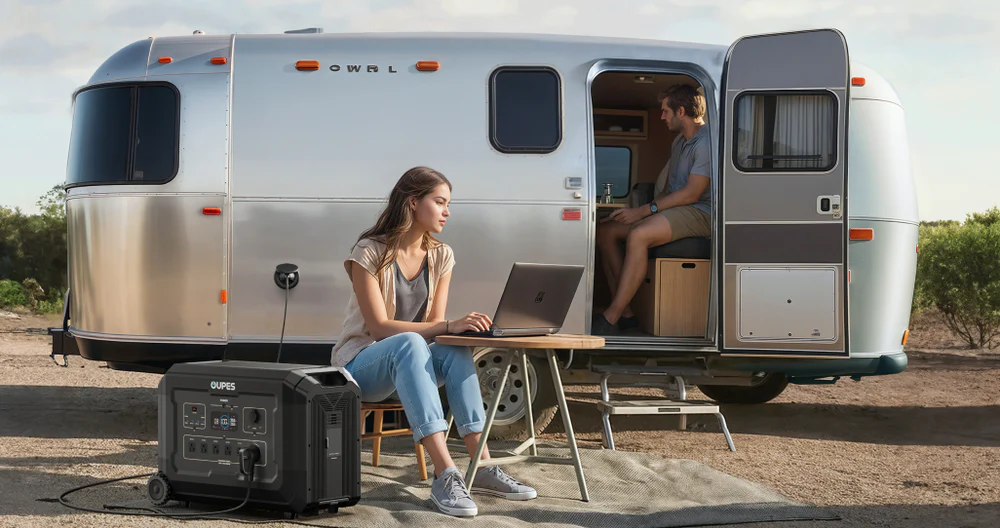
For outdoor portability, Mega 1 Lite is the lightest-capacity match in this database. Mega 2 Pro is the recommended balance for compact camping AC, and Mega 3 suits larger trailer loads.
| Model | Capacity | Output | Recommended cooling role |
|---|---|---|---|
| Mega 1 Lite | 1,024Wh | 2,000W; 4,500W surge | Short, low-draw tent or vehicle cooling |
| Mega 2 Pro | 2,048Wh | 2,500W; 3,600W boost | Best general vehicle-camping match |
| Mega 3 | 3,072Wh | 3,600W; 7,000W surge | Travel trailer and longer sessions |
A compatible solar generator can extend daytime operation, but solar weather variability requires stored reserve.
Battery-Life Comparison
| Battery | Cycle life | Physical safety |
|---|---|---|
| OUPES LiFePO4 | 3,500+ cycles for Mega 1 Lite/Mega 3; 4,000+ for Mega 2 Pro | Stable phosphate cathode makes severe thermal runaway difficult to initiate |
| Generic ternary lithium-ion | Often 500–800 cycles | Generally lower thermal stability |
No lithium battery is risk-free. Follow ventilation, water-protection, impact, and temperature instructions.
Improve Comfort Without More AC
- Camp at elevation or in shade when conditions allow.
- Set up before the shelter heat-soaks.
- Use a reflective fly with an air gap.
- Ventilate until outdoor air becomes hotter than the controlled space.
- Use low-watt circulation fans.
- Cool only the sleeping zone.
Safety and Weather Planning
Check National Weather Service heat guidance. If heat is dangerous, relocate to dependable air conditioning. Keep condensate away from electricity, do not block ventilation, and never use a combustion generator or fuel-burning cooling/heating appliance inside a tent or vehicle.
Frequently Asked Questions
What camping AC works best in humidity?
A compressor air conditioner that exhausts outdoors and manages condensate is more reliable than evaporative cooling.
Can a fan cool a tent?
It improves air movement and perceived comfort but does not reduce air temperature below ambient.
Can I use a room portable AC in a tent?
Only with safe exhaust, condensate, weather, electrical, and airflow provisions allowed by both manufacturers.
How long will a 2,048Wh station run 700W AC?
About 2.49 hours using an 85% planning factor, before considering changing conditions.
Is a bigger AC better?
No. Oversizing wastes energy and can reduce humidity removal; control heat gain and size appropriately.
Can I sleep with camping AC running?
Only when the equipment is approved for the setup, stable, dry, correctly vented, and not dependent on combustion.