




Power outages are no longer rare or short-lived. Extreme weather, grid overloads, and aging infrastructure have made home power interruptions increasingly common. For many households, a portable power station combined with solar panels has become a practical, flexible solution for maintaining electricity during outages.
This guide is designed to help homeowners choose the best portable power station with solar panels for home use. Rather than focusing on technical jargon, we take a scenario-oriented, user-guided approach—explaining what matters most, how to match capacity to real needs, and how to build a reliable, long-term home backup solution.
Why Homes Need Portable Power Stations with Solar Panels
Traditional backup solutions often rely on fuel, fixed installation, or complex maintenance. Portable power stations with solar panels offer a different approach—one that prioritizes flexibility, safety, and sustainability.
For homeowners, these systems provide:
- Emergency power during blackouts
- Energy independence from the grid
- Safe indoor operation without emissions
- Quiet performance suitable for residential areas
- Scalable capacity without permanent installation
By combining battery storage with renewable solar energy, homeowners can stay prepared without relying solely on external fuel or infrastructure.
Common Home Power Outage Scenarios
Understanding how outages affect daily life helps determine what kind of power station you need.
- Short outages (1–4 hours): Lighting, internet, and device charging
- Day-long outages: Refrigerators, freezers, routers, and cooking appliances
- Multi-day outages: Medical equipment, heating controls, and essential electronics
- Severe weather events: Combined heating, communication, and food preservation needs
A well-chosen power station ensures continuity across all these scenarios.
Key Factors to Consider When Choosing a Home Power Station
Battery Capacity and Runtime
Battery capacity, measured in watt-hours (Wh), determines how long your power station can run essential devices.
As a general guideline:
- 1000Wh: Phones, lights, router, small appliances
- 2000–3000Wh: Refrigerator, freezer, multiple devices
- 5000Wh+: Extended outages and higher household demand
Always calculate daily energy consumption and add a buffer of 20–30% for safety.
AC Output and Surge Power
Output power determines which appliances you can run. Many home devices require high startup (surge) power, even if their running wattage is lower.
- Refrigerators and freezers
- Microwaves and kettles
- Power tools and pumps
Choose a power station with sufficient continuous output and surge capacity to handle these loads without interruption.
Solar Charging Capability
Solar input capacity defines how quickly you can recharge during an outage. A higher solar input allows faster recovery and better performance during extended blackouts.
For home backup:
- Lower solar input suits short outages
- High solar input is critical for multi-day emergencies
Efficient solar charging reduces reliance on the grid and increases resilience.
Battery Chemistry and Lifespan
Battery chemistry directly affects safety and longevity. Lithium iron phosphate (LFP) batteries are widely preferred for home use because they:
- Offer over 3500 charge cycles
- Provide stable performance under load
- Have enhanced thermal and chemical safety
A longer battery lifespan translates into lower long-term cost and better reliability.
Safety and Indoor Use
Home backup systems must be safe for indoor operation. Battery-based power stations produce no emissions and operate quietly, making them suitable for bedrooms, living rooms, and apartments.
Built-in protection systems further ensure safe use around family members and sensitive electronics.
How to Choose the Right Solar Panels for Home Backup
Solar panels are the energy source that keeps your power station running during prolonged outages.
When selecting solar panels for home use, consider:
- Total wattage relative to battery capacity
- Available outdoor space (yard, balcony, rooftop)
- Sunlight availability and seasonal variation
- Ease of setup and storage
For effective home backup, solar input should ideally cover daily energy consumption to maintain system balance.
OUPES MEGA Series for Home Backup Power
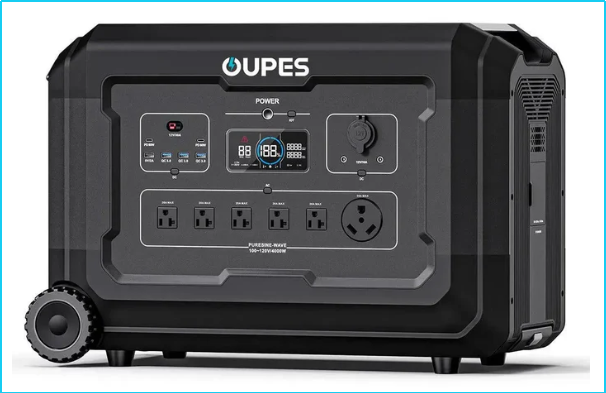
The OUPES MEGA series is designed to meet diverse home backup needs, from essential device support to extended outage protection. All models share core features:
- LFP batteries with long cycle life
- High AC output and strong surge capacity
- Solar, AC, and hybrid charging support
- Expandable capacity options
- UPS/EPS functionality for critical devices
This flexibility allows homeowners to choose a system that fits current needs while remaining expandable for the future.
MEGA Series Home Backup Comparison Table
| Model | Base Capacity | AC Output | Max Solar Input | Expandable Capacity | Best Home Use Case |
|---|---|---|---|---|---|
| MEGA 1 | 1024Wh | 2000W | 800W | Up to 5120Wh | Essential devices, short outages |
| MEGA 2 | 2048Wh | 2500W | 2100W | Up to 10.24kWh | Family backup, refrigeration |
| MEGA 3 | 3072Wh | 3600W | 2100W | Up to 15.36kWh | Multi-room backup, medical devices |
| MEGA 5 | 5040Wh | 4000W | 2100W | Up to 45.36kWh | Extended outages, whole-home support |
Practical Setup Tips for Home Use
To maximize effectiveness:
- Place the power station in a well-ventilated indoor area
- Pre-connect essential appliances for quick access
- Test solar charging before emergencies
- Monitor power usage during outages
- Recharge immediately when grid power returns
Routine testing ensures your system performs reliably when needed.
Common Mistakes Homeowners Make
- Underestimating daily energy consumption
- Ignoring surge power requirements
- Choosing capacity without solar planning
- Failing to test the system before emergencies
- Overpaying for unused capacity
Avoiding these mistakes leads to a more balanced and cost-effective solution.
Frequently Asked Questions
1. Is a portable power station enough for home backup?
Yes, for essential loads and emergency use.
2. Can I run a refrigerator during an outage?
Yes, with sufficient capacity and output.
3. Are solar panels required?
They are optional but highly recommended for extended outages.
4. Is it safe to use indoors?
Yes. Battery-based systems produce no emissions.
5. How long do LFP batteries last?
Typically over 8–10 years of regular use.
6. Can capacity be expanded later?
Yes, expandable systems allow future upgrades.
7. Does weather affect solar charging?
Yes, but solar still works under cloudy conditions.
8. Should I leave the unit plugged in?
Occasional charging is recommended to maintain battery health.
Final Thoughts
Choosing the best portable power station with solar panels for home use is about preparation, not fear. By understanding your household’s real energy needs and selecting a scalable, safe solution, you can protect comfort, safety, and independence during power outages. A well-chosen system offers peace of mind—today and for years to come.