




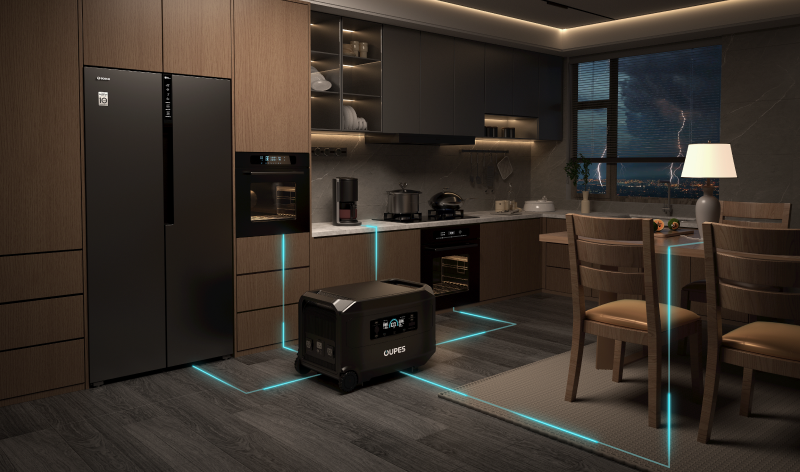
Choosing a solar home portable generator is no longer just about buying the biggest battery or the highest wattage. For most households, the right choice depends on how electricity is actually used during outages, how long backup power is needed, and whether the system can be expanded or replenished with solar energy.
This guide explains how to choose a solar home portable generator from a practical, educational perspective. Instead of comparing dozens of products, it focuses on two complete and realistic home-ready solutions: the OUPES Mega 5 + B5 Battery + 2×240W Solar Panel bundle and the OUPES Guardian 6000 + G5 Battery + 2×240W Solar Panel bundle.
Quick Navigation
- What is a solar home portable generator?
- Key factors to consider before choosing
- Understanding power levels for home use
- Scenario-based choice: Mega 5 + B5 + 2×240W
- Scenario-based choice: Guardian 6000 + G5 + 2×240W
- Which bundle fits your home better?
- FAQ
1. What Is a Solar Home Portable Generator?
A solar home portable generator is a system that combines three essential components:
- A battery-based power station to store energy
- Solar panels to recharge the system using sunlight
- Power outputs to run household appliances and devices
Unlike traditional fuel generators, solar portable generators operate quietly, require no fuel storage, and can be used indoors. Their purpose is not to replace the grid entirely, but to provide reliable electricity for essential home needs during outages.
2. Key Factors to Consider Before Choosing
Before selecting a system, it helps to think in terms of real usage rather than specifications alone.
Output power
Output power determines how many devices can run at the same time and whether higher-demand appliances can be supported without overloading.
Usable capacity
Battery capacity determines how long essential devices can stay powered. Longer outages require either larger capacity or the ability to recharge.
Expandability
A system that supports expansion batteries allows households to scale up as needs grow, instead of replacing the entire setup later.
Solar recharging
Solar input is critical for multi-day outages. Even moderate solar capacity can significantly extend runtime when grid power is unavailable.
3. Understanding Power Levels for Home Use
Most households do not need to power everything at once during an outage. Typical priority loads include:
- Refrigerator or freezer (intermittent use)
- Wi-Fi router and communication devices
- Lighting and small electronics
- Television and basic entertainment
- Medical or mobility devices if required
The right solar generator supports these loads comfortably while leaving some margin for unexpected needs.
4. Scenario-Based Choice: OUPES Mega 5 + B5 Battery + 2×240W Solar Panel
This bundle is designed for households that want a balanced combination of portability, expandable capacity, and solar recharging for essential home power.
The Mega 5 serves as the core power station, while the B5 expansion battery increases total stored energy. The two 240W solar panels provide daytime recharging to offset daily consumption.
Why this setup works
- Provides a solid power level for essential appliances and electronics
- Expandable capacity allows longer runtime during outages
- Solar panels help preserve battery energy over multiple days
This type of system is well-suited for:
- Small to medium households
- Short to medium-length outages
- Users who want flexibility without installing a permanent system
5. Scenario-Based Choice: OUPES Guardian 6000 + G5 Battery + 2×240W Solar Panel
For homes with higher power demands or a desire for more comprehensive backup coverage, this bundle offers a more robust solution.
Guardian 6000 provides higher output and supports both 120V and 240V appliances. The G5 expansion battery significantly increases available energy, while the solar panels support ongoing recharging during extended outages.
Why this setup works
- Higher output power supports more appliances simultaneously
- Larger expandable capacity suits longer outages
- Solar input reduces dependence on stored energy alone
This system is more suitable for:
- Larger households
- Homes with higher baseline electricity needs
- Users planning for multi-day outages or severe weather events
6. Which Bundle Fits Your Home Better?
Rather than choosing based on specifications alone, consider how each bundle aligns with your household situation.
- Mega 5 + B5 + 2×240W: Best for essential home power, moderate loads, and flexible use where portability and expandability are key.
- Guardian 6000 + G5 + 2×240W: Best for higher-demand homes, longer outages, and scenarios requiring greater output and capacity.
Both setups share an important advantage: they allow you to adapt to outages without fuel, noise, or permanent installation.
FAQ
Q1: Do I need solar panels if I already have a large battery?
Solar panels are not mandatory for short outages, but they become very valuable for multi-day outages by replenishing energy during daylight hours.
Q2: Can these systems power an entire home?
They are designed to support essential and priority loads. With careful load management, they can maintain key household functions during outages.
Q3: How do I decide between Mega 5 and Guardian 6000?
Choose based on your power needs. Mega 5 fits essential-use scenarios, while Guardian 6000 is better for higher-demand and longer-duration backup.
Q4: Are these systems difficult to set up?
Both bundles are designed for straightforward setup without permanent installation, making them accessible for most households.
Q5: Is a solar portable generator a long-term solution?
Yes. With expansion batteries and solar charging, these systems can serve as reliable backup power for many years with proper use.