




Portable solar panels have become an increasingly popular power solution for camping. Whether you are staying at a developed campsite, camping off-grid, or traveling by RV, solar panels provide a quiet, renewable, and fuel-free way to keep essential devices running.
This article focuses on how to evaluate portable solar panels for camping from an educational perspective. It explains what really matters when choosing a camping solar panel and uses the OUPES 240W Portable Solar Panel and OUPES 100W Portable Solar Panel as practical examples.
Quick Navigation
- Why portable solar panels are ideal for camping
- Key factors when choosing a camping solar panel
- Matching solar wattage to camping power needs
- Understanding a 240W portable solar panel
- Understanding a 100W portable solar panel
- Which panel is right for your camping style
- FAQ
1. Why Portable Solar Panels Are Ideal for Camping
Camping often means limited or no access to the electrical grid. Portable solar panels solve this problem by converting sunlight into usable electricity without fuel, noise, or emissions.
For campers, the main benefits include:
- Silent operation compared to fuel-based generators
- No need to transport gasoline or propane
- Ability to recharge power stations during the day
- Reliable power in remote or off-grid locations
Solar panels do not replace batteries; instead, they extend how long stored power can be used during multi-day trips.
2. Key Factors When Choosing a Camping Solar Panel
Not all portable solar panels are equally suited for camping. Several practical factors matter more than brand names or marketing claims.
Portability and setup
- Foldable designs are easier to transport and store
- Integrated stands help angle panels toward the sun
- Quick setup saves time at camp
Durability and materials
- Weather-resistant surfaces handle outdoor use
- Protective layers reduce wear during transport
- Panels should tolerate occasional dust and moisture
Compatibility and efficiency
- Standard connectors allow use with different power stations
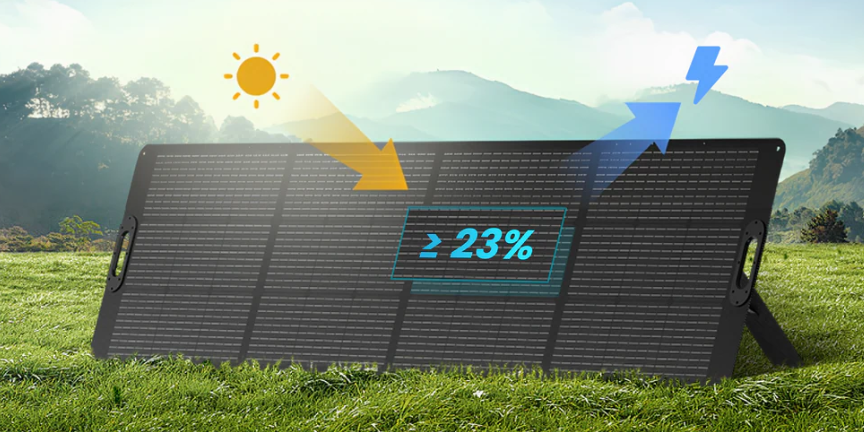
- Higher conversion efficiency improves performance in limited sunlight
- Stable output helps protect connected equipment
Understanding these factors makes it easier to choose the right wattage for your camping needs.
3. Matching Solar Wattage to Camping Power Needs
The “best” portable solar panel depends on how much energy you actually use while camping.
Typical camping power needs include:
- Phones, tablets, and cameras
- LED lights and headlamps
- Portable refrigerators or coolers
- Laptops, drones, or small appliances
Lower power usage favors smaller panels, while longer trips or higher-demand equipment benefit from higher-wattage panels.
4. Understanding the OUPES 240W Portable Solar Panel
A 240W portable solar panel is designed for campers who need faster recharging and more energy throughout the day.
The OUPES 240W Portable Solar Panel illustrates what higher-wattage camping panels are intended for:
- Providing higher daily energy output under good sunlight
- Supporting longer camping trips without grid access
- Recharging larger power stations more efficiently
This type of panel is especially useful for:
- Multi-day off-grid camping
- RV or van-based travel
- Running power-hungry devices such as portable fridges
Despite its higher output, portability remains important. Foldable construction and integrated stands help balance power and ease of transport.
5. Understanding the OUPES 100W Portable Solar Panel
A 100W portable solar panel focuses on simplicity, lightweight design, and convenience.
The OUPES 100W Portable Solar Panel represents an entry-level but highly practical option for camping:
- Easy to carry and quick to deploy
- Sufficient for charging small electronics
- Well-suited for short trips or minimalist setups
This wattage level works well for:
- Weekend camping trips
- Tent camping with limited gear
- Campers who primarily charge phones, lights, and small devices
While charging times are longer compared to higher-wattage panels, the trade-off is greater portability and simpler handling.
6. Choosing Between 240W and 100W for Camping
Rather than asking which panel is “better,” it is more useful to ask which panel fits your camping style.
- Choose a 100W panel if your trips are short, your power needs are modest, and portability is your top priority.
- Choose a 240W panel if you camp for multiple days, rely on electric coolers or laptops, or want to recharge larger power stations more quickly.
Some campers even combine panels over time as their needs evolve, starting small and expanding later.
FAQ
Q1: Can portable solar panels work on cloudy days?
Yes, but output will be reduced. Higher-wattage panels generally perform better under less-than-ideal sunlight because they start with more potential capacity.
Q2: Do I need solar panels if I already have a power station?
A power station stores energy, while solar panels replenish it. For multi-day camping, solar panels significantly extend usable power time.
Q3: Are portable solar panels difficult to set up?
Most modern portable panels are designed for quick setup. Foldable designs with built-in stands can be deployed in just a few minutes.
Q4: Is a higher-wattage panel always better?
Not necessarily. Higher wattage means more power, but also larger size and weight. The best choice depends on how much energy you actually need.
Q5: Which panel is better for beginners?
For beginners, a 100W portable solar panel is often a good starting point due to its simplicity and portability.