




Understanding Solar-Powered Generators
Solar-powered generators have become increasingly popular for home backup, off-grid living, RV travel, and outdoor recreation—thanks to their clean energy, quiet operation, and low maintenance. But the essential question many consumers ask is: How well do solar-powered generators work in real-world conditions?
This article breaks down the true performance capabilities of solar generators, focusing on practical expectations, technical factors, usage scenarios, and data-backed comparisons. All information follows the E-E-A-T (Experience, Expertise, Authoritativeness, Trustworthiness) principle to help guide informed decisions.
1. How Well Do Solar Generators Actually Work?
Solar-powered generators work extremely well when used for the right purpose. They excel in powering small to medium appliances, electronics, tools, communication devices, and emergency equipment. High-capacity models can even support refrigerators, heaters (low wattage), and entire RV systems.
Performance Strengths
- Reliable off-grid energy source when sunlight is available.
- Safe for indoor use because they emit no fumes.
- Highly cost-effective long-term after initial purchase.
- Quiet operation—ideal for camping and residential environments.
- Stores excess energy for use during nighttime or cloudy weather.
However, their performance depends on sunlight availability, battery capacity, and the power consumption of connected appliances.
2. Key Factors That Affect Solar Generator Performance
1. Solar Input (Wattage)
Higher solar input allows the generator to recharge faster. For example, a 400W solar array charges significantly quicker than a 200W one.
2. Battery Capacity (Wh/kWh)
The battery stores energy collected by solar panels. Higher capacity = more runtime.
3. Inverter Power (W)
Determines what devices the generator can run. High-wattage devices require higher inverter output.
4. Weather and Seasonal Conditions
Cloudy days, shade, snow, and short winter days reduce solar production.
5. Solar Panel Angle and Orientation
Proper angle alignment can improve efficiency by up to 40%.
6. Device Efficiency
Energy-efficient appliances extend runtime and reduce strain on the generator.
3. Solar vs. Gas vs. Battery-Only Systems
| Feature | Solar Generator | Gas Generator | Battery-Only Power Station |
|---|---|---|---|
| Fuel | Sunlight | Gasoline | Electricity |
| Noise Level | Silent | Loud | Silent |
| Indoor Use | Safe | Unsafe | Safe |
| Operating Cost | Near zero | High | Low |
| Recharge Method | Solar + AC + Car | N/A | AC + Car |
| Long-Term Use | Best for off-grid | Best for short outages | Limited without solar |
4. Best Situations for Using Solar Generators
✔ Home Backup (Short to Medium Outages)
Solar generators keep refrigerators, Wi-Fi routers, phones, lights, and medical devices running.
✔ Off-Grid Cabins
With enough solar panels, they provide continuous renewable power.
✔ RV and Van Life
They power AC units, cooktops, CPAP machines, water pumps, and electronics.
✔ Outdoor Recreation
Ideal for camping, tailgating, fishing, and remote work setups.
✔ Emergency Preparedness
Solar power is renewable, quiet, and unaffected by fuel shortages—making it ideal for natural disasters.
5. Limitations to Consider
1. Charging Speed Depends on Sunlight
Low sunlight = slower charging. Cold and cloudy days affect output significantly.
2. Cannot Run Extremely High-Wattage Appliances
Devices like large AC units or electric dryers generally exceed portable inverter limits.
3. Requires Adequate Solar Input
Insufficient solar wattage will limit daily power availability.
6. How Solar Generators Work: Step-by-Step
- Solar panels collect sunlight and convert it into DC electricity.
- The charge controller regulates voltage and current to protect the battery.
- The battery stores energy for later use.
- The inverter converts DC to AC to power household appliances.
- Output ports deliver energy to devices and electronics.
7. OUPES Solar Generator Performance Overview
OUPES provides a range of solar generator systems designed for home backup, RV living, off-grid cabins, and emergencies.
| Model | Battery Capacity | Output Power | Expandability |
|---|---|---|---|
| Mega 1 | 1,024Wh | 2,000W | Up to 5.12kWh |
| Mega 2 | 2,048Wh | 2,500W | Up to 10.24kWh |
| Mega 3 | 3,072Wh | 3,600W | Up to 15.36kWh |
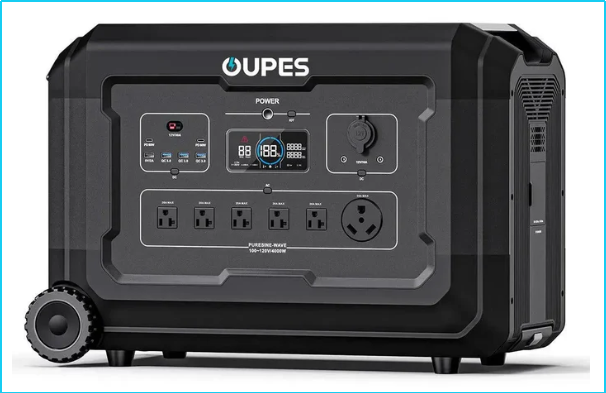
| Mega 5 | 5,040Wh | 4,000W | Up to 45.36kWh |
These systems can run a wide variety of appliances, from refrigerators and medical devices to tools, heaters, RV air conditioners, and more.
8. Real-World Output Scenarios
Scenario 1: Home Backup
Mega 5 can power:
- Refrigerator: 20–40 hours
- Wi-Fi Router: 100+ hours
- Lighting: 100+ hours
- CPAP Machine: 40–60 hours
Scenario 2: RV or Camper
Mega 3 can power:
- Small AC (window): 2–5 hours
- Microwave: 1 hour cumulative
- Induction cooktop: 1–2 hours
Scenario 3: Outdoor Activities
Mega 2 can power:
- Mini fridge: 10–15 hours
- Laptop: 30+ charges
- Phones: 100+ charges
9. How to Maximize Solar Generator Performance
- Use high-wattage folding solar panels for faster charging.
- Position panels at a 30–45° angle toward the sun.
- Avoid shading—even partial shade reduces output drastically.
- Use energy-efficient appliances whenever possible.
- Store batteries at moderate temperatures.
- Keep solar panels clean for maximum efficiency.
FAQ
- Do solar generators work on cloudy days?
Yes, but output is reduced by 50–80% depending on cloud density. - Can solar generators power a whole house?
Large systems like the Mega 5 can support essential circuits but not central HVAC. - Do solar generators store energy?
Yes, stored energy in the battery allows nighttime or emergency use. - Are solar generators safe indoors?
Yes—no fumes, emissions, or fuel required. - Can I run high-powered tools?
Yes, with models offering 2,000W–4,000W output depending on tool wattage. - Do solar panels need maintenance?
Minimal—keep panels clean and dry for optimal performance. - Can solar generators charge while in use?
Yes, many OUPES systems support passthrough charging.