




Why Choosing the Right Portable Power Station Matters
Portable power stations are no longer just camping gadgets — they’ve become essential tools for home backup, road life, off-grid living, medical device power support, and emergency preparedness. Selecting the right one determines how long you can run key appliances, how reliably you stay powered, and how effectively you manage energy when the grid isn’t available.
A poorly matched unit can leave your refrigerator off, your CPAP unplugged, or your RV without power. The right model keeps your devices running smoothly, silently, and cleanly — no fumes, no fuel, and no noise.
1. Battery Capacity & Runtime
Battery capacity (measured in Wh/kWh) determines how long your station can power appliances. Higher capacity means longer runtime — essential for outages, RV living, and continuous medical device support.
How battery capacity translates into runtime
Runtime (hours) ≈ Battery Capacity (Wh) ÷ Device Load (W)
| Appliance | Average Watts | Battery Required for 8hrs Usage |
|---|---|---|
| CPAP Machine | 30–60W | 240–480Wh |
| Laptop | 60–100W | 480–800Wh |
| Mini Refrigerator | 60–120W | 480–960Wh |
| Portable Heater (short use) | 1000–1500W | 8000–12000Wh |
If you only power small devices, 1,000Wh may be enough. For whole-home backup or RV air conditioning, larger 3–5kWh systems perform far better.
2. Output Power & Surge Handling
Output power determines what you can run. A power station should exceed the combined wattage of your devices — especially those with surge requirements.
Typical device wattage needs:
- Phone / Camera charging: 10–30W
- Laptop / Router: 40–120W
- Mini fridge: 60–120W
- Microwave: 800–1500W
- Induction cooker / Heater: 1200–2000W+
Always check continuous power vs surge rating. Motors (fridges, pumps, A/C compressors) require extra surge headroom.
3. Battery Chemistry & Lifespan
The most common chemistries are Lithium-ion (lightweight) and LiFePO4 (long lifespan and safer thermal stability). For long-term reliability and daily charging, LiFePO4 is the preferred standard.
| Battery Type | Cycle Life | Advantages |
|---|---|---|
| Lithium-ion | ~500 cycles | Lightweight, fast charge |
| LiFePO4 (OUPES uses) | 3000–3500+ cycles | Long life, safer chemistry, stable in temperature |
4. Number & Type of Output Ports
More ports = more flexibility. A good portable power station supports multi-device use including AC outputs, USB-C PD charging, 12V outlets for car appliances, and high-watt ports for kitchen appliances.
- AC outlets for refrigerators, A/C units, microwaves
- USB-C PD 60W/100W for laptops, drones, tablets
- DC ports for car refrigerators and CPAP machines
- Anderson / XT60 for RV and solar integration
5. Charging Methods & Speed
The best power stations support multi-source charging. The faster the recharge, the less downtime you experience.
- Solar charging — free, renewable, off-grid friendly
- AC wall charging — fastest recovery before emergencies
- Car charging — useful while driving
Choose models with high solar input capacity if off-grid camping is frequent.
6. Size, Weight & Portability
Power increases weight — but not all large units are difficult to move. Ergonomic handles, wheels, and modular battery design help maintain mobility while still supporting large power demands.
Good portability indicators
- Weight below 30 lbs for lightweight travel units
- Wheeled units for home backup systems
- Modular battery support for scalable power
7. Safety Features & Certifications
Safety matters when electricity powers your home, RV, or medical devices. Choose power stations with protective circuits and verified safety protocols.
- BMS protection (overload, overheat, short circuit)
- Temperature regulation for winter/summer stability
- Fire-safe LiFePO4 chemistry
- Pass-through charging support
Real-Life Application Scenarios
Home Backup Power
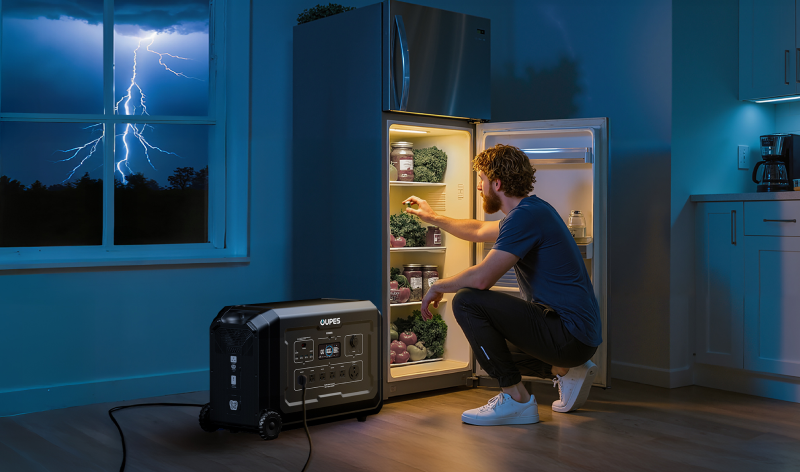
Keeps refrigerators, lights, Wi-Fi, medical devices, and small cooking appliances running during grid failure.
Camping & Road Trips
Silent, fume-free power for portable fridges, fans, heaters, cameras, and phone charging anywhere outdoors.
RV/Van Living
Essential for boondocking — supports A/C, induction cooking, CPAP, and entertainment electronics.
Work & Construction Use
Power tools such as drills, saws, air compressors — without needing a fuel generator.
Recommended OUPES Portable Power Stations
| Model | Capacity (Wh) | Output Power | Best For |
|---|---|---|---|
| Mega 1 | 1024Wh | 2000W | Camping / weekend backup |
| Mega 2 | 2048Wh | 2500W | RV trips & extended use |
| Mega 3 | 3072Wh | 3600W | More appliances & inverter headroom |
| Mega 5 | 5040Wh | 4000W | Whole-home & heavy loads |
Quick Comparison Chart
| Feature | Light Use | RV/Outdoor | Home Backup | Whole-House |
|---|---|---|---|---|
| Recommended Model | Mega 1 | Mega 2 | Mega 3 | Mega 5 |
| Runs refrigerator | ✔ | ✔ | ✔✔ | ✔✔✔ |
| Powers cooktop/A/C | ✖ | Limited | Mid-range | Full support |
FAQ
- How big of a power station do I need? Sum wattage of your devices, then add 20–30% headroom.
- Is LiFePO4 worth paying extra for? Absolutely — lifespan is 5–7× longer than standard lithium.
- Can portable stations run heaters? Yes, but heaters draw high power — larger models are recommended.
- Do power stations work in winter? Yes — LiFePO4 performs well with proper thermal control.
- Can I use solar, AC, and car charging? Yes — multi-source charging is supported for reliable power.
- Is it safe indoors? Yes — no fumes, no gasoline, zero emissions.
- How long do they last? 3,000–3,500+ cycles — often more than 10 years with care.