




Living off the grid is no longer limited to remote wilderness cabins or extreme survivalists. Today, off-grid solar panel kits with batteries and inverters are increasingly used for home backup, remote living, cabins, RVs, and emergency preparedness. As power outages become more frequent and energy independence more appealing, many households are exploring off-grid solar as a practical, long-term solution.
This article provides a detailed, scenario-oriented explanation of off-grid solar panel kits. Rather than focusing on technical jargon, it guides you through how these systems work, when they make sense, and how to choose the right configuration for your home backup or remote living needs.
What Is an Off-Grid Solar Panel Kit?
An off-grid solar panel kit is a self-sufficient power system that operates independently from the utility grid. Unlike grid-tied systems, off-grid setups generate, store, and deliver electricity entirely on their own.
A complete off-grid kit typically includes:
- Solar panels to generate electricity
- A battery system to store energy
- An inverter to convert DC power into AC power
- A charge controller to manage solar input
Together, these components allow a home or remote location to maintain electricity without relying on external power infrastructure.
Why More People Choose Off-Grid Solar Systems
There are several reasons why off-grid solar systems are gaining popularity:
- Increased power outages caused by extreme weather
- Desire for energy independence
- Rising utility costs and grid instability
- Growth of remote work and off-grid lifestyles
- Need for reliable power in remote locations
For many users, off-grid solar is not about completely disconnecting from modern life, but about ensuring reliability, resilience, and control over energy supply.
Core Components of an Off-Grid Solar Kit
Understanding each component helps you evaluate system performance and suitability.
Solar Panels
Solar panels are the energy source of an off-grid system. They convert sunlight into direct current (DC) electricity.
Panel output is measured in watts (W). Common panel sizes for off-grid systems include:
- 200W panels for small systems
- 400W panels for medium home backup
- Multiple-panel arrays for extended off-grid living
The total panel capacity determines how much energy your system can generate each day.
Battery Storage
Batteries store solar energy for use at night, during cloudy weather, or when energy demand exceeds solar production.
Modern off-grid systems typically use lithium iron phosphate (LFP) batteries because they:
- Offer long cycle life (over 3500 cycles)
- Provide stable performance under load
- Require minimal maintenance
- Are safer for indoor use
Battery capacity is measured in watt-hours (Wh) or kilowatt-hours (kWh).
Inverter
The inverter converts stored DC electricity into AC electricity, which is required by most household appliances.
In off-grid systems, inverter capacity determines:
- Which appliances can be powered
- How many devices can run simultaneously
- Whether high-surge appliances can start reliably
Pure sine wave inverters are preferred for off-grid use, as they protect sensitive electronics and ensure stable operation.
Charge Controller
The charge controller regulates the flow of electricity from solar panels to batteries. It prevents overcharging and improves system efficiency.
Most modern off-grid kits use MPPT (Maximum Power Point Tracking) controllers, which maximize energy capture under varying sunlight conditions.
Real-World Use Scenarios
Home Backup Power
For homeowners, off-grid solar kits provide reliable backup power during outages.
Typical home backup applications include:
- Refrigerators and freezers
- Lighting and internet equipment
- Medical devices
- Basic kitchen appliances
Unlike fuel-powered generators, solar kits operate quietly and safely indoors, making them ideal for residential use.
Remote Living and Cabins
Remote cabins and off-grid homes often lack access to utility power. In these scenarios, off-grid solar is not just a backup—it is the primary power source.
Off-grid kits support:
- Daily household electricity needs
- Water pumps and communication systems
- Lighting, refrigeration, and electronics
With proper sizing, solar energy can provide year-round reliability even in isolated locations.
RV, Vanlife, and Mobile Homes
Mobile lifestyles demand flexible and efficient power solutions. Off-grid solar kits are widely used in:
- RVs and camper vans
- Tiny homes on wheels
- Mobile workshops and offices
Solar allows users to stay powered without hookups, reducing dependence on campgrounds or fuel.
How to Size an Off-Grid Solar System
System sizing is the most important step in off-grid planning. An undersized system leads to frequent power shortages, while an oversized system increases cost unnecessarily.
Basic sizing steps:
- List all appliances and devices
- Estimate daily energy consumption (Wh)
- Determine peak power requirements (W)
- Account for solar availability and weather
A balanced system matches daily solar production with daily energy usage, with enough battery capacity for at least one to two days of autonomy.
Understanding Daily Energy Production and Usage
Solar production depends on panel wattage and peak sun hours.
Example:
- 400W solar panels
- 5 peak sun hours
400W × 5 hours = 2,000Wh (2kWh) per day
This energy can support:
- Refrigeration
- Lighting
- Computers and communication devices
Battery storage ensures this energy remains available at night or during poor weather.
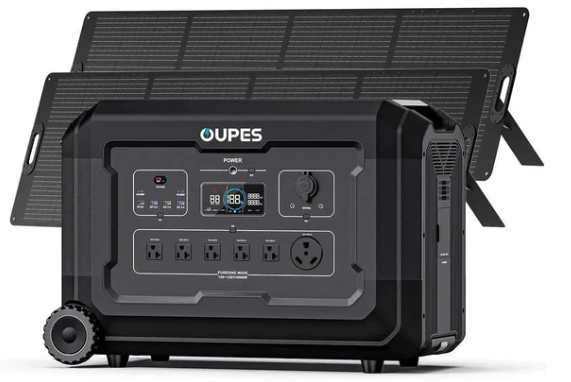
Off-Grid Power Solutions with OUPES
OUPES offers portable power stations designed to function as the core of off-grid solar systems. These systems integrate:
- High-capacity LFP battery storage
- Pure sine wave inverters
- Advanced MPPT solar charge controllers
- Multiple input and output options
OUPES solutions allow users to build scalable off-grid systems without complex installation or permanent infrastructure. They are suitable for both home backup and remote living applications.
Example Off-Grid System Configuration Table
| System Size | Solar Input | Battery Capacity | Typical Use Case |
|---|---|---|---|
| Small | 400W | 1–2kWh | Basic home backup |
| Medium | 800–1200W | 3–5kWh | Cabins, RV living |
| Large | 2000W+ | 10kWh+ | Full off-grid homes |
Practical Installation and Usage Tips
- Place solar panels where shading is minimal
- Angle panels for seasonal sunlight optimization
- Keep batteries in temperature-stable environments
- Monitor energy usage regularly
- Test the system before relying on it full-time
Routine monitoring helps ensure consistent performance and long-term reliability.
Common Off-Grid Solar Mistakes to Avoid
- Underestimating daily energy consumption
- Ignoring seasonal sunlight variation
- Choosing insufficient battery capacity
- Overloading the inverter
- Failing to plan for future expansion
Avoiding these mistakes significantly improves user satisfaction and system lifespan.
Frequently Asked Questions
1. Can an off-grid solar kit power a home?
Yes, with proper sizing and storage.
2. Is off-grid solar reliable in winter?
Yes, though production may be lower.
3. How long do batteries last?
LFP batteries often last 8–10 years or more.
4. Can systems be expanded later?
Yes, modular designs allow easy expansion.
5. Is off-grid solar safe indoors?
Yes, battery-based systems produce no emissions.
6. Do I need professional installation?
Portable systems often do not.
7. What happens during cloudy days?
Batteries supply stored energy.
8. Is off-grid solar worth it?
Yes, for reliability, independence, and remote living.
Final Thoughts
An off-grid solar panel kit with a battery and inverter offers a powerful solution for home backup and remote living. By combining renewable energy generation with reliable storage and conversion, these systems provide independence, resilience, and peace of mind.
Whether you are preparing for outages, living remotely, or embracing an off-grid lifestyle, a well-designed solar kit can deliver consistent, clean power where the grid cannot. With thoughtful planning and the right components, off-grid solar becomes not just an alternative—but a dependable energy foundation.