




“How long does it take for a 200W solar panel to charge a battery?” is one of the most frequently asked questions among people exploring solar power for camping, home backup, RV travel, or emergency preparedness. It’s a high-interest topic because 200W solar panels are affordable, portable, and widely used.
However, the answer is not a single number. Charging time depends on several real-world factors, including battery size, sunlight conditions, system efficiency, and how the power is being used while charging. This article breaks the question down step by step, using practical examples and user-guided explanations to help you estimate charging time accurately.
The Short Answer (And Why It’s Not That Simple)
Under ideal conditions, a 200W solar panel can produce about 1,000Wh (1kWh) of energy per day.
So:
- A 500Wh battery may charge in about half a day
- A 1,000Wh battery may charge in about one full sunny day
- A 2,000Wh battery may take two or more days
But this assumes ideal sunlight, no losses, and no power usage during charging—which rarely happens in real life. That’s why understanding the details matters.
How Solar Panels Charge a Battery
A solar panel does not charge a battery directly in a simple way. Instead, the process looks like this:
- Sunlight hits the solar panel
- The panel produces DC electricity
- A charge controller regulates the power
- Electricity is stored in the battery
Each step introduces small efficiency losses. Modern systems use MPPT (Maximum Power Point Tracking) technology to reduce these losses and capture as much energy as possible from the panel.
Key Factors That Affect Charging Time
Battery Capacity
Battery capacity is measured in watt-hours (Wh). The larger the battery, the longer it takes to charge.
Examples:
- 300Wh battery: small electronics
- 1,000Wh battery: camping or emergency use
- 2,000Wh+ battery: home backup or RV use
A 200W solar panel will always charge a smaller battery faster than a larger one.
Peak Sun Hours
Peak sun hours represent how many hours per day sunlight is strong enough for solar panels to operate near their rated output.
Typical averages:
- Sunny regions: 5–6 peak sun hours
- Mixed weather regions: 3–5 peak sun hours
- Cloudy regions: 2–4 peak sun hours
More peak sun hours directly translate to faster charging.
System Losses and Efficiency
No solar system is 100% efficient. Losses occur due to:
- Charge controller inefficiency
- Cable resistance
- Heat
- Battery charging limits
In practice, you should expect about 75–85% of a panel’s rated output to reach the battery.
Battery Chemistry
Different battery chemistries accept charge at different speeds.
- LFP (LiFePO₄): High efficiency, fast charging
- Lithium-ion: Efficient but more temperature-sensitive
- Lead-acid: Slower charging, lower usable capacity
Modern portable power stations typically use LFP batteries, which maximize the usable energy from a 200W solar panel.
Simple Math: Estimating Charging Time
Here is a practical formula:
Charging Time (hours) = Battery Capacity (Wh) ÷ Effective Solar Output (W)
Example:
- Battery: 1,000Wh
- Solar panel: 200W
- Efficiency: ~80%
Effective output ≈ 160W
1,000Wh ÷ 160W ≈ 6.25 hours of peak sunlight
That usually means one full sunny day.
Real-Life Scenarios with a 200W Solar Panel
Charging Small Batteries
For small batteries (300–500Wh), a 200W solar panel performs very well.
In good sunlight:
- 300Wh battery: ~2–3 hours
- 500Wh battery: ~3–4 hours
These setups are common for day trips, camping, and lightweight emergency kits.
Charging Medium-Capacity Power Stations
Medium-sized batteries (1,000–2,000Wh) are popular for:
- Home backup essentials
- RV travel
- Outdoor work
With a single 200W panel:
- 1,000Wh battery: ~1 day
- 2,000Wh battery: ~2 days
Adding more panels significantly reduces charging time.
Charging Large Backup Batteries
Large batteries (3,000Wh and above) are designed for extended outages.
A single 200W panel will still work—but slowly. In these cases:
- Solar is often combined with AC or multiple panels
- Daily charging offsets usage rather than fully recharging
This approach is common in long-term emergency preparedness.
Daily Solar Charging vs Total Recharge Time
One common misunderstanding is expecting a battery to charge fully in one continuous session. In reality, solar charging often happens gradually over multiple days.
Example:
- Battery capacity: 2,000Wh
- Daily solar input: ~1,000Wh
Day 1: Battery reaches ~50% Day 2: Battery reaches ~100%
This gradual approach is normal and effective for off-grid systems.
How Weather and Seasons Affect Charging Time
Weather has a significant impact on solar charging speed:
- Clear summer days: Fastest charging
- Cloudy days: 30–60% output
- Winter sun: Shorter charging window
Solar panels still work in cold weather, but shorter daylight hours may extend total charging time.
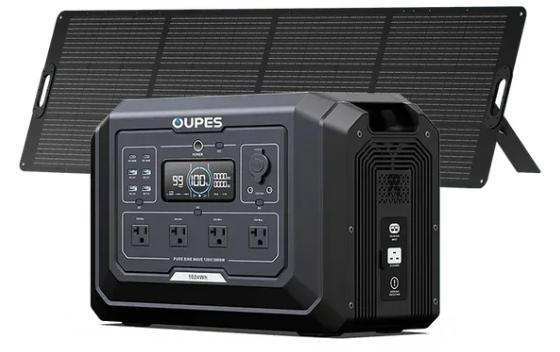
Using a 200W Solar Panel with OUPES Power Stations
OUPES power stations are designed to work efficiently with 200W solar panels. They feature:
- High-efficiency MPPT solar charge controllers
- LFP batteries with fast charge acceptance
- Clear input power monitoring
- Support for expanding solar input
This allows users to start with a 200W panel and scale up as energy needs grow.
200W Solar Panel Charging Time Reference Table
| Battery Capacity | Usable Solar Output | Estimated Charging Time | Typical Use Case |
|---|---|---|---|
| 300Wh | 160W | 2–3 hours | Phones, lights |
| 500Wh | 160W | 3–4 hours | Camping essentials |
| 1,000Wh | 160W | 6–7 hours | Home backup basics |
| 2,000Wh | 160W | 12–14 hours | Extended outages |
Common Mistakes When Estimating Solar Charging Time
- Assuming 200W output all day
- Ignoring efficiency losses
- Forgetting seasonal daylight changes
- Charging while running high loads
- Underestimating battery size
Avoiding these mistakes leads to more realistic expectations and better system planning.
Frequently Asked Questions
1. Can a 200W solar panel charge a battery?
Yes, it is well-suited for small to medium batteries.
2. How long to charge a 1,000Wh battery?
About one full sunny day.
3. Does solar charge faster in summer?
Yes, due to longer daylight and stronger sunlight.
4. Can I use power while charging?
Yes, but it increases total charging time.
5. Is MPPT important?
Yes, it significantly improves charging efficiency.
6. Can I add more panels later?
Yes, modular systems support expansion.
7. Does battery type matter?
Yes, LFP batteries charge more efficiently.
8. Is 200W enough for emergencies?
Yes, for essential loads and gradual recharging.
Final Thoughts
So, how long does it take for a 200W solar panel to charge a battery? In real life, it ranges from a few hours to a couple of days, depending on battery size, sunlight, and system efficiency.
A 200W solar panel offers an excellent balance of portability and performance. When paired with an efficient power station and realistic expectations, it becomes a reliable energy source for camping, home backup, and emergency preparedness. Understanding the variables involved allows you to plan smarter—and get the most out of solar power.