




Quick Navigation
- The Meaning and Basics of 240V Dual-Voltage
- Why 240V Is a Key Advantage in Modern Energy Systems
- Guardian 6000 Use-Case Breakdown
- Home Backup Power
- Outdoor & Camping Scenarios
- Tools & On-Site Equipment Applications
- Typical 240V Appliance List & Runtime Reference
- Practical Tips for 240V + 120V Mixed Power Use
- FAQ
The Meaning and Basics of 240V Dual-Voltage
In the North American power system (including the U.S. and Canada), residential electricity commonly uses what is known as 120/240V single-phase split-phase power. This system can output both traditional 120V (for lighting, small appliances, etc.) and a higher 240V voltage for higher-demand household appliances and equipment. In fact, 240V output comes from the voltage difference between two 120V lines that are opposite in phase; the combined voltage between them is 240V.
For portable energy storage systems, providing 120V alone is common, but products that can deliver truly continuous 240V output are relatively rare. A power station like the OUPES Guardian 6000, with built-in 240V output capability, can approach household-grid-level power delivery.
Why 240V Is a Key Advantage in Modern Energy Systems
Higher Available Output
Compared with a single 120V output, 240V can provide more usable power for high-power loads. For example, high-demand devices such as water heaters, dryers, central air conditioners, and electric ranges are often difficult to run steadily on 120V. On 240V, they can not only run, but often operate closer to their rated performance.
Higher Efficiency, Less Line Loss
At the same power level, increasing voltage generally means reducing current, which helps reduce resistive loss in wiring. This is especially important for mobile power solutions, because lower line loss translates into more efficient energy use.
Compatibility with Home Electrical Systems
Many modern high-power household appliances (such as air conditioners, washing machines, and electric water heaters) are designed around the 240V residential standard. A power station that can output 240V means it can truly drive household loads during an outage.
Guardian 6000 Use-Case Breakdown
Home Outage Backup Power
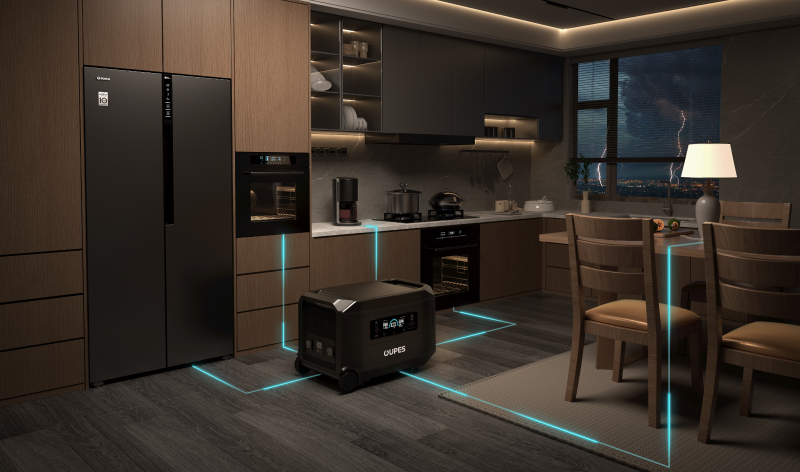
When the grid goes down, home power needs are often more than just lighting and phone charging. Many critical household appliances rely on 240V power to operate normally. Guardian 6000’s 240V output makes it a backup solution that is closer to home-grid-level capability.
Central AC / Split AC Systems (240V)
Air conditioners are high-startup-power devices and typically cannot be driven reliably by standard 120V portable power. With 240V output, Guardian 6000 provides the right voltage conditions for AC systems, helping maintain basic indoor comfort during outages.
Electric Water Heater (240V)
Electric water heaters draw high power and concentrate load, so they are often the first appliances to be sacrificed in emergency power use. With 240V output, Guardian 6000 can restore hot water for short periods during outages, supporting essential needs like washing and basic hygiene.
Automatic Washing Machine & Dryer (240V)
Washing and drying appliances are high-frequency, high-load devices in everyday life. Guardian 6000 can support a full or key wash cycle, helping households maintain basic routines during outages.
Outdoor & Camping Scenarios
Compared with portable power stations that only support 120V, 240V output enables Guardian 6000 to cover higher-power outdoor electricity needs.
- Induction cooktops and camping kitchen appliances: Supports high-power cooking devices such as induction cookers and electric griddles, reducing reliance on gas or open flames.
- Portable air conditioners or cooling equipment: In hot environments, it can drive portable AC units or higher-power cooling devices, significantly improving camping comfort.
- Laundry or food-processing equipment: Ideal for RV campsites or long-stay setups, improving convenience for outdoor living.
Construction & Temporary On-Site Power
In construction or temporary job-site scenarios, many devices are designed for 240V input.
- Pumps: For drainage, water supply, and other emergency or worksite applications.
- Fans and larger power tools: Higher requirements for startup voltage and stability.
- High-power lighting: Suitable for night work or emergency repair operations.
240V output reduces extra conversion steps, allowing equipment to be connected and used more directly, improving overall work efficiency.
Typical 240V Appliance List & Runtime Reference
The following runtime estimates are conservatively calculated based on the usable energy of the OUPES Guardian 6000, to help users prioritize loads in real-world scenarios.
To better reflect real usage, this article uses the following unified calculation method:
Usable energy = Total battery capacity × 80%
Guardian 6000 has a rated battery capacity of 4,608Wh. After accounting for inverter efficiency, battery protection, and load fluctuations, usable energy is approximately: 4,608Wh × 80% ≈ 3,686Wh
Note: The following values are for reference only. Actual runtime may vary based on appliance efficiency, surge current, operating mode (continuous / intermittent), and reserve strategies.
| 240V Appliance | Approx. Power | Estimated Runtime* |
|---|---|---|
| Central AC (small, 2–3 tons) | 3000 W | ~1.2–1.8 hours |
| Central AC (large, 4–5 tons) | 5000 W | ~0.7–1.1 hours |
| Split AC / Mini-Split | 2000–3000 W | ~1.2–1.8 hours |
| Electric Water Heater (tankless) | 4000–5000 W | ~0.7–1.1 hours |
| Water Heater (tank type, heating phase) | 3000–4500 W | ~0.8–1.3 hours |
| Automatic Washing Machine | 1800–2500 W | ~1.5–2.0 hours |
| Clothes Dryer | 2500–4000 W | ~0.9–1.5 hours |
| Induction Cooktop (single zone) | 2000–3000 W | ~1.2–1.8 hours |
| Electric Oven | 2500–3500 W | ~1.0–1.5 hours |
| Electric Stove (single burner) | 2000–2500 W | ~1.5–1.8 hours |
| Well Pump / Pressure Pump | 2000–3000 W | ~1.2–1.8 hours |
| Pool Pump | 2000–3000 W | ~1.2–1.8 hours |
| Commercial Refrigeration (small) | 2000–3000 W | ~1.2–1.8 hours |
* Runtime is estimated based on approximately 3,686Wh usable energy, not the theoretical full rated capacity.
Usage Notes (Strongly Recommended to Keep)
- Most 240V appliances operate intermittently (such as AC compressors and water-heater heating phases), so in real life they often cover a longer usable time window.
- Guardian 6000’s 240V output plus simultaneous 120V supply capability is well-suited for time-sharing and load-splitting between high-power devices and essential household appliances.
- With solar input, you can run high-power devices during the day and switch to lower loads at night, significantly extending overall usable time.
These estimates can help you plan power usage and allocate energy more effectively.
Practical Tips for 240V + 120V Mixed Power Use
Having both 240V and 120V dual-voltage output does not mean you must choose only one. On the contrary, this is a key advantage for flexible energy allocation and real-world use:
Run High-Power 240V Loads + 120V Household Appliances at the Same Time
For example, you can power a washing machine while also running lights and a refrigerator.
Smart Load Allocation Strategy
Prioritize critical 240V devices that need continuous operation, while assigning 120V appliances to secondary load strategies, which helps extend overall usable time.
This flexibility is something single-voltage output cannot match.
Frequently Asked Questions (FAQ)
Why do homes need 240V voltage?
In North American homes, 120V is used for common small appliances and lighting, while 240V is used for high-power devices (such as air conditioners, electric water heaters, and dryers). They are two output forms within the same electrical circuit system.
Can Guardian 6000 really run high-power household appliances?
Yes. With 6,000W continuous power (7,200W surge/boost) and 240V output capability, Guardian 6000 can drive many high-power household appliances.
Does running 240V and 120V at the same time affect runtime?
Yes, because total energy is shared. However, reasonable load allocation (such as prioritizing core 240V needs) can maximize overall energy utilization efficiency.


Leave a comment
This site is protected by hCaptcha and the hCaptcha Privacy Policy and Terms of Service apply.