




A 12V DC refrigerator is one of the most practical appliances you can bring into an outdoor power setup. For camping, road trips, RV travel, fishing, overlanding, and outage backup, it solves a problem that traditional ice coolers never fully solve: keeping food at a stable, controlled temperature without constantly dealing with melting ice, water buildup, and shrinking storage space.
But to use a 12V fridge well, it helps to understand what is happening inside it. A real 12V DC refrigerator is not just a “cold box.” In most cases, it is a compact vapor-compression refrigeration system with a DC compressor, condenser, evaporator, temperature control logic, and low-voltage protection. That matters because outdoor refrigeration is not only about cooling performance. It is also about battery efficiency, runtime planning, heat management, and food safety.[1][2][3]
Table of Contents
- What Is a 12V DC Refrigerator?
- How the Refrigeration Cycle Works
- Cooling Technology Comparison
- Why 12V Fridges Work Well Outdoors
- Understanding Real Power Draw and Duty Cycle
- How to Calculate Runtime with the 80% Rule
- Recommended OUPES Power Stations
- Food Safety and Outdoor Refrigeration
- References
- FAQ
What Is a 12V DC Refrigerator?
A 12V DC refrigerator is a portable refrigeration unit designed to run on direct current power, which makes it suitable for vehicles, battery systems, solar-charged setups, and portable power stations. Its main advantage is that it can actively remove heat and hold low temperatures without relying on ice.
That is very different from a passive cooler. It is also different from a basic thermoelectric cooler. The U.S. Department of Energy explains that compressor-based cooling uses refrigerant and pressure changes to absorb and release heat, while thermoelectric systems use current passing through conductors and represent a different, typically lighter-duty approach.[1] A refrigeration industry scoping report also notes that vapor-compression units provide much more cooling capacity than thermoelectric units.[2]
| Type | Core Mechanism | Cooling Ability | Best Use Case |
|---|---|---|---|
| Compressor 12V Fridge | Vapor-compression refrigeration | Strong, stable refrigeration and freezing | Camping, RV, long trips, food storage |
| Thermoelectric Cooler | Electric current through conductors | More limited cooling capacity | Drinks, short trips, mild weather |
| Ice Cooler | Passive cooling from stored ice | Depends on remaining ice | Short, simple outings |
How the Refrigeration Cycle Works
Most serious 12V DC refrigerators use the same basic physics as home refrigerators: a vapor-compression cycle. According to the Department of Energy, a compressor applies pressure to refrigerant so that heat can be released into the air, and when controlled by a thermostat, the compressor cycles on and off to maintain the target temperature.[1]
In practice, the process looks like this:
- Compression: The DC compressor pressurizes refrigerant gas, raising its temperature.
- Condensation: The hot refrigerant moves through the condenser and releases heat to outside air.
- Expansion: The refrigerant passes through an expansion stage, where pressure drops sharply.
- Evaporation: In the evaporator, the refrigerant absorbs heat from inside the fridge compartment, cooling the contents.

| Component | Role in Cooling | Outdoor Relevance |
|---|---|---|
| DC Compressor | Drives the refrigerant cycle | Determines efficiency, startup behavior, and cooling speed |
| Condenser | Releases heat outside the fridge | Needs airflow; performs worse in direct sun and poor ventilation |
| Evaporator | Absorbs heat from the interior | Directly affects cooling stability |
| Thermostat / Controller | Turns compressor on and off | Reduces wasted energy and extends battery runtime |
| Insulation & Door Seal | Slows heat gain | Critical in hot outdoor environments |
This on-off behavior is important. A fridge does not pull full wattage every minute of the day. It cycles. That is why runtime calculations should be based on daily energy consumption, not just the compressor’s nameplate wattage.[1]
Cooling Technology Comparison
If your goal is real food refrigeration outdoors, compressor-based units are usually the right choice. A refrigeration scoping report notes that thermoelectric units generally provide much more limited cooling capacity than vapor-compression units.[2] That is the key reason many outdoor users find thermoelectric coolers acceptable for drinks in mild conditions, but less dependable for multi-day food storage in summer heat.
| Technology | Strengths | Weaknesses | Outdoor Verdict |
|---|---|---|---|
| Compressor | Accurate temperature control, strong cooling, efficient cycling | Higher upfront cost | Best overall for serious outdoor use |
| Thermoelectric | Simple, light, quiet | Limited cooling, more affected by ambient heat | Better for light-duty use |
| Ice Cooler | No electricity required | Needs constant ice replacement, less stable temperature | Good only for short trips |
Why 12V Fridges Work Well Outdoors
Outdoor conditions are harsher than kitchen conditions. Ambient temperatures can be high, the unit may sit in a vehicle, airflow can be restricted, and the power source is often limited. That is exactly why 12V DC fridges are useful: they are designed around battery-based operation and controlled cycling.
Good insulation, precise temperature control, and efficient compressors all help reduce energy use. An efficiency guide for freezers highlights that high-efficiency compressors create less heat while running and that improved insulation and better door designs help keep cold air in and reduce heat leakage.[3] Those same engineering principles are highly relevant when you are trying to keep a fridge cold in a campsite, truck bed, or RV storage bay.
Understanding Real Power Draw and Duty Cycle
The biggest misunderstanding around portable refrigeration is this: a fridge that draws 45W while running does not use 45W continuously for 24 hours. The compressor cycles based on internal temperature, ambient temperature, how often the lid is opened, how well the fridge is shaded, and whether the food was pre-cooled before loading.
A practical outdoor planning formula is:
Average power draw = Running wattage × Duty cycle
Daily energy use = Average power draw × 24 hours
Example:
If a fridge pulls 50W while the compressor is running, and it runs 40% of the time, then:
Average draw = 50W × 0.40 = 20W
Daily energy use = 20W × 24 = 480Wh/day
| Outdoor Condition | Typical Planning Range | Estimated Daily Consumption |
|---|---|---|
| Mild weather, pre-cooled contents, shaded placement | Low duty cycle | ~300Wh/day |
| Warm weather, normal opening frequency | Moderate duty cycle | ~500Wh/day |
| Hot weather, frequent opening, higher heat load | High duty cycle | ~700Wh/day |
These three bands are a practical way to estimate outdoor runtime without pretending that all trips happen in perfect conditions.
How to Calculate Runtime with the 80% Rule
For real-world trip planning, this article uses a conservative rule:
Usable battery capacity = Rated battery capacity × 80%
That 80% method is a practical planning assumption that helps account for inverter losses, temperature effects, battery-management overhead, cable losses, and the fact that outdoor use is rarely as ideal as a lab test.
Then the runtime formula becomes:
Runtime (days) = Usable capacity ÷ Daily fridge consumption
| OUPES Model | Rated Capacity | Usable Capacity (80%) | Runtime at 300Wh/day | Runtime at 500Wh/day | Runtime at 700Wh/day |
|---|---|---|---|---|---|
| Exodus 1500 | 1488Wh | 1190.4Wh | 3.97 days | 2.38 days | 1.70 days |
| Mega 2 | 2048Wh | 1638.4Wh | 5.46 days | 3.28 days | 2.34 days |
| Exodus 2400 | 2232Wh | 1785.6Wh | 5.95 days | 3.57 days | 2.55 days |
These figures are for the fridge load only. If you also run lights, a fan, phone charging, a camera battery charger, or a laptop, actual runtime will drop accordingly.
Recommended OUPES Power Stations
OUPES Exodus 1500: A Practical Entry Point for Weekend Use
The OUPES Exodus 1500 offers 1488Wh of capacity and 1500W of output.[8] For a 12V fridge, that places it in a very practical range for weekend camping or short road trips. Using the 80% rule, it gives about 1190.4Wh of usable energy. That is enough for a typical compressor fridge plus smaller essentials such as lights, phones, and a few accessory loads.
OUPES Mega 2: More Headroom for RV and Mixed Loads
The OUPES Mega 2 is a stronger fit if your fridge is only one part of a larger power plan. OUPES lists it at 2048Wh capacity and 2500W AC output, with LiFePO4 chemistry, 15 outputs, and expansion up to 10.24kWh.[7] That means it is not just a fridge battery. It is a broader campsite or RV hub with enough output to handle other intermittent loads while still maintaining solid fridge runtime.
OUPES Exodus 2400: Better Buffer for Hot Weather and Longer Trips
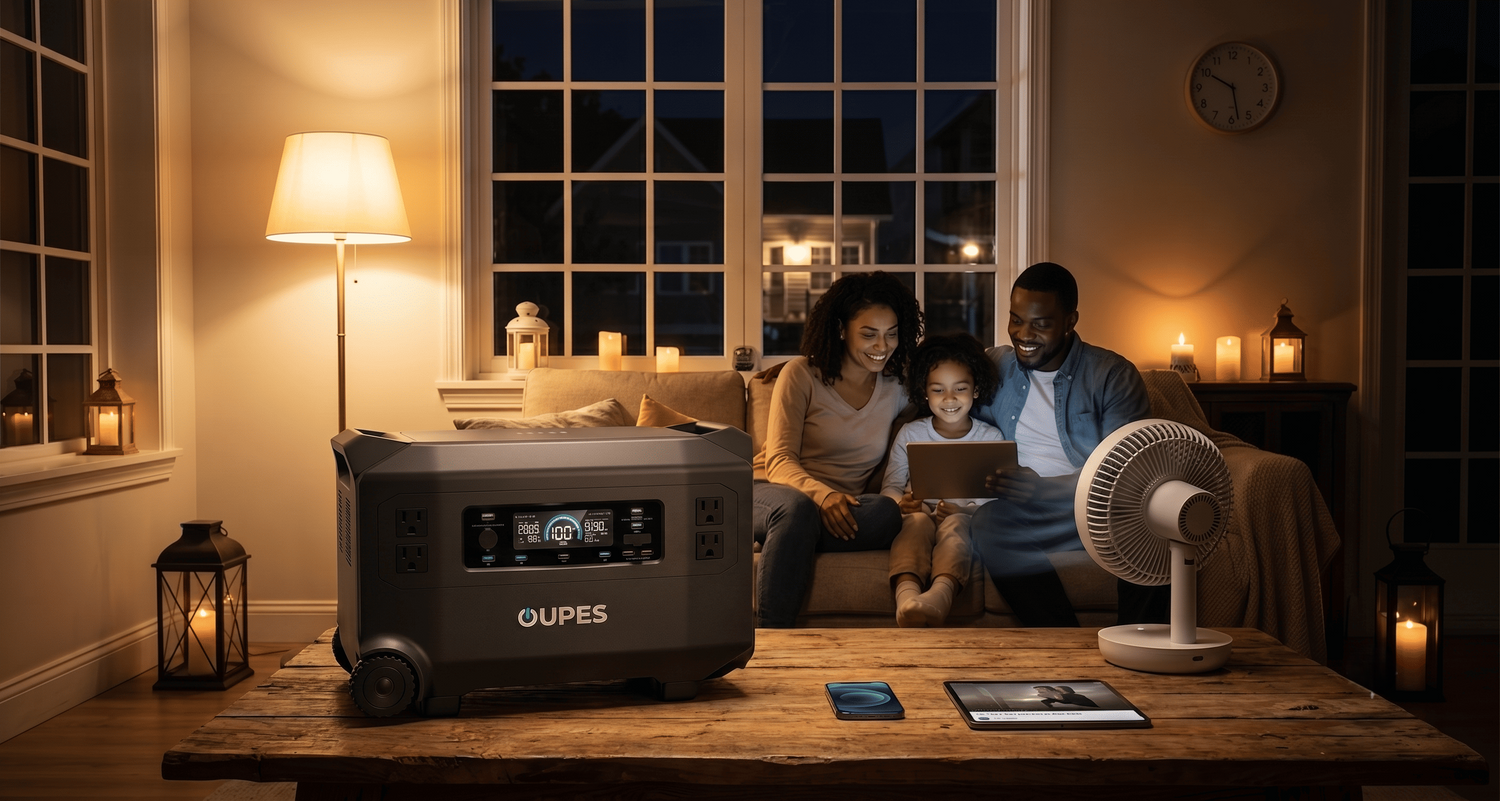
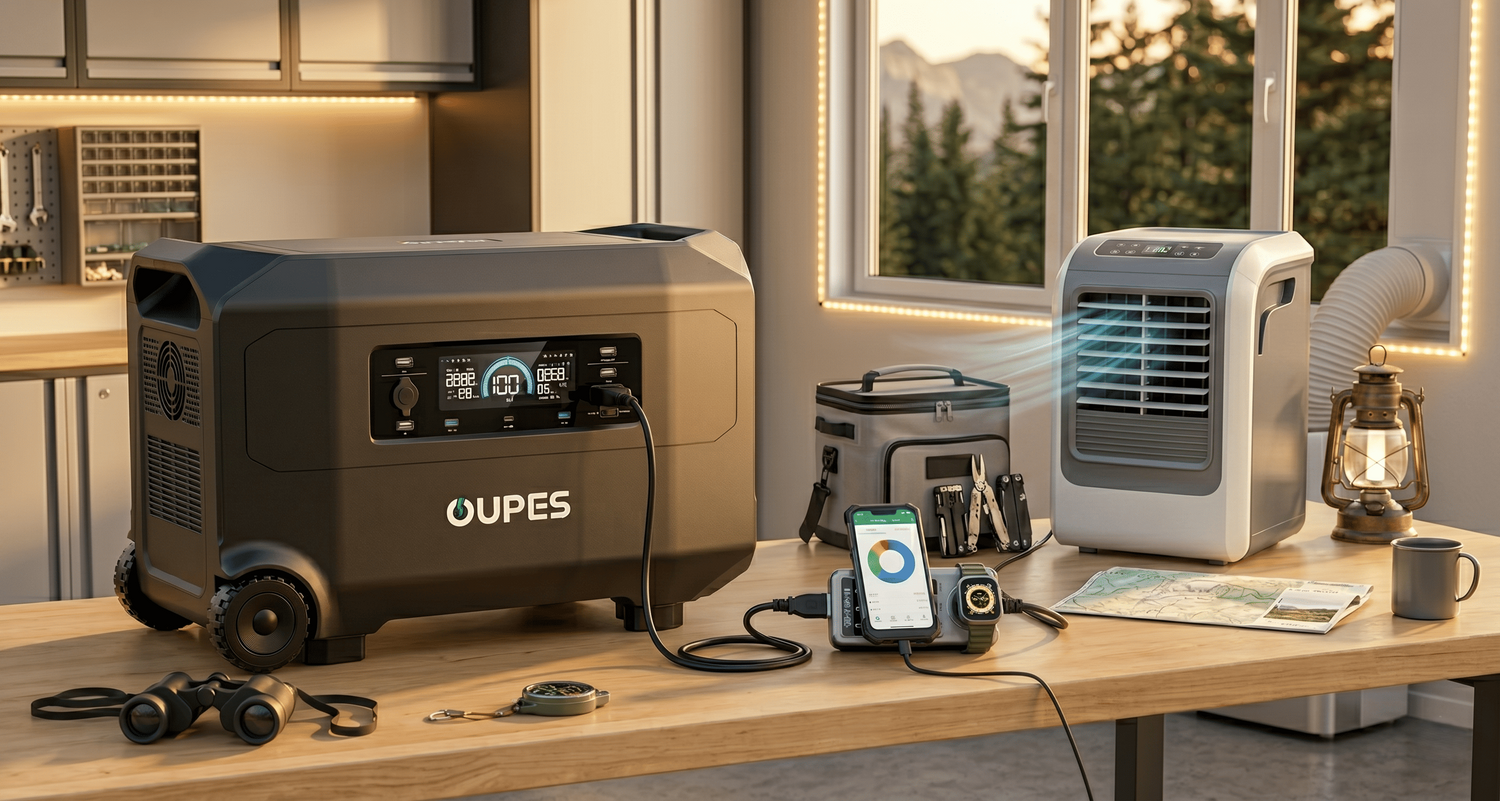
The OUPES Exodus 2400 provides 2232Wh capacity and 2400W output, and OUPES highlights 1.5-hour full AC charging and a 2600W boost mode on the official product page.[9] For outdoor refrigeration, that extra capacity is useful because heat increases compressor duty cycle. If you expect summer trips, heavier use, or several companion loads beyond the fridge, the larger battery buffer reduces runtime anxiety and gives you more recovery flexibility.
| Model | Capacity | Output | Best Fit for 12V Fridge Use |
|---|---|---|---|
| Exodus 1500 | 1488Wh | 1500W | Weekend camping, lighter mobile setups |
| Mega 2 | 2048Wh | 2500W | RV use, mixed devices, longer trips |
| Exodus 2400 | 2232Wh | 2400W | Hot-weather travel, larger energy buffer, multi-day off-grid use |
Food Safety and Outdoor Refrigeration
A technical discussion of refrigeration is incomplete without food safety. The FDA states that refrigerators should be kept at 40°F or below and freezers at 0°F.[4] The FDA also says perishables should be refrigerated or frozen within 2 hours of cooking or purchasing, or within 1 hour if the outdoor temperature is above 90°F.[5]
That guidance is especially relevant outdoors. Loading a fridge with warm food, leaving it open while unpacking, or letting groceries sit in the sun too long all increase both food risk and battery consumption. In addition, the FDA notes that during a power outage, refrigerated food is generally safe for about 4 hours if the door remains closed, which helps illustrate how important temperature retention and door-opening discipline really are.[6]
- Pre-cool the fridge before leaving home.
- Load cold items whenever possible.
- Use an appliance thermometer or reliable internal display to confirm food-safe temperature.
- Keep the unit shaded and ventilated.
- Open it less often, especially in hot weather.
References
- U.S. Department of Energy — Thermoelectric Coolers
- Miscellaneous Residential Refrigeration Products Scoping Report
- Consumer Messaging Guide for Qualified Appliances
- FDA — Refrigerator Thermometers: Cold Facts about Food Safety
- FDA — Safe Food Handling
- FDA — Food and Water Safety During Power Outages and Floods
- OUPES Mega 2 Official Product Page
- OUPES Exodus 1500 Official Product Page
- OUPES Exodus 2400 Official Product Page
FAQ
1. Is a 12V DC refrigerator better than a cooler for camping?
For multi-day trips, usually yes. A compressor-based 12V fridge gives stable temperatures, better food protection, and more usable storage space because ice does not take over the compartment.
2. Why is compressor technology preferred for outdoor use?
Because it provides stronger and more stable cooling than thermoelectric systems, especially when ambient temperature rises.[2]
3. Why use only 80% of battery capacity for runtime planning?
Because outdoor performance is rarely ideal. Using 80% of rated capacity gives a more conservative and practical estimate for real trips.
4. What affects fridge runtime the most?
Ambient heat, direct sunlight, poor ventilation, frequent lid opening, and loading warm food all increase compressor duty cycle and daily energy use.
5. What temperature should a portable fridge maintain for food safety?
As a practical food-safety benchmark, refrigerated storage should stay at 40°F or below.[4]
6. Can a 12V fridge run directly from a portable power station?
Yes. That is one of the most common outdoor setups, especially when the power station provides stable DC output or enough AC output for the fridge’s adapter.
7. Which matters more for a 12V fridge: output wattage or battery capacity?
Battery capacity usually matters more. Most 12V fridges are not extremely high-wattage devices, but they need to run for many hours or days.


Leave a comment
This site is protected by hCaptcha and the hCaptcha Privacy Policy and Terms of Service apply.