




Table of Contents
- Overview
- Common Refrigerator Types & Power Consumption
- Runtime of OUPES Mega Series for Each Refrigerator Type
- How Runtime Is Calculated (Professional Method)
- FAQ
Overview
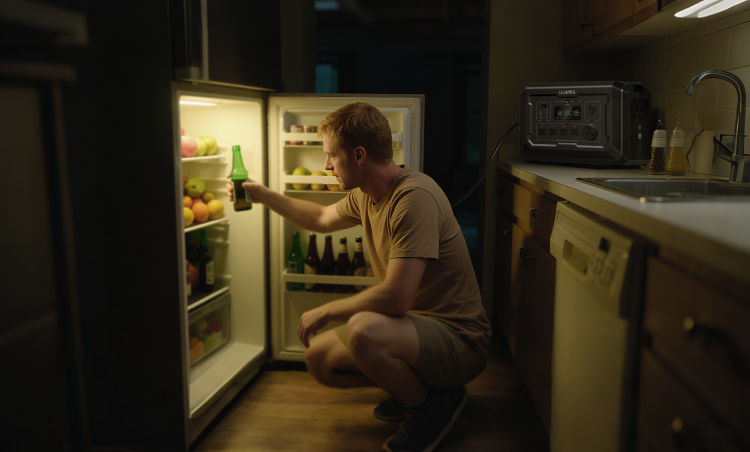
Refrigeration is one of the highest-priority loads during a power outage. Whether you are protecting a full-size kitchen refrigerator, a compact unit in a small apartment, or an RV fridge on the road, maintaining safe food temperatures is essential for health and safety.
This guide explains how long different OUPES Mega series power stations can run several common categories of refrigerators. To keep the estimates realistic and technically sound, all calculations use an engineering-standard 80% usable battery capacity for LiFePO₄ batteries rather than the full nameplate value.
We focus on four OUPES models commonly used for home backup and mobile power:
- Mega 1 – 1024 Wh nominal capacity
- Mega 2 – 2048 Wh nominal capacity
- Mega 3 – 3072 Wh nominal capacity
- Mega 5 – 5040 Wh nominal capacity
All models use LiFePO₄ batteries, support pure sine wave AC output, and are suitable as backup power sources for refrigeration when sized and used correctly.
Common Refrigerator Types & Power Consumption
Refrigerators do not draw their rated running watts continuously. Modern units cycle their compressors on and off depending on internal temperature, ambient conditions, and door openings. However, for battery runtime estimation, it is useful to look at typical running wattage and approximate daily energy consumption ranges.
The following table summarizes representative values for different refrigerator categories, based on typical appliance specifications and standard test procedures used in energy efficiency research.
| Refrigerator Type | Typical Running Wattage | Daily Energy Use (Wh/day) | Typical Use Scenario |
|---|---|---|---|
| Mini Fridge (40–70 L) | 40–70 W | 200–350 Wh | Dorm rooms, offices, bedroom drink coolers |
| Compact Home Refrigerator | 80–120 W | 600–900 Wh | Small apartments, studio kitchens |
| Double-Door Refrigerator | 120–180 W | 1200–2000 Wh | Standard family kitchens, higher food volume |
| Portable 12V Car Fridge (Compressor) | 40–60 W | 150–300 Wh | Overlanding, camping, tailgating, trunk-mounted coolers |
| RV Refrigerator – 12V Compressor Type | 45–70 W | 200–400 Wh | Modern RVs with efficient DC compressors |
| RV Absorption Refrigerator (Electric Mode) | 150–350 W | 1500–3000 Wh | Traditional propane/electric RV units when run on AC |
These values provide the baseline for runtime calculations using OUPES Mega power stations.
Runtime of OUPES Mega Series for Each Refrigerator Type
To avoid overstating performance, we assume only 80% of the nameplate battery capacity is used. This is a conservative but realistic planning value that accounts for inverter losses, battery management system reserve, and the desire to avoid deep cycling the pack to 0% repeatedly.
| OUPES Model | Nominal Capacity (Wh) | Usable Capacity (80%) (Wh) |
|---|---|---|
| Mega 1 | 1024 Wh | 819 Wh |
| Mega 2 | 2048 Wh | 1638 Wh |
| Mega 3 | 3072 Wh | 2458 Wh |
| Mega 5 | 5040 Wh | 4032 Wh |
All runtimes below are calculated assuming continuous operation at the indicated running wattage. In real-world use, because compressors cycle, the calendar duration in hours or days is often longer than the simple continuous-power estimate.
1. Mini Fridge Runtime (40–70 W)
| Model | Runtime @ 40 W | Runtime @ 70 W |
|---|---|---|
| Mega 1 | 20.5 hours | 11.7 hours |
| Mega 2 | 41.0 hours | 23.4 hours |
| Mega 3 | 61.5 hours | 35.1 hours |
| Mega 5 | 100.8 hours | 57.6 hours |
For many users, even the Mega 1 offers nearly a full day of continuous mini-fridge runtime, while the Mega 5 can support multi-day cooling in outage scenarios, especially when real-world duty cycles are considered.
2. Compact Home Refrigerator Runtime (80–120 W)
| Model | Runtime @ 80 W | Runtime @ 120 W |
|---|---|---|
| Mega 1 | 10.2 hours | 6.8 hours |
| Mega 2 | 20.5 hours | 13.7 hours |
| Mega 3 | 30.7 hours | 20.5 hours |
| Mega 5 | 50.4 hours | 33.6 hours |
In practice, a compact fridge does not draw full running power 100% of the time. With a typical 30–40% duty cycle, a Mega 3 or Mega 5 can often maintain cooling over multiple days, especially if paired with solar input between outages.
3. Double-Door Refrigerator Runtime (120–180 W)
| Model | Runtime @ 120 W | Runtime @ 180 W |
|---|---|---|
| Mega 1 | 6.8 hours | 4.5 hours |
| Mega 2 | 13.7 hours | 9.1 hours |
| Mega 3 | 20.5 hours | 13.7 hours |
| Mega 5 | 33.6 hours | 22.4 hours |
For a typical family-size refrigerator, the Mega 3 and Mega 5 offer the most practical protection against full-day or multi-day outages, particularly if load management (limiting door openings, turning off other nonessential loads) is implemented.
4. Portable 12V Compressor Car Fridge Runtime (40–60 W)
| Model | Runtime @ 40 W | Runtime @ 60 W |
|---|---|---|
| Mega 1 | 20.5 hours | 13.7 hours |
| Mega 2 | 41.0 hours | 27.3 hours |
| Mega 3 | 61.5 hours | 41.0 hours |
| Mega 5 | 100.8 hours | 67.2 hours |
Portable compressor fridges are very efficient. When used with an OUPES Mega power station and optionally solar panels, they are well suited for off-grid overlanding, camping, and RV trips.
5. RV Compressor Refrigerator Runtime (45–70 W)
| Model | Runtime @ 45 W | Runtime @ 70 W |
|---|---|---|
| Mega 1 | 18.2 hours | 11.7 hours |
| Mega 2 | 36.4 hours | 23.4 hours |
| Mega 3 | 54.6 hours | 35.1 hours |
| Mega 5 | 89.6 hours | 57.6 hours |
Modern 12V compressor RV fridges pair very well with LiFePO₄-based stations. With an OUPES Mega 3 or Mega 5 plus solar input, continuous refrigeration during extended boondocking becomes realistic.
6. RV Absorption Refrigerator (Electric Mode)
RV absorption refrigerators are designed primarily to run on propane. When used in electric mode, they rely on a resistive heating element and are therefore much less energy efficient, drawing in the range of 150–350 W continuously.
| Model | Runtime @ 150 W | Runtime @ 300 W |
|---|---|---|
| Mega 1 | 5.5 hours | 2.7 hours |
| Mega 2 | 10.9 hours | 5.5 hours |
| Mega 3 | 16.4 hours | 8.2 hours |
| Mega 5 | 26.9 hours | 13.4 hours |
Because of the high continuous draw, running an absorption fridge purely on battery is generally not recommended except for short durations. When possible, propane mode should be used for long-term RV stays.
How Runtime Is Calculated (Professional Method)
All runtimes are computed using the standard energy relationship between power, time, and capacity:
Runtime (hours) = Usable Battery Capacity (Wh) ÷ Average Load (W)
For the OUPES Mega series, we adopt:
- Usable Capacity = 0.8 × Nominal Capacity (Wh)
- Average Load = typical running wattage of the refrigerator
The 80% factor is a conservative engineering assumption that:
- Provides a buffer to avoid fully depleting the battery
- Accounts for inverter and conversion losses
- Aligns with good practice for LiFePO₄ cycle life management
In real cold-chain planning (such as medical storage or critical food supply), users should apply an additional safety factor and consider ambient temperature, door-opening frequency, and whether the refrigerator is already at stable temperature before the outage.
FAQ
1. Why did you use only 80% of the rated battery capacity?
Using 80% of the nameplate watt-hours avoids optimistic estimates. Real systems experience inverter losses and reserve capacity held back by the battery management system. Planning with 80% usable capacity results in more reliable expectations and better long-term battery health.
2. Does compressor starting surge significantly reduce runtime?
No. Startup surge is short in duration (typically a fraction of a second). OUPES Mega power stations are designed with pure sine wave inverters and sufficient surge capability to handle refrigerator compressor starts. Runtime is primarily determined by average running power, not surge.
3. Can I power my refrigerator and other appliances at the same time?
Yes, but your total runtime will decrease. To estimate, add the wattage of all loads that will run simultaneously (for example, refrigerator + lights + router). Then divide the usable battery capacity by the total combined wattage.
4. How can I extend refrigerator runtime on an OUPES Mega station?
Several strategies help:
- Pre-cool the refrigerator and freezer before an expected outage.
- Minimize door openings during the outage period.
- Reduce the temperature setpoint slightly before the outage begins.
- Use an OUPES-compatible solar array to recharge the station during the day.
- Disconnect nonessential AC loads so that the refrigerator has priority.
5. Are OUPES Mega power stations suitable as a primary backup for home refrigeration?
Yes. For most households, the Mega 3 and Mega 5 offer practical runtimes for compact and standard double-door refrigerators, especially when combined with basic energy management and optional solar recharging. They provide a flexible, portable alternative to fixed whole-home backup systems.


Leave a comment
This site is protected by hCaptcha and the hCaptcha Privacy Policy and Terms of Service apply.