




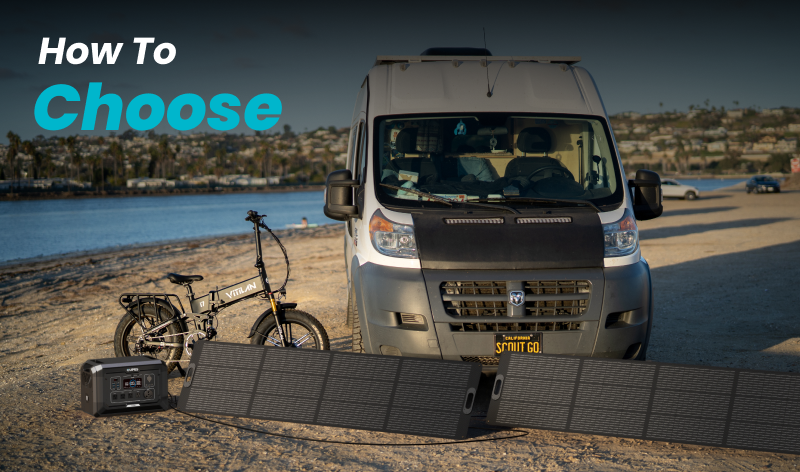
TL;DR
Solar panels and batteries must be adjusted to the energy needs of your home, sunlight exposure, as well as your budget.Think about panel efficiency, warranty, battery capacity, depth of discharge, and overall cost before making your decision. Size your solar panels and batteries correctly to avoid wasting money or going out of power.
Just imagine you are living off-grid, or you just had a power cut.There are no lights, no fan, and your phone battery is draining.This is not the life most of us would want to live. Isn't it?
That is why a lot of families are opting for solar systems.Solar panels convert sunlight into electricity, and batteries store this power for later use.
However, the issue is that not every solar panel or battery is the same.Some are more effective, some are durable and some are expensive.Choosing the wrong panel or battery can result in system failures, as you might not get the power you require, or you might spend extra money without actual gain.
Here, in this guide, we will learn how to choose solar panels and batteries that will fit in your home.
Choosing the Best Solar Panels and Batteries for Your Home

By following the simple steps, you can choose the best solar panels and batteries for your backup:
Step 1: Choosing the Right Solar Panel
Check your electricity bill before purchasing panels.Monitor daily kilowatt-hours (kWh) usage.A small house can consume 5-8 kWh per day; larger houses consume more.
You also need to know how much sunlight your roof gets.On average, many areas receive 4-6 hours of full sunlight per day.These are called peak sun hours. More sun hours = fewer panels needed.
Key Features to Compare
Here are the key things to look for when you evaluate your solar panel needs:
|
Feature |
What It Means |
Why It Matters |
|
Efficiency (%) |
How much sunlight can be converted into electricity by the panel |
Higher efficiency equates to more power |
|
Warranty |
How long is the panel covered by a guarantee |
Reliable panels have a life of 25 years or more |
|
Degradation |
How fast it loses power |
A drop of less than 0.5% per year is good |
|
Type / Technology |
Monocrystalline, polycrystalline, thin film |
Mono has greater efficiency, Poly is cheaper |
|
Cost per Watt |
Price divided by its wattage |
Helps compare value |
When you get quotes from installers, ask them the above-mentioned specs. The Center for Sustainable Systems (University of Michigan)states that most available solar panels achieve ~ 20% efficiency.
Sizing the Panel Array
Let's say your home uses 6kWh per day.If you have 5 hours of full sun, then:
6 kWh ÷ 5 hours = 1.2 kW needed per hour.
If each panel is 300W (0.3kW) then you need 4 panels.
Always get an additional panel for cloudy days and power loss in wires.
Explore solar paneloptions for your home.
Step 2: Choosing the Right Battery
The battery stores the energy so you can use the solar power at night or in the event of any outage.Choosing a bad one means you can run out of power or damage it.
Important Battery Specs
The following are the most important things to look out for when picking a battery:
● Capacity (kWh): How much energy it can store.
● Power (kW output capacity): How much electricity it can provide at a single moment.
● Depth of Discharge (DoD): What percent of stored energy you can safely use.A battery with 90% DoD means you can use 90% of the battery's capacity.
● Cycle life / lifespan: How many times it can be charged + discharged before it's performance drops.
● Warranty & brand support: How long does the company give a guarantee for it, and do they service it locally?
● Temperature tolerance: How well it functions in hot or cold climates.
Types of Batteries
Common types of batteries are:
● Lithium-ion: Long life, high efficiency, but expensive
● Lead-acid: Cheaper, shorter life and heavier.
● Others (saltwater, flow): New tech, not common for homes yet.
According to EnergySage, the average U.S. home battery is around 10 kWh, and many homes require 2-3 batteries to meet peak usage.
How Much Battery Wattage Do You Need?
You want a battery that can provide you with power when there is no sunlight.Here is how you can calculate the required battery capacity:
Battery capacity = (Total daily energy consumption) / (DoD x days of autonomy)
● Total daily energy usage is in kWh (from your bills).
● DoD is like 0.8 if the battery will allow 80%.
● Days of autonomy is how many days you want battery to last.
For example, if you require 5 kWh/day, and battery DoD is 80%, and you want 2 days of backup:
Battery size = 5x2 ÷ 0.8 = 12.5 kWh. You'd go for a battery of maybe 13 or 14 kWh to be safe.
Check our battery storagesolutions.
Step 3: Matching the Panel & Battery
You can choose the battery and panels independently; however, make sure they work together.
Steps to Match
1. Decide energy target: How much of your consumption you want solar + battery to cover (for example, 80%).
2. Size panels to generate energy to meet daily use + charge battery.
3. Size the battery to cover night use or outages with a margin.
4. Check inverter / controller compatibility: The system that connects panels and battery must be compatible with both sides.
5. Expansion plan: Pick systems where you can add panels or batteries down the line without making huge changes.
Example Scenario
Your home uses 6 kWh daily.
● Panels: 5 sun hours = 1.2 kW panels (about 4-5 panels).
● Battery: If you choose a lithium battery with 90% DoD, and want 1 day autonomy, then the capacity needed = 4.8 / 0.9 = ~5.33 kWh.So pick a 6 kWh battery.
Make sure your inverter can provide the peak loads (e.g. when lots of devices are running at one time). See our solar kitsfor combined systems.
Tips & Common Mistakes
To make your system as efficient as possible, here are some tips to follow;
● Don't undersize the battery: It'll put the battery into deep discharge and ruin it.
● Don't oversize wildly: extra capacity that is never used is equal to wasted cost.
● Always ask for actual performance data (efficiency, degradation).
● Make sure the brand you buy has local support.
● Monitor your system after installation: see actual solar output and battery behavior.
● Keep batteries in a cool place; heat shortens the life of batteries.
FAQs
1. How long do solar panels last?
Around 25-30 years, with little reduction in power each year.
2. Can I use any battery with any solar panel?
No, panels and batteries must be of the same voltage and type.
3. Will cloudy days ruin my battery?
No, cloudy days don't damage batteries; they just charge less.
4. Do I need more battery if I want blackout backup too?
Yes, blackout backup requires a larger battery for extended power.
Conclusion
Solar panels give you power from the sun, and batteries save that power for night or blackouts. Always match panels and batteries carefully, pick trusted brands, and plan for the future. This way, your home can stay bright and safe, even when the grid fails.

Leave a comment
This site is protected by hCaptcha and the hCaptcha Privacy Policy and Terms of Service apply.