




Table of Contents
Introduction: Understanding Power Ratings
When exploring power systems, you'll often see ratings listed in both kVA (kilovolt-amperes) and kW (kilowatts). Understanding the difference between these units is essential, especially when working with solar generators and portable power stations. While kVA measures apparent power, kW measures the actual usable power available for running electrical devices.
This article explains how to convert between kVA and kW, why power factor matters, and how these measurements apply to solar energy and off-grid systems.
Difference Between kVA and kW
Both kVA and kW describe power, but they represent different aspects of it:
1. kW (Kilowatts) — Real Power
This measures the actual power that performs useful work, such as lighting a bulb or running a motor. It is the portion of power that's effectively converted into energy output.
2. kVA (Kilovolt-Amperes) — Apparent Power
This represents the total power supplied by a system, including both real power and reactive power. Reactive power doesn't perform useful work but is necessary to maintain voltage levels in AC systems. Reactive power maintains the magnetic and electric fields required by inductive or capacitive loads (like motors or transformers) to operate properly.
3. The Relationship Between Them
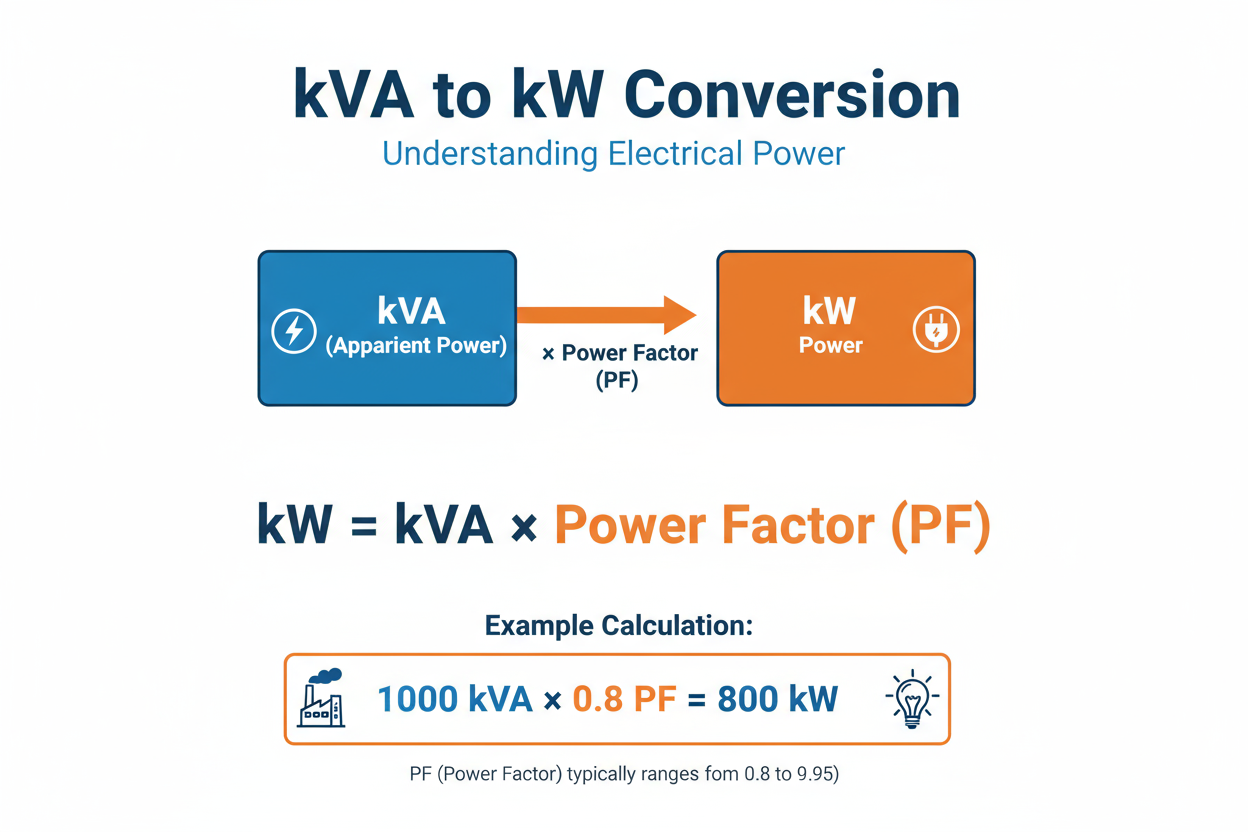
The relationship between kVA and kW depends on the power factor (PF) — the efficiency with which electrical power is converted into useful work. Mathematically:
kW = kVA × Power Factor
The Formula: How to Convert kVA to kW
The conversion from kVA to kW depends on the power factor (usually between 0.8 and 1.0). Here's the simple formula:
kW = kVA × Power Factor (PF)
Where:
- kW = Real power (the useful power)
- kVA = Apparent power (the total power supplied)
- Power Factor (PF) = Efficiency of power usage, In industrial systems with motors and transformers, PF is often around 0.8. In modern inverter-based or residential systems, PF is typically between 0.95 and 1.0.
Reverse Formula: kVA = kW ÷ Power Factor
If you want to find kVA from kW, you can rearrange the equation:
kVA = kW ÷ Power Factor
Example Calculations
Example 1: Standard Conversion
If a generator is rated at 10 kVA with a power factor of 0.8:
kW = 10 × 0.8 = 8 kW
That means the generator can supply 8 kW of real power.
Example 2: High-Efficiency System
If a solar inverter has a nearly perfect power factor of 1.0 and is rated at 5 kVA:
kW = 5 × 1.0 = 5 kW
In this case, the apparent power equals the real power because the system operates at full efficiency.
Example 3: Finding kVA from kW
If a portable power station delivers 4 kW and has a PF of 0.9:
kVA = 4 ÷ 0.9 = 4.44 kVA
What Is the Power Factor?
The power factor (PF) represents how effectively electrical power is converted into usable energy. It's a dimensionless number between 0 and 1.
1. Power Factor = 1.0 (Unity)
This means all power is effectively used — there's no wasted energy. Most modern electronics, especially those using DC or inverter technology, have PF values close to 1.0.
2. Power Factor < 1.0
This indicates some portion of power is wasted as reactive power. Industrial equipment with motors and transformers often operates at PF = 0.8.
Typical Power Factors by Equipment
| Equipment Type | Typical Power Factor (PF) |
|---|---|
| Resistive Loads (Heaters, Lamps) | 1.0 |
| Motors and Pumps | 0.8 – 0.9 |
| Computers and Electronics | 0.9 – 1.0 |
| Transformers or Inductive Loads | 0.7 – 0.8 |
Applications in Solar Generators and Portable Power Stations
Understanding kVA and kW is crucial when choosing a solar generator or portable power station. These devices convert and store energy for off-grid, home backup, and outdoor uses.
1. Rated Power vs. Usable Power
Manufacturers often list both rated power (kVA) and output power (kW). Since most modern inverters and LiFePO₄ battery systems operate at near 1.0 power factor, kVA ≈ kW for solar generators.
2. Choosing the Right System
When sizing a power station or solar generator, always consider your appliance wattage requirements (kW), not just kVA. For example:
- A refrigerator (150W) + TV (100W) + router (20W) = 270W total load.
- A 1 kW-rated power station can handle this easily with room to spare.
3. OUPES Example
For instance, the OUPES Mega series power stations feature advanced LiFePO₄ batteries and efficient inverter systems operating at nearly unity power factor. That means their rated capacity in kWh corresponds closely to real usable power, ensuring you get maximum performance for your appliances.
Comparison Table: kVA vs. kW
| Parameter | kVA (Apparent Power) | kW (Real Power) |
|---|---|---|
| Definition | Total supplied power (real + reactive) | Usable power that performs actual work |
| Formula | kVA = kW ÷ PF | kW = kVA × PF |
| Power Factor Impact | Not affected directly | Depends on PF value |
| Unit Purpose | Used for generator/inverter capacity ratings | Used to measure actual energy output |
| Example | 10 kVA generator at 0.8 PF → 8 kW usable | 8 kW = 10 kVA × 0.8 |
Why This Matters for Energy Users
Knowing how to convert between kVA and kW helps you make smarter decisions when selecting power equipment — from household generators to industrial systems. For users of portable power stations or solar setups, it ensures that your devices run efficiently without overloading your system.
Key Takeaways:
- kW measures usable energy; kVA measures total supplied power.
- Power factor (PF) determines conversion efficiency between kVA and kW.
- For most solar generators, PF ≈ 1.0, so kW ≈ kVA.
- Accurate understanding helps in selecting the right capacity for your backup or off-grid needs.
How OUPES Power Stations Handle Power Ratings
OUPES power stations are engineered with high-efficiency inverters and LiFePO₄ batteries, ensuring maximum real power output with minimal energy loss. Their near-unity power factor means what you see (kW rating) is what you actually get in performance.
Models like the OUPES Mega Series provide stable power for home appliances, outdoor work, and emergency use — delivering real, dependable wattage without noise or fuel.
FAQ
1) What's the difference between kW and kWh?
kW measures power (instantaneous energy use), while kWh measures energy consumption over time (1 kW used for 1 hour = 1 kWh).
2) Why is power factor important?
It determines how efficiently power is used. A higher PF means less energy waste and better system performance.
3) Can I assume kVA = kW for solar generators?
Yes, most solar generators and modern power stations have PF values close to 1.0, making kVA roughly equal to kW.
4) How do I choose the right power station capacity?
Add up the wattage of all devices you plan to power simultaneously and choose a unit with at least 20% higher output capacity.
5) What battery type is best for power efficiency?
LiFePO₄ batteries, used in OUPES power stations, are among the safest and most efficient, offering over 3,500 charge cycles and stable voltage output.
Final Thoughts
Converting kVA to kW is simple once you understand the role of the power factor. This knowledge helps you size and operate power systems efficiently — whether it's a home backup solution or an off-grid solar generator. With high-efficiency, LiFePO₄-powered systems like those from OUPES, users can count on maximum usable power and energy reliability in every situation.




Leave a comment
This site is protected by hCaptcha and the hCaptcha Privacy Policy and Terms of Service apply.