




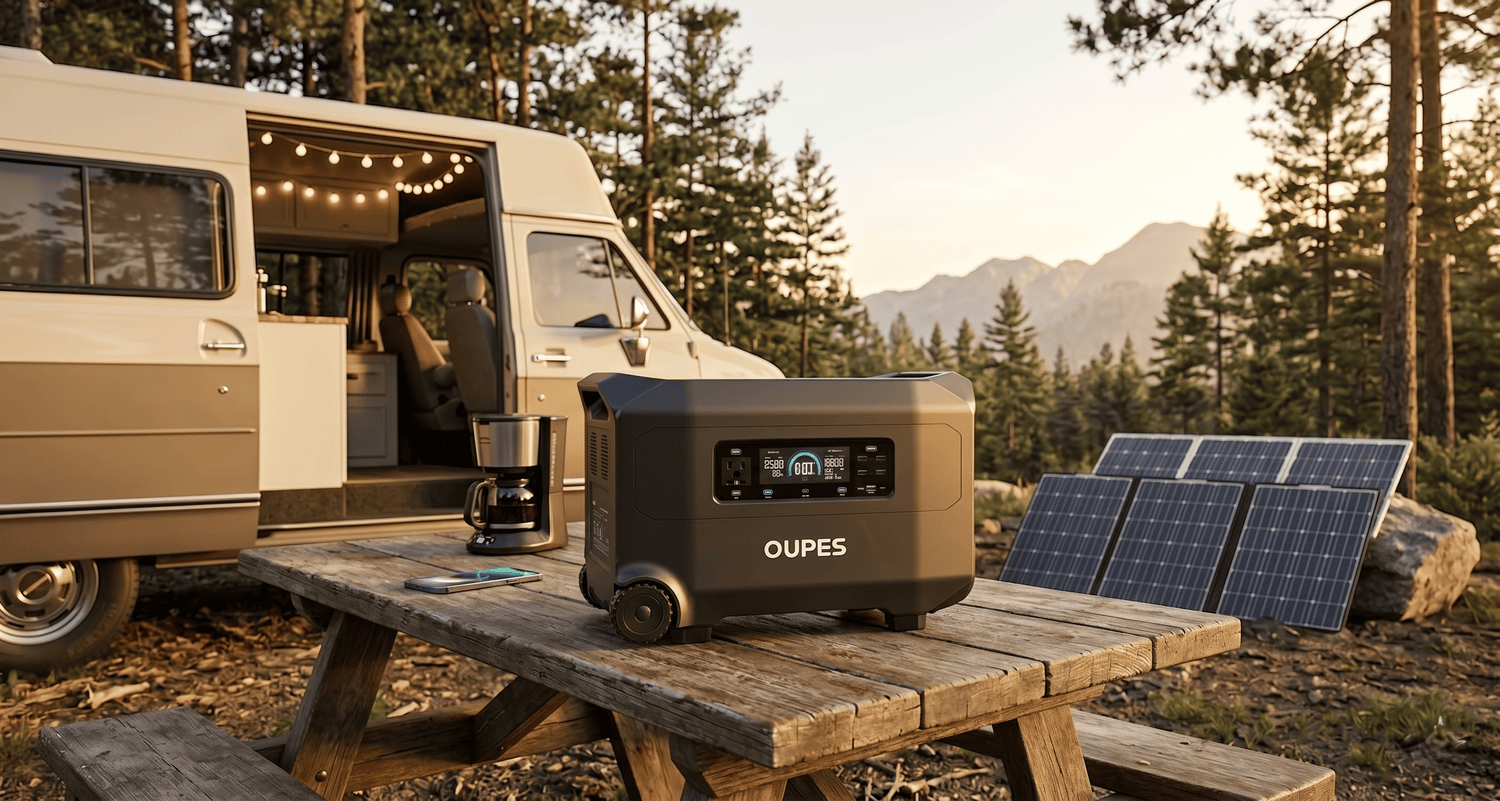
Powering a camper off grid is really about balancing three things: how much electricity you use, how much energy you can store, and how quickly you can recharge. Many people start with the wrong question and ask, “Which power station should I buy?” The better question is, “What loads do I need to run every day, and how do I keep that system replenished when there are no hookups?”
That matters because off-grid camping is not the same as full-hookup camping. On public land, dispersed camping is generally limited to 14 days within any 28-day period, and many popular campgrounds either have no electrical hookups or place restrictions on generator use.[1][2][3] So if you want to camp comfortably away from shore power, your camper needs an energy system that can match your travel style.
The good news is that a workable off-grid camper setup is not mysterious. Once you understand your daily loads and recharge options, it becomes much easier to decide whether a small solar generator kit is enough or whether you need a larger battery-and-solar platform for serious boondocking.
Table of Contents
- Start with your daily electrical loads
- Understand battery capacity vs. inverter output
- How solar fits into an off-grid camper setup
- Other ways to recharge off grid
- Why campsite rules make battery systems more useful
- How to estimate real runtime
- Detailed OUPES kit recommendations
- Bottom line
- References
- FAQ
Start with your daily electrical loads
The first step in powering a camper off grid is not buying equipment. It is making an honest list of what you actually want to run. In a camper, electricity usually falls into three categories:
- essential loads, such as lights, phones, charging, a water pump, or a 12V fridge
- comfort loads, such as laptops, fans, routers, or a coffee maker
- heavy loads, such as microwaves, induction cookers, portable air conditioners, or hair dryers
That distinction matters because not every camper needs the same power system. A small teardrop or weekend trailer might only need enough energy for lighting, device charging, and light food storage. A larger travel trailer or van used for remote work may need hours of laptop runtime, stronger ventilation, cooking support, and enough reserve power for cloudy days. The more your camper starts to feel like a tiny house, the larger the off-grid power system usually needs to be.
| Camper Style | Typical Power Need | Best System Approach |
|---|---|---|
| Weekend minimalist camper | Lights, phones, charging, fan, small fridge support | Modest battery plus solar recharge |
| Comfort-focused travel trailer | Essentials plus coffee, work gear, longer lighting, electronics | Mid-size battery with faster charging and more solar |
| Heavy off-grid RV living | Longer appliance use, larger loads, broader backup expectations | High-capacity expandable system with strong solar and AC charging |
Understand battery capacity vs. inverter output
A camper power system has to answer two different questions:
- How long can I run things? That is a capacity question, usually measured in watt-hours or kilowatt-hours.
- What can I run at the same time? That is an output question, usually measured in watts.
Many off-grid mistakes happen because people focus on only one of those numbers. A system may have enough stored energy for a full day, but still not enough inverter output to run a microwave or coffee maker comfortably. Or it may have a strong inverter, but not enough battery to last through the evening.
That is why a good camper setup needs both the right battery size and the right inverter size. For simple off-grid camping, you can often get away with less. But for longer stays or more comfort-heavy use, both numbers start to matter quickly.
How solar fits into an off-grid camper setup
Solar changes the off-grid equation because it lets you turn parked time into recovery time. The U.S. Department of Energy explains that solar photovoltaic systems work by absorbing sunlight with PV cells and converting it into electricity.[4] In camper use, that means your battery is not just a tank you drain. It becomes a tank you can refill while you camp.
That is the core reason solar generator kits are so useful for campers. If you are only carrying a battery and no recharge plan, you eventually run out. If you add solar, the system can keep supporting lighter loads day after day, and it can slow the drain of heavier-use days.
Of course, solar is not magic. Weather, shading, season, and panel size all matter. But even modest solar can make a big difference in a camper because many camper loads are intermittent rather than constant. Lights turn off. Chargers cycle down. Fans may run only part of the time. Solar does not need to replace every watt instantly to be useful. It just needs to reduce how much stored power you burn through.
Other ways to recharge off grid
A smart camper system usually does not rely on only one recharge path. Instead, it combines a few options:
- shore power before departure or when available at a stop
- solar charging while parked
- vehicle charging while driving between camps
- generator backup only where allowed and when really necessary
This is why fast AC charging matters almost as much as battery size. A larger battery is great, but if it takes too long to refill, you may still struggle. Likewise, strong solar input matters because it determines how much useful daytime recovery you can get on extended trips.
Why campsite rules make battery systems more useful
Another reason battery-and-solar systems are attractive for campers is that generators are not always convenient or welcome. For example, Yosemite campground regulations list quiet hours from 10 p.m. to 6 a.m. and allow generator use only during specific daytime windows: 7 a.m. to 9 a.m., noon to 2 p.m., and 5 p.m. to 7 p.m..[2]
That kind of rule matters in real life. If your best solar charging hours are during the day and your battery covers the quiet evening period, your camper setup feels much smoother and more campsite-friendly. By contrast, a system that depends heavily on generator runtime may feel restrictive, noisy, and harder to use around other campers.
Generator safety matters too. Ready.gov says generators should be used only outdoors and away from windows during outages.[5] Even if your main goal is camper comfort rather than emergency backup, that is another reason why many campers prefer battery-first systems for regular off-grid use.
How to estimate real runtime
A practical planning formula for campers is:
Estimated runtime (hours) = battery capacity × 0.8 ÷ average load
The 80% factor is a realistic planning buffer. It helps account for inverter losses, system overhead, and the fact that real-world conditions are rarely as perfect as the label math suggests.
Below is a simple runtime comparison using the three OUPES kits you linked and three example camper load levels:
| Kit | Rated Capacity | Usable Capacity (80%) | Runtime at 300W | Runtime at 600W | Runtime at 1000W |
|---|---|---|---|---|---|
| Mega 2 + 2×240W Solar | 2048Wh | 1638Wh | 5.46 hours | 2.73 hours | 1.64 hours |
| Mega 3 + 2×240W Solar | 3072Wh | 2458Wh | 8.19 hours | 4.10 hours | 2.46 hours |
| Guardian 6000 + 2×240W Solar | 4608Wh | 3686Wh | 12.29 hours | 6.14 hours | 3.69 hours |
These figures assume the load is running continuously, which is rarely true in a camper. Real runtime is often longer when your loads cycle on and off. But the table still shows the relative difference between the three systems very clearly.
Detailed OUPES kit recommendations
OUPES Mega 2 + 2×240W Solar Panel Kit: the sweet spot for most campers
The OUPES Mega 2 + 2×240W Solar Panel Kit is one of the most balanced camper setups in this group. The official page lists it at 2,048Wh capacity, 2,500W output, 5,400W surge, and 480W solar, with a LiFePO4 battery rated for 3,500+ life cycles to 80%, 15 outputs, and expansion up to 10.24kWh with four B2 batteries.[6]
The same kit page also highlights a 3,700W max input charging speed and a full charge in about 0.6 hours under its fastest charging configuration, while the related Mega 2 product page notes up to 2,100W solar charging and a TT-30 120V/30A RV outlet along with multiple DC and USB outputs.[6][7]
For campers, this is the strongest all-around choice when you want more than basic lighting but do not need a massive home-backup-class system. It suits travel trailers, van conversions, and camper setups where you want to run daily essentials, charge multiple devices, support an RV-style outlet, and still recover quickly from solar or AC charging.
OUPES Mega 3 + 2×240W Solar Panel Kit: for longer stays and heavier use
The OUPES Mega 3 + 2×240W Solar Panel Kit moves into a stronger off-grid tier. OUPES lists it at 3,072Wh capacity, 3,600W AC pure sine wave output, 7,000W surge, 480W solar, 16 outputs, and expansion up to 15.36kWh with six B2 batteries.[8]
The product page also states that it can fully recharge in about 1 hour with 3,900W max input, and details 1,800W AC charging, 2,100W solar charging, and a TT-30 120V/30A outlet among its outputs.[8]
This is a very strong fit for campers who stay out longer, run more appliances, or want a higher comfort level without immediately stepping into a much larger 240V platform. It is especially useful for longer boondocking stays, bigger trailers, and travel styles where “just enough” power is not enough.
OUPES Guardian 6000 + 2×240W Solar Panel Kit: the serious off-grid platform
The OUPES Guardian 6000 + 2×240W Solar Panel Kit is in a different category. The official pages show it as a 4,608Wh capacity system with 480W solar, scalable up to 41.4kWh with G5 batteries.[9] OUPES also lists 240V/6,000W rated output with 7,200W Boost and 9,000W surge, plus 120V/3,600W output, 2,100W max solar charging, and 240V 3,600W AC charging for a full 4,608Wh recharge in as fast as 84 minutes.[9]
The outlet mix is also much more serious, including RV- and high-load-friendly options such as NEMA L14-30R, NEMA 14-50R, and other heavy-duty outlets.[9]
For campers, Guardian 6000 is the choice when the camper setup is starting to look more like a true off-grid electrical system than a light camping accessory. It fits larger RVs, longer off-grid trips, more demanding appliance plans, and users who want a system that can handle both travel and major backup use.
Bottom line
To power a camper off grid well, you need more than a battery. You need a system. That system starts with an honest daily load estimate, then adds enough battery capacity, enough inverter output, and enough recharge flexibility to keep the trip comfortable without constant power anxiety.
For many campers, the most practical path is a solar generator kit that combines stored energy with real solar recovery. Mega 2 + 2×240W is the best all-around fit for many travel styles. Mega 3 + 2×240W is the stronger choice for longer stays and bigger daily loads. Guardian 6000 + 2×240W is the platform for campers who want serious off-grid capability and much more headroom.
The best kit is not the biggest one. It is the one that matches how your camper is actually used.
References
- Bureau of Land Management — Camping on Public Lands
- Yosemite National Park — Campground Regulations
- Yosemite National Park — Campgrounds
- U.S. Department of Energy — How Does Solar Work?
- Ready.gov — Power Outages
- OUPES Mega 2 + 2×240W Solar Panel Kit — Official Product Page
- OUPES Mega 2 Platform — Official Product Page
- OUPES Mega 3 + 2×240W Solar Panel Kit — Official Product Page
- OUPES Guardian 6000 + 2×240W Solar Panel Kit — Official Product Page
FAQ
1. What is the most important part of an off-grid camper power setup?
The most important part is matching the system to your real daily loads. Battery size, inverter size, and recharge speed all matter, but they only make sense when they are based on how you actually camp.
2. Is solar enough to power a camper off grid by itself?
Sometimes, but only if your daily consumption stays within what the battery and panels can support. Solar works best when it is part of a full system, not a substitute for battery storage.
3. Why is battery capacity not enough on its own?
Because you also need enough inverter output to run the loads you want at the same time. A big battery with a weak inverter can still feel limiting.
4. Do I still need shore power if I have a solar generator kit?
Not always, but shore power remains useful because it lets you top off quickly before a trip or recover fully after a few cloudy days.
5. Is a generator still useful for campers?
Sometimes, but generator use is often restricted by campground rules, and generator safety matters. That is one reason battery-and-solar systems are so popular for quieter, easier off-grid use.[2][5]
6. Which OUPES kit is best for most campers?
For many camper setups, the Mega 2 + 2×240W kit is the best balance of size, output, solar support, and expansion. Mega 3 + 2×240W is better for longer stays or heavier loads, while Guardian 6000 + 2×240W is the choice for the most demanding off-grid setups.
7. What is the biggest off-grid camper power mistake?
Underestimating daily electricity use and overestimating how much one day of charging will solve. The best systems are built around realistic habits, not wishful thinking.

Leave a comment
This site is protected by hCaptcha and the hCaptcha Privacy Policy and Terms of Service apply.