


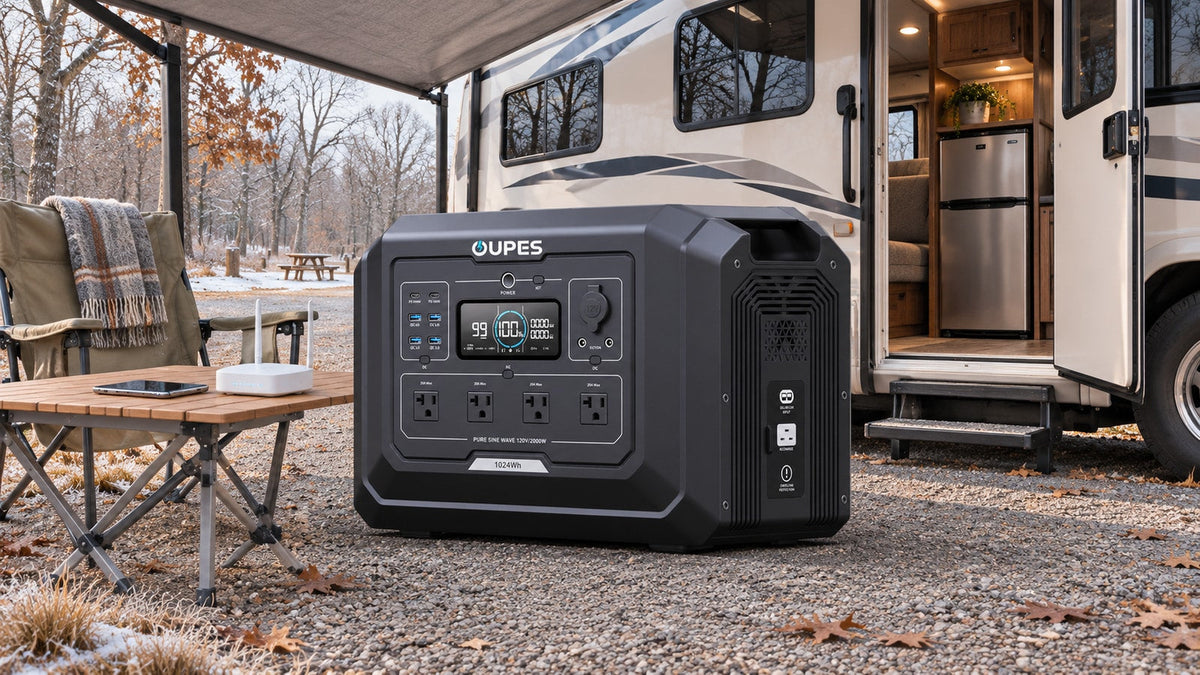
For a Thanksgiving or Christmas RV trip, calculate the loads you will actually run between charging stops. Start with refrigerator energy, then add communications, lights and personal devices. Check both watt-hours and the highest simultaneous watts. A holiday travel survey signals interest in RV trips; it does not tell you the electrical needs of your vehicle.
Key Takeaways
- Measure refrigerator energy over a realistic day; its compressor rating is not its all-day average.
- Size stored energy to the time between dependable charging opportunities, with a reserve.
- Keep the station dry, ventilated and secured; verify any RV system connection against both manuals.
Why holiday travel changes the power plan
The RV Industry Association’s November 5, 2026 Winter Travel Intentions survey estimated that 11.4 million Americans planned an RV trip over Thanksgiving and 11.2 million over Christmas. Those are intentions, not counts of completed trips. They are useful context for a practical question: will your refrigerator and essential electronics have power during a long drive, overnight stop or campsite without a working hookup?
Make a separate load sheet for each leg. An RV with shore power, an alternator-charged house battery and a portable station has different options from one parked off grid. Holiday traffic, campground rules and short winter days can delay a planned recharge. Treat a charging opportunity as dependable only after you have confirmed the outlet, charging method and time available.
Measure the refrigerator and electronics
Write down each device’s input voltage, average watts, hours of use and connection type. For a compressor refrigerator, use a plug-in energy meter or the appliance’s documented daily energy where appropriate; its running wattage alone misses on/off cycling. Measure in conditions similar to the trip, since ambient temperature, thermostat setting and door openings change consumption. Check the compressor’s starting demand separately.
For communications, count the entire chain: router or cellular gateway, any separate modem or satellite terminal, and the phone. A powered router cannot create cellular or campground service when the upstream network is unavailable. Phone charging is often easier to budget as total Wh per charge than as a charger’s maximum rated watts. Our RV TV and router guide explains how to measure an electronics-only system; add refrigeration and other RV loads to make a full holiday plan.
A 12-hour stop worked example
These are illustrative measured-load assumptions, not specifications for your RV: refrigerator average 35W for 12 hours, communications 12W for 8 hours, phone charging 40Wh in total, and an 8W LED lamp for 5 hours. Energy is 35 × 12 + 12 × 8 + 40 + 8 × 5 = 596Wh. If the battery-to-device planning factor is an illustrative 0.80, required nominal capacity is 596 ÷ 0.80 = 745Wh. A further 20% operating reserve brings the planning target to about 894Wh.
Extend only the refrigerator to 24 hours and the same example becomes 1,016Wh at the devices, or 1,270Wh nominal before reserve. The overnight plan and the full-day plan therefore need different charging or storage choices. Do not add a second efficiency deduction to an energy figure you have already measured at the battery output.
Match a station to the measured plan
The current US OUPES Mega 1 page lists 1,024Wh nominal capacity and 2,000W rated AC output. It can be a reference for the 894Wh short-stop planning target, but that margin is small if your refrigerator uses more energy or the stop runs long. A smaller pack may serve an electronics-only trip; a full-day refrigerator plan can require recharge or more stored energy. Confirm the exact unit configuration and availability before ordering.

OUPES Mega 1
- 1,024Wh nominal battery capacity.
- 2,000W rated AC output; verify individual outlet limits.
- Compare against measured refrigerator and electronics energy.
Battery capacity does not establish whether a compressor will start. Verify AC voltage, plug type, continuous output, startup tolerance and any port-specific limits. Never infer that a portable station can power an entire RV just because its outlet resembles an RV connector.
Plan recharge and safe placement
Charge fully before departure and record the next realistic charging point. Solar can extend a stay, but winter cloud, shade, panel angle, daylight and the station’s input limit make a panel’s nameplate watts an unreliable daily yield. If you estimate solar, use panel watts × site-specific peak-sun-hours × an explicit system factor, then compare with the measured daily Wh demand.
Secure the station for travel, keep ventilation clear and use it only in the operating conditions allowed by its manual. Place it on a stable dry surface when parked. Do not improvise a connection into the RV wiring or feed a station’s output into an RV converter that could try to recharge the same station. Ask an installer to check any dedicated RV integration.
Frequently asked questions
Can I estimate a refrigerator from its labelled running watts?
Only as a rough upper bound for the time the compressor is on. Measure daily Wh or estimate duty cycle, and separately verify startup load.
Should I count heating?
Yes if your heating system uses an electric fan, controller or ignition. Measure it separately; do not assume a portable battery can run electric space heat all night.
Does a solar panel replace the reserve?
No. Keep enough stored energy for poor weather or a delayed recharge.


Leave a comment
This site is protected by hCaptcha and the hCaptcha Privacy Policy and Terms of Service apply.