




A well pump backup source must match the pump's voltage, continuous running demand, motor-start surge and daily operating energy. Many home well pumps are hardwired and some use 240V, so capacity alone is not enough. Start with the pump/control-panel nameplate and have a qualified electrician measure inrush and design the transfer connection.
Key Takeaways
- Confirm 120V or 240V before considering battery size.
- Motor startup can be several times running current and must be measured or documented.
- Daily Wh depends on total pump runtime, not simply horsepower.
- Hardwired pumps need an appropriate transfer arrangement.
- Pressure tanks, pump depth and household water use affect cycling and energy.
Collect the Pump and Control Specifications
Record pump model, voltage, phase, horsepower, full-load amps, control box, breaker size and whether a soft starter or variable-frequency drive is present. Inspect the pressure system and note how often the pump cycles.
Do not infer voltage from horsepower. Two pumps with similar water output can have different electrical requirements.
Measure Running and Startup Demand
A qualified person can use an inrush-capable clamp meter on the appropriate conductor. The measurement must capture the brief starting envelope, while a separate reading establishes running current. Starting conditions can change with water pressure and supply voltage.
For an illustrative 240V pump drawing 8A while running, apparent power is 1,920VA. If measured startup reaches 40A, the apparent startup event is 9,600VA. These are examples, not typical values or a recommendation.
Calculate Daily Pump Energy
Measure or estimate total daily motor runtime. If a pump draws 1,500W and runs for two cumulative hours per day, energy is 3,000Wh. At 90% usable fraction and 85% efficiency, nominal battery capacity is about 3,000 ÷ 0.765 = 3,922Wh before contingency.
Frequent short cycling can raise the number of starts without greatly increasing running hours. Correct pressure-tank or plumbing problems rather than oversizing backup power around a fault.
Design the Connection Safely
The backup system's grounding, neutral arrangement, breaker protection, voltage and receptacle/connection must suit the pump controls. An electrician should also confirm whether other loads share the well circuit.
Match the System to the Pump
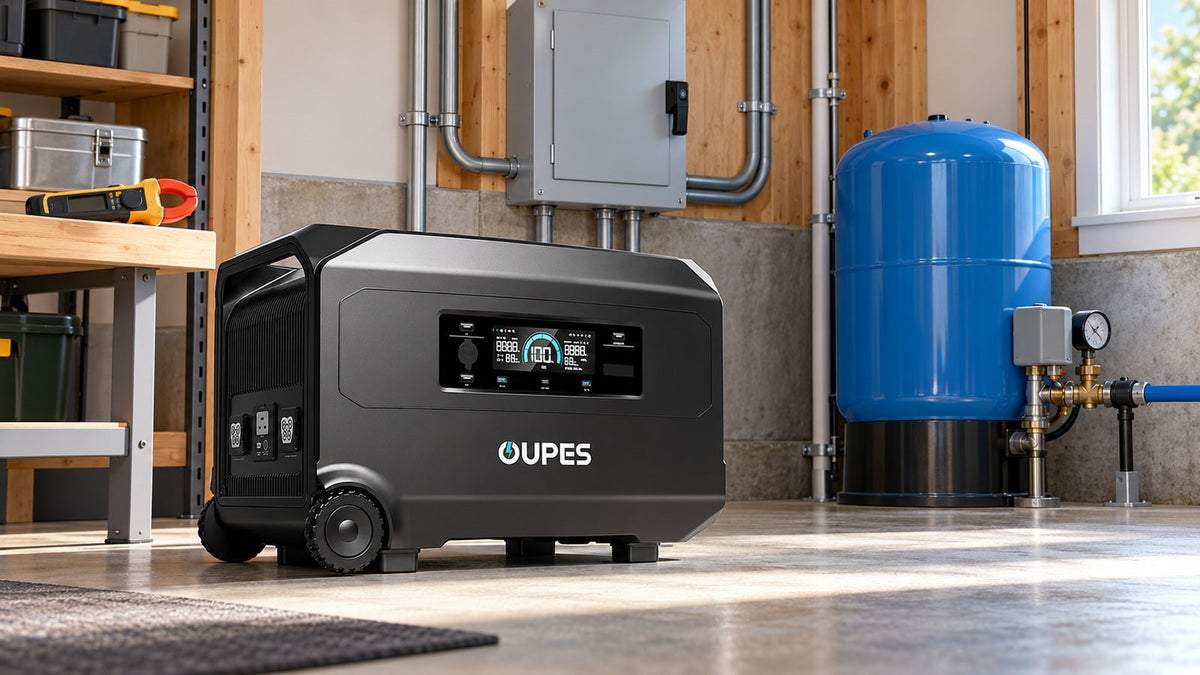
Small 120V pumps with modest measured startup may fit some high-output stations. Large 240V pumps can require a dual-voltage system with substantial surge support. The Guardian 6000 V2 is one current OUPES platform to evaluate for compatible 120V/240V loads; it is not a universal well-pump guarantee.

OUPES Guardian 6000 V2
- 4,608Wh base capacity.
- 6,000W at 240V and 3,600W at 120V, subject to outlet limits.
- Native 120V/240V dual-voltage output.
- A dual-voltage platform to evaluate against measured pump startup and transfer requirements.
Reduce Electrical Demand Through Water Planning
Enter an outage with a functioning pressure tank and repair leaks. Schedule high-water activities and avoid unnecessary simultaneous electrical loads during pump starts. Safe stored drinking water provides resilience if electrical or mechanical equipment fails.
For a wider plan, compare home backup systems only after the pump assessment. Keep an alternate water source appropriate to household needs.
Commission the Pump Backup as a System
After installation, test a normal pressure cycle, a start with other allowed loads running, low-battery behavior and the documented shutdown procedure. Confirm that transfer equipment prevents unintended energizing of utility or generator circuits.
Record pump inrush, running current, daily runtime, battery energy used and recovery time. Repeat after pump, pressure-tank or control changes; those changes can alter both starts and energy demand.
Frequently Asked Questions
Can I size from pump horsepower alone?
No. Voltage, running amps, startup current, controls and runtime are required.
Are all well pumps 240V?
No. Verify the exact pump and control panel.
How do I measure startup current?
Use an inrush-capable instrument and qualified person on the correct conductor.
Can a 3kWh battery run a well pump?
Energy may fit some use patterns, but inverter voltage and surge must also fit.
Does a pressure tank reduce energy use?
It changes cycling and provides stored pressure; a correctly functioning system can avoid unnecessary starts.
Can I plug a hardwired pump into a station?
Only through a properly designed compatible connection, not an improvised cord.
Does an expansion battery increase surge power?
Usually it increases stored energy, not inverter output.
Should I include other loads?
Yes. Add loads that may run while the pump starts.
What if the pump requirement exceeds the station?
Use a larger compatible system, reduce concurrent loads, or develop an alternate water plan with a professional.

Leave a comment
This site is protected by hCaptcha and the hCaptcha Privacy Policy and Terms of Service apply.