




A 1000Wh portable power station offers a practical balance of stored energy, appliance capability, and portability. It can support weekend camping, RV travel, mobile work, and selected home essentials during a short outage. However, capacity alone does not tell you whether a power station can start an appliance or how useful it will be in your situation. A good choice must combine adequate watt-hours with the right continuous output, surge capability, charging options, ports, and battery design.
Key Takeaways
- 1000Wh is an energy rating. It describes the battery's storage capacity, while watts describe the load the inverter can supply.
- A 1000Wh-class power station is well suited to communications, lighting, laptops, portable refrigeration, and carefully planned short-term home backup.
- Actual runtime is lower than rated capacity divided by appliance wattage because conversion losses, idle consumption, temperature, and load behavior affect delivered energy.
- Continuous output and surge capability determine whether the unit can run an appliance; battery capacity determines how long it can run.
- Battery chemistry, solar input, AC charging speed, weight, ports, and expansion support can matter as much as capacity.
What Does 1000Wh Mean?
Watt-hours measure stored energy. One kilowatt-hour equals 1,000 watt-hours, so a 1,024Wh model belongs to the same general capacity class as a 1000Wh portable power station.
Energy used (Wh) = appliance power (W) × operating time (h).
A device averaging 100W for five hours requires 500Wh at the load. In a loss-free calculation, a 1000Wh battery could run a constant 100W load for ten hours. Real systems lose some energy through the inverter, wiring, battery protection, idle consumption, and temperature effects.
A more useful planning formula is:
Estimated runtime (h) = rated capacity (Wh) × delivered-energy factor ÷ average load (W).
For example, using an illustrative delivered-energy factor of 0.85:
1,024Wh × 0.85 ÷ 100W ≈ 8.7 hours.
The 0.85 factor is a planning assumption rather than a guaranteed efficiency. Actual results depend on the power station, load, operating mode, temperature, and battery condition.
1000Wh Is Not the Same as 1000W
| Specification | What it describes | What it affects |
|---|---|---|
| Wh | Stored battery energy | How long devices can run |
| Continuous W | Power the inverter can supply continuously | Which appliances can operate |
| Surge W | Short-duration peak output | Whether motors and compressors can start |
A 1000Wh battery paired with a 2,000W inverter may run a high-power appliance successfully, but the battery will discharge quickly. A large inverter expands appliance compatibility; it does not create more stored energy.
Who Should Choose a 1000Wh Portable Power Station?
This capacity class is useful when a small power bank is too limited but a 2–3kWh system would add unnecessary weight and cost. Before choosing one, list every device, its average and startup power, and the number of hours you expect to use it.
Weekend Camping
A 1000Wh power station can support phones, cameras, laptops, camp lighting, a portable refrigerator, a fan, and short sessions with compatible cooking equipment. Adding a compatible portable solar panel can replace part of the energy used during the day, but solar harvest depends on weather, orientation, shade, and the power station's input limits.
RV Travel and Van Life
For an RV or van, 1000Wh can cover a carefully managed combination of a router, television, lighting, laptop, and portable refrigerator. Longer trips require a daily energy budget and a reliable charging plan. Review the available RV power station options if vehicle charging, solar input, or multi-day use is important.
Mobile Work
Photographers, remote workers, and mobile technicians can use this capacity for laptops, displays, camera batteries, drones, networking equipment, and selected tools. Check USB-C power delivery requirements as well as the total AC load.
Short Home Outages
A 1000Wh unit can keep communications, lighting, computers, a refrigerator, a fan, or a compatible CPAP device running for a limited period. It is best treated as backup for selected essentials rather than a whole-home system.
How Long Can a 1000Wh Portable Power Station Run Common Devices?
The following examples use a 1,024Wh battery and an illustrative 0.85 delivered-energy factor, providing about 870Wh for connected loads. They are planning estimates, not product guarantees. Use measured average consumption whenever possible.
| Device | Assumed average load | Estimated runtime |
|---|---|---|
| Wi-Fi router | 15W | About 58 hours |
| LED lighting | 20W | About 43.5 hours |
| CPAP device without heated accessories | 40W | About 21.8 hours |
| Portable refrigerator | 50W average | About 17.4 hours |
| Laptop computer | 60W | About 14.5 hours |
| Electric blanket | 80W | About 10.9 hours |
| Television | 100W | About 8.7 hours |
| Household refrigerator | 120W average | About 7.3 hours |
| Microwave | 1,000W electrical input | About 52 minutes of cumulative operation |
Refrigerators, air conditioners, water pumps, and power tools may draw substantially more power during startup than during normal operation. Verify both continuous and surge requirements. For cycling loads, a measured 24-hour energy value is usually more useful than a single running-watt reading.
High-power appliances also consume energy quickly. A compatible microwave or coffee maker may run successfully for short periods, while continuous electric heating can exhaust the same battery in well under an hour.
Which Specifications Matter Most?
Continuous Output and Startup Demand
Add the power of all devices that will operate at the same time. Check motor and compressor startup separately, and leave reasonable operating headroom. Multiple AC outlets share the inverter's total rating; each outlet is not an independent full-power source.
LiFePO4 Battery Chemistry
LiFePO4 batteries are widely used in current 1000Wh-class products because they are suitable for repeated cycling and long-term backup use. Battery life still depends on temperature, storage charge, discharge depth, and operating conditions.
AC and Solar Charging
Fast AC charging can help restore the battery between outages or trips. For solar charging, verify the panel's open-circuit voltage, current, connector, cable, and array configuration against the power station's accepted input range. Matching connectors alone do not prove electrical compatibility.
Solar energy can be estimated with:
Daily solar energy ≈ array power × peak sun hours × system factor.
For example, a 240W panel receiving four equivalent peak-sun hours with an illustrative 0.75 system factor would produce about 720Wh: 240 × 4 × 0.75. Weather, shade, temperature, charging curves, and input limits can reduce the result.
Ports and Device Compatibility
Review the number and ratings of AC outlets, USB-C ports, USB-A ports, and 12V outputs. A suitable USB-C port can charge a laptop without its AC adapter, but the port, cable, and laptop must support the same power-delivery profile.
Weight and Portability
A 1000Wh unit is easier to transport than a large home battery, but it can still be heavy when combined with panels and accessories. Consider stairs, vehicle storage, campsite distance, handle design, and how often the unit will move.
Expansion Support
An expandable system can start at about 1kWh and add energy later. Confirm the exact supported battery model and maximum expansion quantity. Added batteries increase runtime but do not automatically increase inverter output.
Is 1000Wh Enough for Home Backup?
It can provide useful short-term backup when loads are prioritized. A practical sequence is:
- Communications and phones;
- Necessary lighting;
- Refrigeration;
- Computers and work equipment;
- Compatible medical equipment;
- Low-power comfort devices such as a fan.
Running a refrigerator, television, computer, and lights together reduces runtime quickly. Long outages require additional stored energy or a dependable way to recharge. If the goal includes central air conditioning, electric water heating, an electric range, or several large appliances, consider a larger home backup power system.
Which OUPES 1000Wh Option Should You Choose?
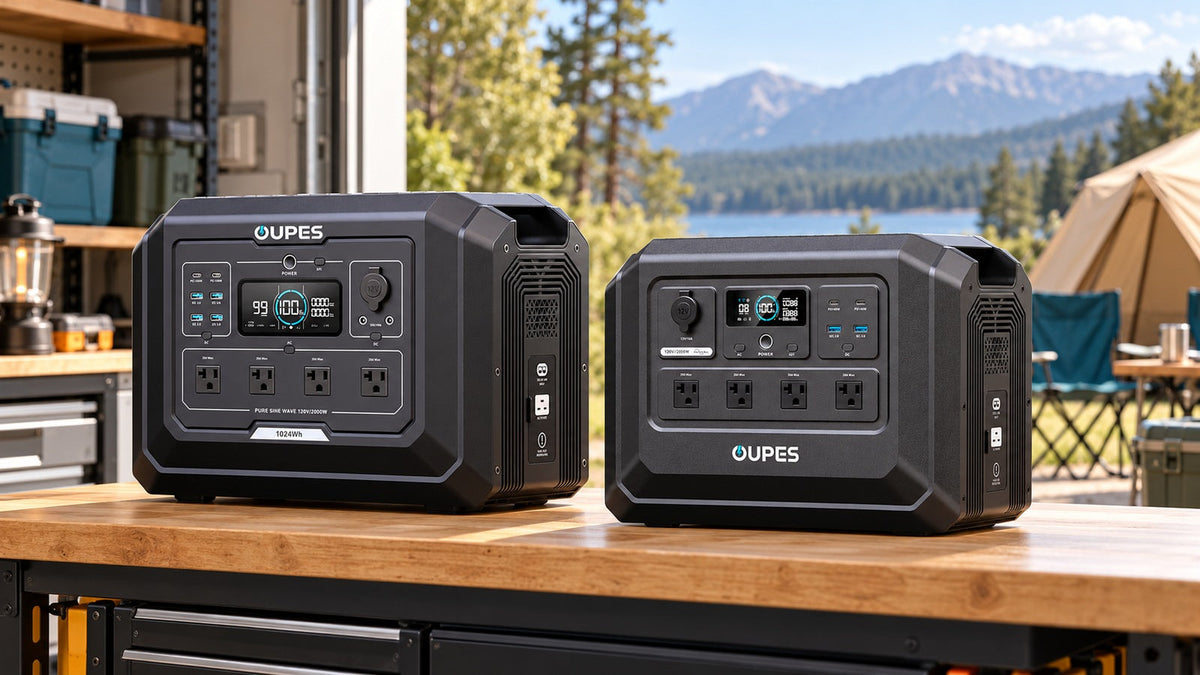
The current U.S. OUPES lineup includes two 1,024Wh, 2,000W models in the Mega Series: Mega 1 and Mega 1 Lite. Both use LiFePO4 batteries and list 4,500W surge capability, but they serve different priorities.
| Feature | Mega 1 | Mega 1 Lite |
|---|---|---|
| Battery capacity | 1,024Wh | 1,024Wh |
| Rated AC output | 2,000W | 2,000W |
| Surge output | 4,500W | 4,500W |
| Output ports | 13 | 9 |
| Maximum solar input | 800W | 800W |
| Listed weight | 27.8 lb | 26.8 lb |
| Expansion | Up to 5.12kWh with two compatible B2 batteries | No expansion option listed on the current product page |
| Best fit | More ports and future capacity expansion | Simpler, slightly lighter 1kWh setup |
Choose Mega 1 for Expansion and More Connections
Mega 1 is the stronger choice when you want 1,024Wh today but may need more stored energy later. Its expansion support and additional ports suit home-backup planning, RV setups, and multi-device use.

OUPES Mega 1
- 1,024Wh LiFePO4 battery capacity.
- 2,000W rated AC output and 4,500W surge.
- 13 outputs for multi-device setups.
- Expandable up to 5.12kWh with two compatible B2 batteries.
Choose Mega 1 Lite for a Streamlined 1kWh System
Mega 1 Lite retains the same 1,024Wh capacity and 2,000W rated output in a slightly lighter configuration with nine ports. It is a practical fit for camping, mobile work, and short outages when battery expansion is not a priority.

OUPES Mega 1 Lite
- 1,024Wh LiFePO4 battery capacity.
- 2,000W rated AC output and 4,500W surge.
- Nine outputs, including two USB-C ports rated up to 140W each.
- Up to 800W solar input for compatible off-grid charging.
Choose between them after calculating the connected loads and required runtime. If the energy budget already exceeds 1kWh before adding a reserve, move to a larger system. If the main loads are phones, cameras, and one laptop, a smaller unit may provide better portability and value. You can also compare the current range of OUPES portable power stations.
Frequently Asked Questions
Can a 1000Wh portable power station run a refrigerator?
Often, yes, but check the refrigerator's running power, startup surge, voltage, and measured energy use. Battery capacity alone does not prove that the power station can start the compressor.
How long will a 1000Wh power station run a refrigerator?
Using a 120W average load and an illustrative 0.85 delivered-energy factor, a 1,024Wh battery would provide about 7.3 hours. A real refrigerator cycles on and off, so measured daily watt-hours provide a better estimate.
Can a 1000Wh power station run a microwave?
It can run a compatible microwave when the appliance's electrical input and startup demand remain within the inverter's limits. Microwaves draw substantial power, so they are best used for short sessions.
Is 1000Wh enough for a CPAP device?
It may cover one or more nights, depending on the device and settings. Heated humidifiers and heated tubing can increase consumption significantly. Use the CPAP manufacturer's power data and maintain a separate backup plan for medically necessary equipment.
Can a 1000Wh portable power station run an air conditioner?
Some small air conditioners may operate for a limited time if continuous and startup requirements fit the inverter. Air conditioning is energy intensive, so 1000Wh usually does not provide long runtime.
Can I use a portable power station while it is charging?
Some models support pass-through charging or an EPS/UPS mode, but supported loads and switching behavior vary. Follow the exact product manual rather than assuming every charging mode works the same way.
How many watts of solar should I use with a 1000Wh power station?
Choose the array from the power station's accepted voltage, current, and power limits, then consider local sunlight and the required recharge time. Panel wattage alone does not establish compatibility or real daily production.
Should I choose a 1000Wh or 2000Wh power station?
Choose about 1000Wh for weekend camping, mobile work, and selected home essentials when portability matters. Choose 2000Wh or more when you need longer outage coverage, repeated high-power appliance use, or more energy between charging opportunities.
What should I check before ordering?
Confirm the exact U.S. configuration, current availability, included cables, outlet and port ratings, solar input range, appliance startup requirements, warranty terms, and current manual. Do not base the decision on capacity or a promotional runtime example alone.
Final Recommendation
A 1000Wh portable power station is a strong middle-ground option for users who want meaningful backup energy without moving to a much larger system. It can cover many camping, RV, work, and short-outage needs when loads are measured and prioritized.
Start with the appliances, their running and startup power, and the hours of operation. Then compare capacity, continuous output, charging access, ports, weight, and expansion support. That process produces a more reliable choice than simply buying the largest watt or watt-hour number on the product page.


Leave a comment
This site is protected by hCaptcha and the hCaptcha Privacy Policy and Terms of Service apply.