




Add the running watts of every device that may operate at the same time, then test the largest startup event separately. Calculate daily energy by multiplying each device's average watts by its operating hours and summing the watt-hours. Output sizing and energy sizing are related but cannot be combined into one number.
Key Takeaways
- Simultaneous W determines required inverter output.
- Daily Wh determines required battery capacity.
- Motor startup demand must be added to the other loads already running.
- Individual port and voltage limits still apply even when total watts fit.
- Use measurements for cycling and variable loads whenever possible.
Build a Load Inventory
For every device, record running watts, startup watts if applicable, hours per day, voltage and connection. Separate “must run together” from “can be scheduled.” A coffee maker and microwave may never need to operate together, while a router and refrigerator may.
Use the input watts on the equipment label or a suitable power meter. Output ratings printed on adapters do not always equal wall input.
Add Simultaneous Running Watts
Assume a router uses 20W, a laptop setup uses 90W and a refrigerator uses 120W while its compressor runs. If all three operate together, continuous load is 230W. Add reserve rather than selecting an inverter at exactly 230W.
For AC labels that show volts and amps, V × A gives volt-amperes. True watts may differ because of power factor. Use measured watts or manufacturer input data when available.
Calculate the Startup Case Separately
If the illustrative refrigerator requires 800W briefly at startup while the 20W router and 90W laptop are already on, the event is about 910W. Compare that event with the station's documented surge behavior and duration. Do not add every device's worst-case surge unless they can realistically start together.
Peak ratings are temporary. A 900W continuous appliance cannot be treated as compatible with a 900W surge-only specification.
Add Watt-Hours for the Battery Size
| Load | Assumption | Energy |
|---|---|---|
| Router | 20W × 12h | 240Wh |
| Laptop setup | 90W × 4h | 360Wh |
| Refrigerator | 60W daily average × 12h | 720Wh |
| Total | 1,320Wh | |
With a 90% usable fraction and 85% efficiency, required nominal capacity is 1,320 ÷ (0.90 × 0.85) ≈ 1,725Wh before additional contingency.
Check Shared and Individual Port Limits
Several AC outlets normally share one inverter. USB-C ports may have individual and combined limits. A 12V output may be limited by amps even when the overall station has plenty of watts. Confirm the exact port used by each device.
Never combine two unrelated AC outputs into one appliance unless the system documentation explicitly provides a supported paired-output function.
Choose a Station After the Math
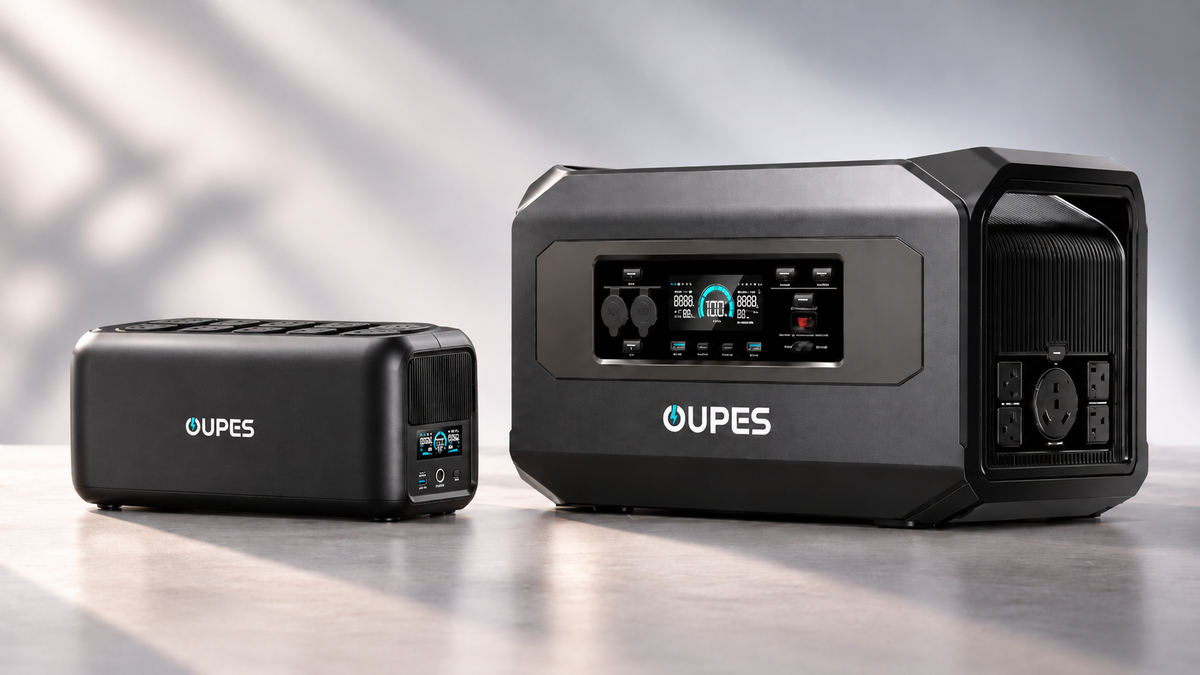
The example points above a 1kWh class for the full energy budget, though load scheduling or recharging may reduce the need. Compare the broader OUPES Mega Series after defining output and Wh.

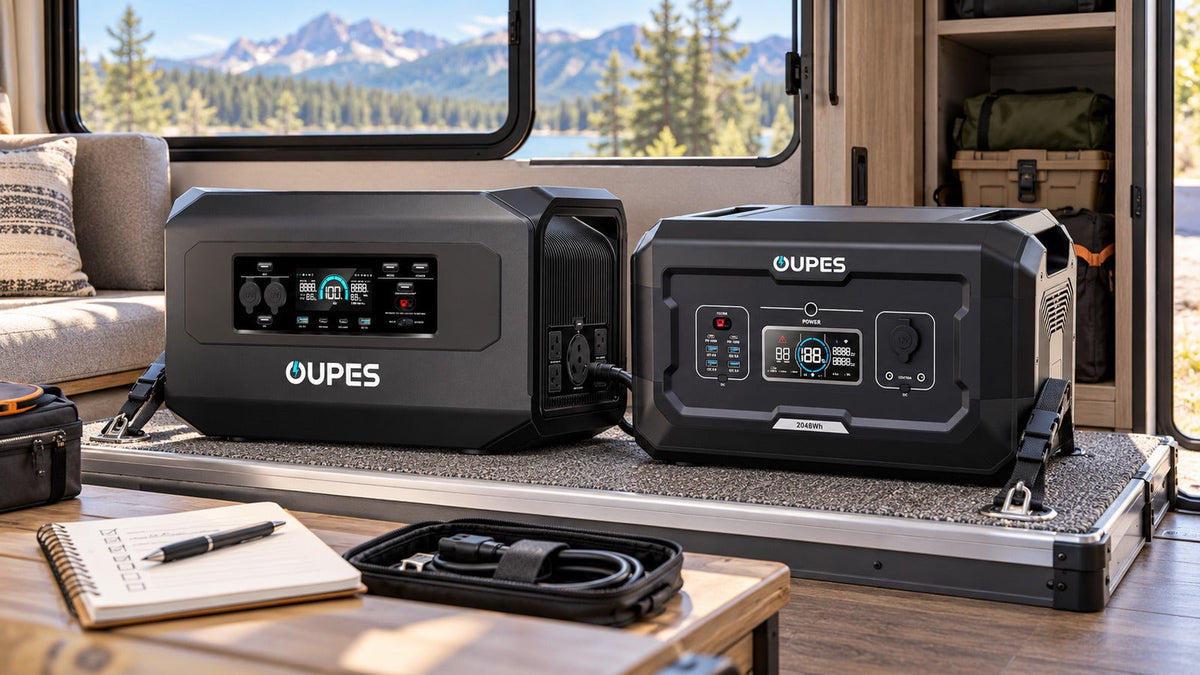
OUPES Mega 2 Pro
- 2,048Wh base capacity.
- 2,500W continuous AC output with 3,600W boost.
- Expandable up to 10.24kWh with compatible B2 batteries.
- A 2kWh-class example for broader multi-device loads and future capacity expansion.
Turn the Calculation Into an Operating Worksheet
Create rows for normal, maximum and emergency modes. Normal mode might include every planned device; maximum mode captures the largest allowed combination; emergency mode keeps only the most important loads. This gives household members clear rules instead of asking them to add watts during an outage.
Retest after adding equipment or changing a power adapter. Keep measured values, not internet averages, in the final worksheet.
Frequently Asked Questions
Do I add all device watts?
Add devices that may run simultaneously; scheduled loads can be evaluated in separate operating states.
How much output reserve should I keep?
There is no universal percentage. Allow margin for measurement error, startup behavior and future loads.
Do I add surge watts to running watts?
Add the starting device's surge event to other loads already running.
Can I use volts times amps as watts?
It gives VA for AC. True watts can differ because of power factor.
How do I handle a cycling refrigerator?
Measure Wh over a representative period and record startup separately.
Do USB and AC watts share one limit?
Product architectures vary; check individual port and total-output specifications.
Can solar input offset active loads?
Yes when supported, but use net input after loads and losses.
Why is my measured load changing?
Variable-speed motors, chargers, thermostats and computing workloads change over time.
What should be on my final load sheet?
Running W, startup W, hours, Wh, voltage, port, priority and whether the load runs with others.

Leave a comment
This site is protected by hCaptcha and the hCaptcha Privacy Policy and Terms of Service apply.