




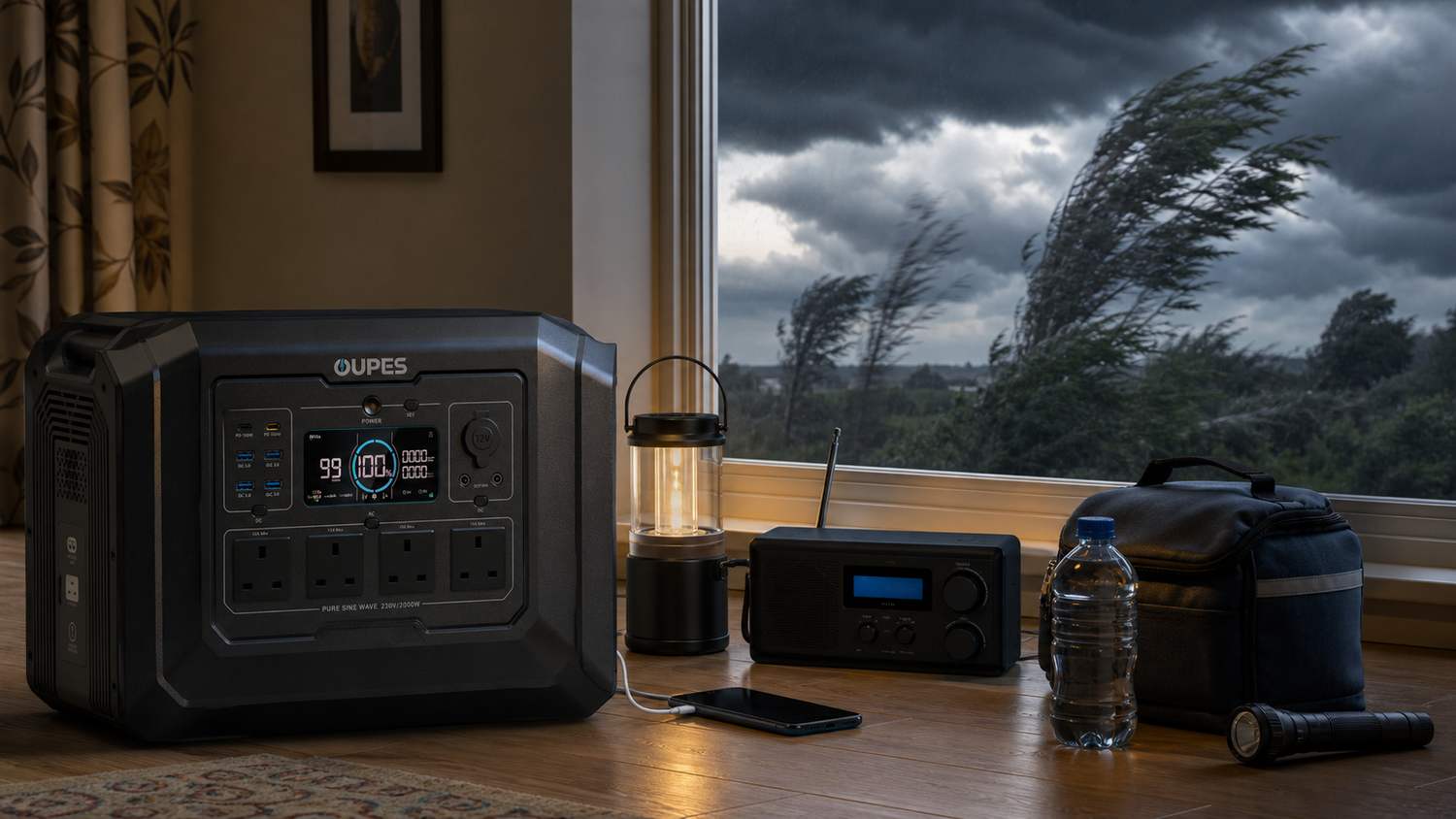
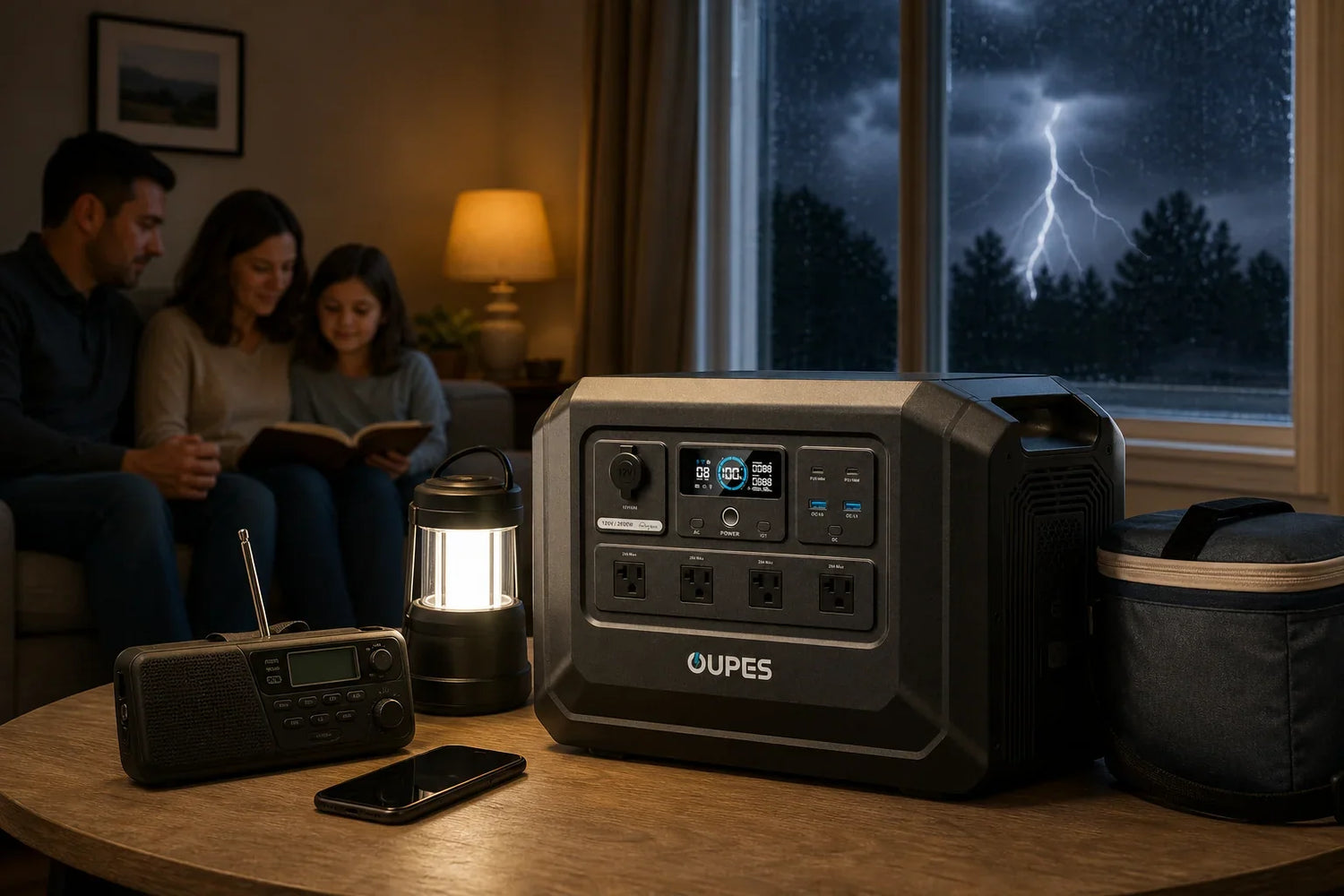
A hurricane backup power station should do more than charge phones. During an extended outage, it may need to keep a refrigerator cold, support a CPAP machine, run fans, maintain internet access, power lights, or briefly operate a microwave, washing machine, sump pump, or room air conditioner.
The challenge is that these appliances do not all use electricity in the same way. Some draw a small, steady load. Others require a large burst of power when a compressor or motor starts. A power station may have enough battery capacity to run an appliance for hours but still lack the output or surge capability needed to start it.
This guide explains how to compare running watts, startup power, battery capacity, and expected outage duration. It also matches common hurricane backup scenarios with the OUPES Mega 1 Lite, Mega 2 Pro, Mega 3, and Guardian 6000 V2.
The U.S. Department of Energy hurricane preparedness guidance recommends preparing alternative power sources before a storm and keeping refrigerator and freezer doors closed during an outage. The best time to size, charge, and test a backup system is before severe weather threatens your area.
The Three Numbers That Determine the Right Power Station
1. Running power
Running power is the electricity an appliance normally consumes while operating. A refrigerator compressor may draw only a few hundred watts after it starts, while a microwave or electric heating appliance can require more than 1,000W continuously.
2. Startup or surge power
Compressors, pumps, and motors often need a short burst of additional power at startup. Refrigerators, freezers, air conditioners, washing machines, sump pumps, and well pumps can all require substantially more power for a few seconds than their normal running wattage.
The power station must support both the appliance's continuous running load and its startup demand. A unit that can run a 700W appliance may still shut down if that appliance briefly requires 2,500W to start.
3. Battery capacity
Battery capacity is measured in watt-hours, or Wh. It determines how long the system can supply electricity. A 2,048Wh battery stores twice the energy of a 1,024Wh battery, but real usable energy is lower than the nameplate capacity because of inverter conversion, wiring, temperature, standby consumption, and other losses.
| Specification | What It Determines | Common Buying Mistake |
|---|---|---|
| Continuous output | How much equipment can operate at the same time | Adding appliance wattages without checking the power station's voltage or outlet limits |
| Surge or Boost output | Whether high-startup appliances can begin operating | Assuming Boost Mode, surge output, and continuous output are interchangeable |
| Battery capacity | How long the connected load can run | Buying a large battery that cannot start the intended appliance |
| Voltage | Whether 120V or 240V equipment can be connected | Assuming every high-output power station can operate 240V appliances |
| Expansion and solar input | How the system can support longer outages | Waiting until a storm warning to discover that accessories are incompatible |
Running and Startup Power of Essential Appliances After a Hurricane
The figures below are planning ranges rather than guarantees. Actual demand depends on appliance size, age, efficiency, operating mode, thermostat setting, motor design, and local voltage. Check the equipment nameplate, user manual, EnergyGuide label, or a plug-in power meter before choosing a backup system.
| Appliance or Device | Typical Running Power | Planning Range for Startup or Peak Power | Backup Priority |
|---|---|---|---|
| Phone or tablet charging | 5-30W | Usually minimal | High for communication |
| Wi-Fi router and modem | 10-30W | Usually minimal | High when local service remains available |
| LED lighting | 5-15W per light | Usually minimal | High after dark |
| Laptop | 45-100W | Usually minimal | Medium to high for work and information |
| CPAP machine | 30-100W | Usually low; heated tubing and humidification increase use | Critical medical load |
| Portable fan | 30-100W | Approximately 60-200W | High in hot and humid weather |
| Household refrigerator | 100-250W while the compressor runs | Approximately 600-1,200W | High for food and medicine |
| Chest or upright freezer | 100-300W while the compressor runs | Approximately 600-1,500W | High for long outages |
| Television | 50-150W | Usually minimal | Optional information and comfort load |
| Microwave | 900-1,500W input | Approximately 1,000-1,800W | Short-duration cooking load |
| Coffee maker | 800-1,200W | Usually close to running power | Optional short-duration load |
| Clothes washing machine | 400-1,200W | Approximately 1,200-2,400W depending on motor and cycle | Delay when water or energy is limited |
| Window air conditioner | 500-1,500W | Approximately 1,200-3,500W | High during dangerous heat, but energy intensive |
| Sump pump | 800-1,500W | Approximately 2,000-4,000W | Critical in flood-prone homes |
| Well pump | 1,000-2,500W | Approximately 3,000-6,000W or more | Critical, but requires measured compatibility |
| Electric clothes dryer | 3,000-5,000W | Approximately 5,000-7,500W | Nonessential during most outages; often requires 240V |
| Central air conditioner | 2,000-5,000W or more | Approximately 5,000-10,000W or more | Requires model-specific 240V and startup analysis |
Refrigerators are especially difficult to estimate from label wattage alone because the compressor cycles on and off. Ambient heat, door openings, food temperature, condenser condition, and thermostat settings all change the average load. The ENERGY STAR refrigerator efficiency guidance recommends maintaining an appropriate temperature, checking door seals, providing ventilation around the appliance, and minimizing the time the door remains open.
How to Calculate Your Hurricane Outage Energy Budget
Start by separating appliances into critical, important, and optional loads. Critical equipment may include medical devices, emergency communication, refrigeration for medicine, sump pumps, and essential lighting. Important loads include food refrigeration, fans, internet equipment, and selected cooking appliances. Laundry, entertainment, and electric heating appliances can usually wait.
| Daily energy use | Appliance watts × operating hours = watt-hours required |
|---|---|
| Estimated AC runtime | Battery capacity × 0.85 ÷ average load watts = approximate runtime in hours |
| Simultaneous output | Add the running wattage of every appliance that may operate at the same time |
| Startup requirement | Confirm that the power station can support the largest motor or compressor startup event |
Example: essential overnight load
| Device | Average Power | Operating Time | Estimated Energy |
|---|---|---|---|
| CPAP machine | 50W | 8 hours | 400Wh |
| Router and modem | 20W | 10 hours | 200Wh |
| Two LED lights | 20W combined | 5 hours | 100Wh |
| Phones and small electronics | 30W combined | 3 hours | 90Wh |
| Portable fan | 45W | 8 hours | 360Wh |
| Total | Variable | One night | 1,150Wh |
This example does not include a refrigerator, freezer, air conditioner, or pump. A household running those appliances needs additional battery capacity and higher output headroom.
OUPES Hurricane Backup Power Comparison
| Product | Battery Capacity | Continuous AC Output | Surge or Boost Capability | Expansion | Best Fit |
|---|---|---|---|---|---|
| Mega 1 Lite portable power station | 1,024Wh | 2,000W | 4,500W surge | No battery expansion listed | Short outages, apartments, evacuation, communication, medical devices, fans, and selective refrigeration |
| Mega 2 Pro home backup power station | 2,048Wh | 2,500W | 3,600W Boost Mode | Up to 10.24kWh with four B2 batteries | Overnight essentials, refrigerator, CPAP, fans, internet, RV loads, and selected kitchen appliances |
| Mega 3 expandable power station | 3,072Wh | 3,600W | 7,000W surge | Up to 15.36kWh with six B2 batteries | Family backup, refrigerator and freezer, washing machine, sump pump, window AC, and multiple simultaneous essentials |
| Guardian 6000 V2 whole-home backup power station | 4,608Wh | 6,000W at 240V; 3,600W at 120V | 7,200W Boost Mode; 9,000W surge | Up to 41.4kWh with G5 batteries | High-demand home backup, compatible 240V equipment, water pumps, central systems, and long-duration expandable storage |
All four models use LFP battery chemistry. Mega 1 Lite and Mega 3 are rated for more than 3,500 cycles to 80% capacity, while Mega 2 Pro and Guardian 6000 V2 are rated for more than 4,000 cycles to 80% capacity.
Guardian 6000 V2 requires special attention to voltage. Its rated 6,000W output applies to 240V operation, while its rated 120V output is 3,600W. A high-wattage 120V load must therefore be evaluated against the 120V limit, not only the headline 6,000W rating.
Recommended OUPES Bundles by Outage Duration
Outage duration recommendations depend on the average load, not only the number of days. A 100W essential load can run several times longer than an 800W cooling and appliance load on the same battery. The following bundle guide assumes disciplined use of critical equipment and recommends solar panels where daytime recharging can meaningfully extend operation.
| Expected Outage | Typical Power Strategy | Recommended OUPES Setup | Why It Fits |
|---|---|---|---|
| Up to 8 hours | Phones, router, lights, CPAP, fan, and selective refrigerator operation | Mega 1 Lite | Portable 1,024Wh battery with enough output for most essential appliances used one at a time |
| 8-24 hours | Continuous medical and communication loads with scheduled refrigeration | Mega 2 Pro, or Mega 2 Pro + B2 for a full-day reserve | The base unit supports a stronger overnight energy budget; a B2 approximately doubles stored energy |
| 1-2 days | Refrigerator, freezer, CPAP, fans, internet, lights, and limited cooking | Mega 3 + B2 + 2 × 240W solar panels | The larger inverter handles more simultaneous loads, while the extra battery supports nighttime use and solar can restore energy in suitable weather |
| 2-3 days | Whole-family essentials, pumps, selected cooling, and strict load scheduling | Guardian 6000 V2 + G5 + 2-4 × 240W solar panels | Approximately 9.2kWh of combined battery capacity, dual-voltage output, and stronger solar charging support longer outages |
| 4-7 days or recurring outages | Critical circuits, refrigeration, medical loads, water systems, and carefully managed cooling | Guardian 6000 V2 with multiple G5 batteries and a properly sized solar array | The platform expands up to 41.4kWh, allowing the system to be sized around the household's measured average load |
Solar panels do not guarantee uninterrupted power. Cloud cover, storm debris, shade, panel temperature, placement, and available daylight all affect charging. Panels should only be deployed after hazardous wind, lightning, and flooding have passed.
Estimated Runtime by Power Station and Average Load
The estimates below use 85% of rated battery capacity to allow for typical conversion losses. They assume a stable average load and do not include solar charging. Real results vary with battery temperature, appliance cycling, motor startup, cable loss, standby power, and battery age.
| Product | 100W Essential Load | 300W Household Essentials | 800W Cooling or Appliance Load | 1,500W High-Power Load |
|---|---|---|---|---|
| Mega 1 Lite | 8.7 hours | 2.9 hours | 1.1 hours | 0.6 hours |
| Mega 2 Pro | 17.4 hours | 5.8 hours | 2.2 hours | 1.2 hours |
| Mega 3 | 26.1 hours | 8.7 hours | 3.3 hours | 1.7 hours |
| Guardian 6000 V2 | 39.2 hours | 13.1 hours | 4.9 hours | 2.6 hours |
| Bundle | Combined Capacity | 100W Load | 150W Load | 250W Load |
|---|---|---|---|---|
| Mega 2 Pro + B2 | 4,096Wh | 34.8 hours | 23.2 hours | 13.9 hours |
| Mega 3 + B2 | 5,120Wh | 43.5 hours | 29.0 hours | 17.4 hours |
| Guardian 6000 V2 + G5 | 9,216Wh | 78.3 hours | 52.2 hours | 31.3 hours |
A refrigerator does not normally draw its full compressor wattage continuously. For a more accurate runtime estimate, measure the appliance's energy use over several hours in warm conditions and use the observed average wattage. Always confirm that startup demand remains within the power station's limits.
How to Extend Backup Runtime During a Hurricane Outage
Keep refrigerator and freezer doors closed
The Department of Energy advises that an unopened refrigerator can keep food cold for about four hours, while a closed freezer may hold temperature for approximately two days. Opening the doors less frequently reduces compressor runtime and preserves both food temperature and battery energy.
Use the safest efficient temperature setting
Do not lower appliance temperatures unnecessarily before every outage. ENERGY STAR recommends keeping a refrigerator at approximately 35-38°F during normal operation. During an outage, use appliance thermometers and follow current food-safety guidance rather than relying only on how food feels.
Cool one occupied room instead of the entire home
When heat is a concern, prioritize one room with shade, closed curtains, a fan, and efficient room cooling. The ENERGY STAR room air conditioner guidance recommends setting the thermostat as high as is comfortable, commonly around 78°F, and using a fan to distribute cooled air.
Operate high-power appliances one at a time
Do not run a microwave, coffee maker, washing machine, pump, and air conditioner simultaneously. Scheduling high-power appliances reduces the chance of an overload and prevents unnecessary inverter losses.
Use intermittent refrigeration when food safety allows
Instead of powering a refrigerator continuously, some households can run it in controlled intervals while monitoring internal temperature with an appliance thermometer. Do not use this strategy for temperature-sensitive medicine unless the storage requirements are fully understood.
Delay laundry and electric cooking
A washing machine may be technically compatible with a large power station, but clean laundry is usually less urgent than refrigeration, medical equipment, communication, and cooling. Use no-cook foods or short microwave sessions instead of long electric cooking cycles.
Turn off unused outputs and phantom loads
Disconnect chargers, televisions, game systems, printers, and other devices that are not currently needed. Turn off unused AC or DC output sections when the product allows it.
Use daytime solar energy for flexible tasks
When solar production is available, schedule flexible loads such as device charging, water pumping, or laundry during the strongest daylight. Preserve stored battery energy for nighttime medical devices, fans, refrigeration, and communication.
Should You Add an Expansion Battery or Solar Panels?
| Your Main Problem | Better First Upgrade | Reason |
|---|---|---|
| Critical loads must run overnight | B2 or G5 expansion battery | Stored energy is available regardless of darkness or cloud cover |
| The base power station is empty before morning | Expansion battery | More capacity directly extends runtime without changing the inverter output |
| The outage may last several days | Expansion battery plus solar panels | The battery provides nighttime reserve while solar offers a daytime recharge path |
| The household has reliable open sunlight after the storm | Solar panels | Daytime generation can reduce net battery depletion |
| The region is frequently cloudy during hurricanes | Expansion battery first | Solar production may be too inconsistent to support critical loads alone |
| The system must support high-wattage appliances | A higher-output base power station | Extra batteries increase runtime but do not increase the main unit's continuous inverter rating |
For Mega 2 Pro and Mega 3, a B2 battery is the most direct way to extend overnight runtime. For Guardian 6000 V2, G5 batteries allow the system to grow from 4.6kWh to as much as 41.4kWh. Solar panels become increasingly valuable as outage duration increases, but they work best as part of a system that already has enough stored energy to cover essential nighttime loads.
Hurricane Backup Power Safety
Ready.gov power outage planning resources emphasize advance preparation and alternative charging methods. A portable battery power station avoids the direct exhaust produced by a fuel generator, but electrical, water, and installation risks still require careful management.
| Safety Rule | Why It Matters |
|---|---|
| Keep the power station dry and above possible floodwater | Water intrusion can damage equipment and create shock or fire hazards |
| Maintain airflow around the unit | Blocked ventilation can cause overheating or automatic shutdown |
| Verify voltage and startup power | High-power motors and 240V appliances require model-specific compatibility |
| Use appropriately rated cords | Undersized or damaged extension cords can overheat |
| Never backfeed a home through a wall outlet | Improvised connections can electrocute utility workers, damage equipment, or start a fire |
| Use approved transfer equipment for household circuits | Electrical-panel integration must safely isolate the home from the utility grid |
| Have a qualified electrician handle 240V or panel connections | Correct protection, grounding, conductor sizing, and transfer equipment are essential |
| Follow evacuation orders immediately | Backup electricity cannot protect a building from storm surge, structural failure, or extreme flooding |
Final Product Recommendations
| Household Need | Recommended Product | Upgrade Path |
|---|---|---|
| Portable emergency power for a short outage or evacuation | Mega 1 Lite | Add compatible solar panels when portable daytime charging is useful |
| Best balanced choice for one night of essential backup | Mega 2 Pro | Add one B2 for approximately twice the stored energy |
| Family backup with refrigeration, pumps, laundry, or window cooling | Mega 3 | Add B2 storage and solar panels for longer outages |
| High-demand home backup, 240V equipment, and long-term expansion | Guardian 6000 V2 | Add G5 batteries and a properly sized solar array |
Mega 1 Lite is the most portable choice for communication, lighting, fans, medical devices, and short-duration backup. Mega 2 Pro provides the strongest balance for most apartments, RVs, and small households. Mega 3 is better when several appliances must operate together or when pumps and room cooling are part of the plan. Guardian 6000 V2 is the appropriate starting point for demanding home systems, compatible 240V equipment, and multi-day expansion.
Before ordering, calculate your actual appliance loads, verify startup wattage and voltage, and decide whether the priority is higher output, longer battery runtime, or daytime recharging. You can compare current bundles on the OUPES Hurricane Preparedness page.
Frequently Asked Questions
What size power station do I need for a refrigerator during a hurricane?
A 1kWh unit can provide short, carefully managed refrigeration, while a 2-3kWh system offers more practical overnight capacity. Always verify compressor startup power.
How many watts does a refrigerator need to start?
Many household refrigerators run at roughly 100-250W but may briefly require approximately 600-1,200W at startup. The exact requirement varies by model.
Can a portable power station run a window air conditioner?
Yes, when both running and compressor startup power fit the station's limits. Air conditioning drains batteries quickly, so use a higher thermostat setting and cool one room.
Is battery capacity or output wattage more important?
Both matter: output determines whether the appliance can start and run, while capacity determines runtime.
Should I buy an extra battery or solar panels first?
Choose an extra battery first for dependable overnight energy. Add solar panels when daylight recharging can help support a multi-day outage.
Can Mega 3 run a washing machine and refrigerator together?
It may, provided their combined running load and the washer's motor startup remain within the 3,600W output and 7,000W surge limits.
Can Guardian 6000 V2 power 240V home appliances?
Yes, it provides native 120V/240V output, but appliance wattage, startup surge, outlet compatibility, and safe installation must be confirmed.
How can I make a backup battery last longer during an outage?
Keep refrigerator doors closed, cool one room, stagger high-power appliances, delay laundry, switch off unused outputs, and recharge with solar when conditions are safe.


Leave a comment
This site is protected by hCaptcha and the hCaptcha Privacy Policy and Terms of Service apply.