




The Atlantic hurricane season officially runs from June 1 through November 30. However, tropical cyclone activity is not evenly distributed throughout those six months. Storm formation typically begins to increase in August, with the climatological peak occurring around September 10. A large portion of Atlantic hurricane activity takes place between mid-August and mid-October.
The National Hurricane Center's hurricane climatology data shows why late July and early August are important preparation windows for households in hurricane-prone regions.
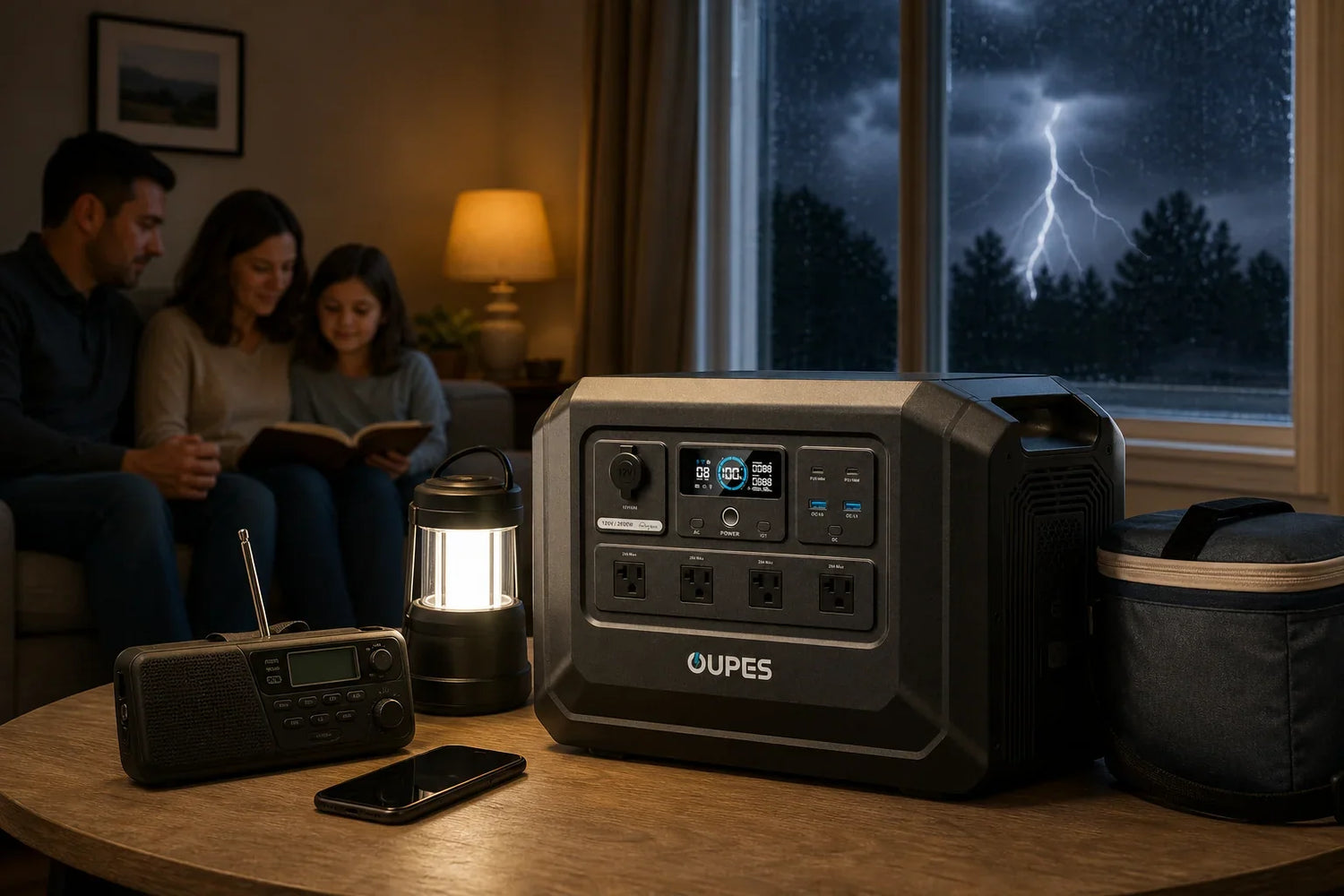
For most families, hurricane risk is not limited to wind and rain. Falling trees, damaged power lines, flooded roads, and overloaded electrical infrastructure can cause outages lasting from several hours to several days. Refrigerators, lighting, phones, internet equipment, fans, medical devices, and water pumps may all become unavailable when the grid goes down.
To help households prepare before hurricane activity intensifies, OUPES is launching its Hurricane Preparedness event from July 27 through August 23, EDT. The campaign includes discounts of up to 62% OFF, four 48-hour flash sales, accessory discounts, 30-day price protection, and 30-day hassle-free returns.
Why Prepare Backup Power Before August?
Many households wait until a hurricane watch or warning is issued before buying water, batteries, food, and emergency power equipment. By that point, popular products may be out of stock, delivery services may be delayed, and there may not be enough time to test the equipment properly.
Ready.gov power outage preparedness guidance recommends preparing emergency supplies in advance and arranging alternative ways to charge phones and other essential electronics.
A portable power station is not intended to keep every household appliance running exactly as it would under normal conditions. Its primary purpose during an outage is to preserve access to the most important electrical needs:
- Emergency lighting and phone charging
- Weather alerts and communication equipment
- Refrigerator and freezer operation
- CPAP machines and other essential medical devices
- Fans and basic cooling equipment
- Wi-Fi routers, laptops, and selected household appliances
An effective backup-power plan must account for both the wattage of each appliance and the number of hours it needs to operate.
How Much Power Do Essential Appliances Need During an Outage?
Battery capacity is measured in watt-hours, or Wh, and determines approximately how long connected equipment can run. Output power is measured in watts, or W, and determines whether the power station can start and operate an appliance.
The values below are general planning ranges. Always check the appliance label, manual, or measured consumption before relying on a backup-power system.
| Appliance or Device | Typical Running Power | Outage Planning Guidance |
|---|---|---|
| Phone charging | 5-30W | Keep phones charged while limiting unnecessary use. |
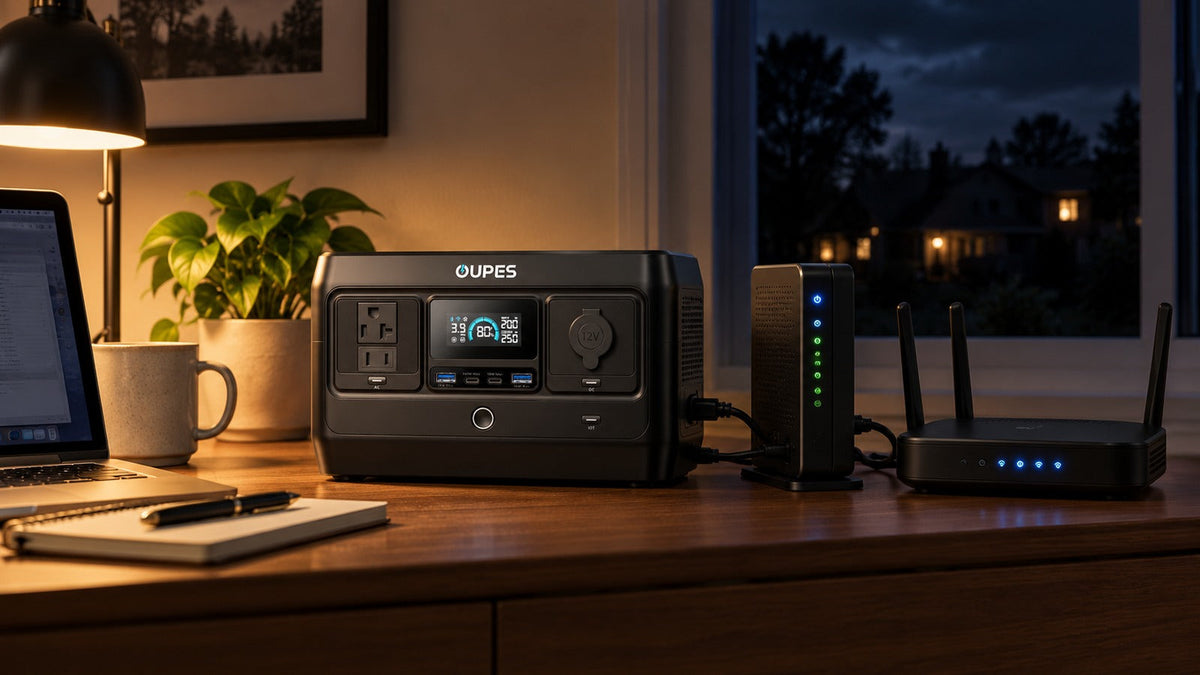
| Wi-Fi router and modem | 10-30W | Keep connected if local internet service remains available. |
| LED lighting | 5-15W per light | Light only essential rooms to conserve energy. |
| CPAP machine | 30-100W | Prioritize medical use; humidifiers and heated tubing may increase consumption. |
| Portable fan | 30-100W | Important during hot and humid post-storm conditions. |
| Refrigerator | 80-250W while running | Compressor startup power may be significantly higher than normal running power. |
| Television | 50-150W | Use selectively for news and emergency information. |
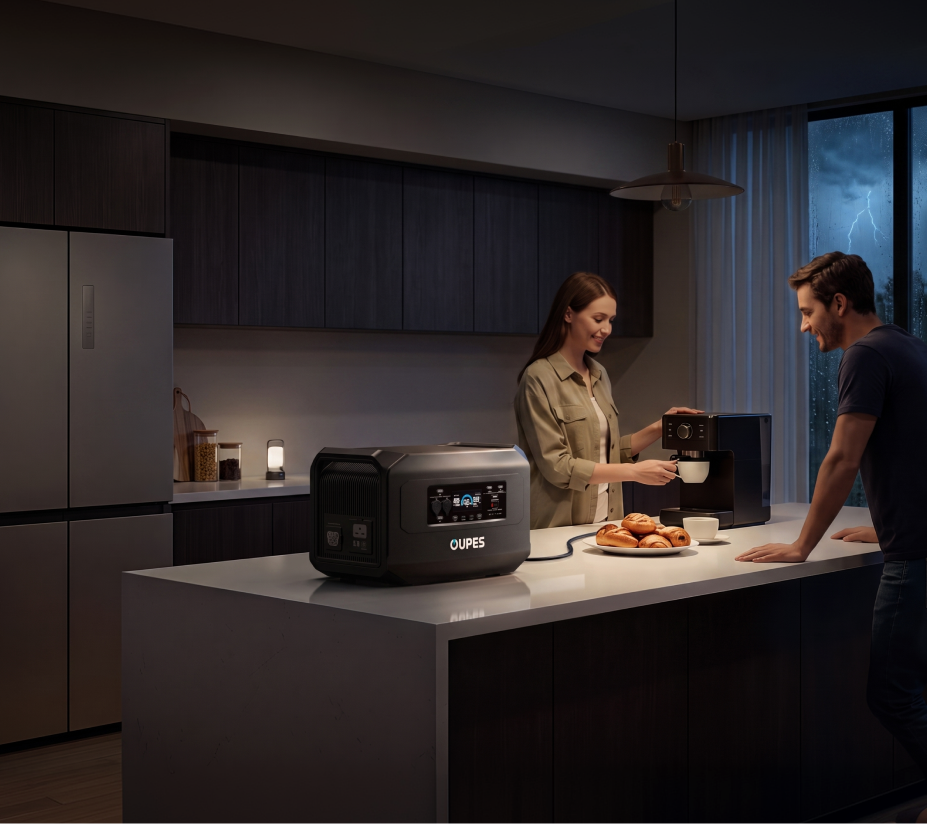
| Coffee maker | 800-1,200W | High power, but usually operated for only a few minutes. |
| Microwave | 900-1,500W | Check the electrical input rating rather than the advertised cooking output. |
| Window air conditioner | 500-1,500W | Compressor startup demand may be much higher. |
| Sump pump or well pump | 800-2,500W | Confirm voltage, running wattage, and startup surge before connecting. |
Calculate Your Energy Requirement
Use the following calculation to estimate how much battery capacity you need:
Appliance wattage × operating hours = required watt-hours
For example, a CPAP machine averaging 50W for eight hours requires approximately 400Wh. Adding a router, lighting, phones, and a fan could raise the total overnight requirement to between 600Wh and 1,000Wh.
Choose a Backup Solution by Expected Outage Duration
The OUPES Hurricane Preparedness event organizes products into three practical categories: Basic Backup Power, Essential Backup Power, and Whole-Home Backup Power. This makes it easier to choose a system based on expected outage duration and essential household loads.
Basic Backup Power: For Outages Lasting Several Hours
During a short outage, the priority is maintaining communication, lighting, and small essential equipment rather than purchasing the largest possible battery.
Typical devices in this category include:
- Phones and tablets
- Wi-Fi routers and modems
- LED lighting
- Weather radios
- Small fans
- Laptops
- CPAP machines used for limited periods
| Basic Backup Product | Recommended Use |
|---|---|
| Exodus 1200 | Portable emergency power for communication, lighting, medical devices, and small electronics |
| Exodus 1200 + 100W Solar Panel | Lightweight backup with a portable daytime recharging option |
| Exodus 1200 + 240W Solar Panel | Faster potential solar recovery for evacuation, camping, or temporary outages |
| OUPES 2400 | Higher-capacity basic backup for refrigeration, internet equipment, lighting, and multiple devices |
Exodus 1200 is suitable for individuals, apartments, and evacuation scenarios. OUPES 2400 provides more base capacity and output for households that need to support a refrigerator, internet equipment, lighting, and several electronic devices at the same time.
Essential Backup Power: For Outages Lasting One to Four Days
Once an outage extends beyond a day, phone charging and lighting are no longer the only priorities. Refrigeration, medical equipment, fans, internet access, and limited kitchen-appliance use become increasingly important.
| Essential Backup Product | Recommended Use |
|---|---|
| Mega 2 Pro | Refrigerator, CPAP, fans, communication equipment, lighting, and selected kitchen appliances |
| Mega 2 Pro + 2 × 240W Solar Panels | Essential backup with additional daytime recharging capability |
| Mega 2 Pro + B2 | Extended runtime for medical devices, refrigeration, and overnight loads |
| Mega 3 + 2 × 240W Solar Panels | Higher-capacity family backup with stronger output and solar recovery |
Mega 2 Pro provides 2,048Wh of capacity and 2,500W of rated AC output. It is well suited to refrigerators, CPAP machines, fans, communication devices, lighting, and short periods of kitchen-appliance use.
Mega 3 increases base capacity to 3,072Wh and rated output to 3,600W. It is a better fit for larger families, households operating both a refrigerator and freezer, or users who need to support pumps, cooking appliances, and selected cooling equipment.
Whole-Home Backup Power: For Longer Outages and High-Demand Appliances
Long-duration outages require more than a large base battery. Households may also need expandable storage and a practical way to recover energy during the day.
| Whole-Home Backup Product | Recommended Use |
|---|---|
| Guardian 6000 V2 | High-output backup for major appliances, critical household loads, and compatible 240V equipment |
| Guardian 6000 V2 + 2 × 240W Solar Panels | Large-home backup with additional solar charging capability |
| Guardian 6000 V2 + G5 | Expanded stored energy for longer outages and overnight operation |
| Guardian 6000 V2 + G5 + 2 × 240W Solar Panels | Expanded home backup with both additional capacity and renewable recharging |
| Mega 2 Pro + B2 + 2 × 240W Solar Panels | Expandable essential backup for refrigeration, medical devices, and household electronics |
| Mega 3 + B2 | Extended family backup with increased stored energy |
| Mega 3 + B2 + 4 × 240W Solar Panels | Higher-capacity backup with stronger daytime solar recovery |
Guardian 6000 V2 provides a 4,608Wh base battery and up to 6,000W of rated 240V output. It is intended for households that need to support more appliances, compatible well pumps, selected 240V equipment, or critical home circuits.
Adding a G5 expansion battery increases available energy storage, making the system more suitable for multi-day outages and homes with limited access to grid recharging.
Any connection to a household electrical panel, transfer switch, or 240V circuit should be planned and installed by a qualified electrician. Never use improvised wiring to backfeed power into a home electrical system.
Should You Choose Solar Panels or an Extra Battery?
Expansion batteries and solar panels solve different backup-power problems.
| Accessory | Primary Function | Best For |
|---|---|---|
| B2 or G5 expansion battery | Increases stored energy and appliance runtime | Medical equipment, overnight loads, refrigeration, and locations with inconsistent sunlight |
| 100W solar panel | Provides lightweight, portable daytime charging | Mobile use, evacuation, camping, and smaller power stations |
| 240W solar panel | Provides higher solar charging potential | Mega and Guardian backup systems |
| Multiple solar panels | Increases potential daytime energy recovery | Multi-day outages in locations with sufficient safe sunlight |
Choose an expansion battery first when critical devices must operate overnight, the household uses both a refrigerator and freezer, or local weather often limits solar production.
Choose solar panels when the base battery is already large enough for overnight use and you want an additional way to recharge during a prolonged outage.
Actual solar charging performance depends on cloud cover, shade, panel angle, temperature, available daylight, and the input limits of the connected power station. Rated panel output should not be treated as guaranteed continuous charging power.
OUPES Hurricane Preparedness Campaign Offers
The Hurricane Preparedness event runs from July 27 through August 23, EDT.
| Campaign Benefit | Offer Details |
|---|---|
| Product discounts | Up to 62% OFF selected backup-power products and bundles |
| Flash sales | Four separate 48-hour limited-time sale periods |
| Accessory discount | 15% OFF eligible accessories |
| Multi-accessory discount | Buy two eligible accessories and receive an additional 5% OFF |
| B2 exclusion | B2 expansion batteries are excluded from the accessory promotion |
| Price protection | 30-day price protection |
| Returns | 30-day hassle-free returns, subject to applicable terms |
Four 48-Hour Flash Sale Events
| Flash Sale | Dates in EDT |
|---|---|
| Flash Sale 1 | July 29-July 30 |
| Flash Sale 2 | August 4-August 5 |
| Flash Sale 3 | August 11-August 12 |
| Flash Sale 4 | August 18-August 19 |
Featured Flash Sale Bundles
- Guardian 6000 V2 + 2 × 240W Solar Panels
- Guardian 6000 V2 + G5 + 4 × 240W Solar Panels
- Mega 2 Pro + 240W Solar Panel
- Mega 2 Pro + B2 + 2 × 240W Solar Panels
- Mega 3 + 2 × 240W Solar Panels
- Mega 3 + B2 + 4 × 240W Solar Panels
Visit the OUPES Hurricane Preparedness campaign page to view current pricing, product availability, bundle contents, and flash sale offers.
How to Choose the Right Product During the Campaign
Do not choose a backup-power system based only on the discount percentage or the largest available battery. Use the following process to match the system to your household.
Step 1: List the Appliances That Must Remain Powered
Start with medical equipment, phones, emergency lighting, refrigeration, freezers, fans, internet equipment, and water pumps. Add televisions, coffee makers, microwaves, and entertainment devices only after essential loads are covered.
Step 2: Calculate the Highest Simultaneous Load
A refrigerator, pump, and microwave may exceed the power station's output if they start at the same time, even when their total daily energy consumption is manageable. Plan to stagger high-power appliances when necessary.
Step 3: Match Battery Capacity to Expected Outage Duration
| Expected Outage Duration | Recommended Product Level |
|---|---|
| Several hours | Exodus 1200 or OUPES 2400 |
| One to four days | Mega 2 Pro or Mega 3 |
| Five days or high-demand backup | Mega 3 + B2 or Guardian 6000 V2 + G5 |
Step 4: Decide Whether You Need Solar Recharging
For short outages, prioritize sufficient battery capacity. For multi-day outages, consider combining the power station with solar panels or expansion batteries.
Step 5: Receive, Charge, and Test the System Early
Do not wait until a hurricane warning is issued to turn on the power station for the first time. Test the refrigerator, CPAP machine, router, fan, and other critical appliances in advance. Confirm that all required charging cables, adapters, and connectors are available.
Hurricane Power-Outage Safety Tips
Portable battery power stations provide quiet backup electricity without the direct fuel combustion of a conventional generator, but they still require correct operation and storage.
- Place the power station in a dry, ventilated location protected from rain and floodwater.
- Do not cover ventilation openings or operate the unit inside a sealed container.
- Do not exceed the rated output or connect too many high-power appliances simultaneously.
- Use extension cords and power strips rated for the connected load.
- Never connect a power station directly to home wiring without approved transfer equipment.
- Do not deploy solar panels during high winds, thunderstorms, or flooding.
- Follow local evacuation orders immediately and never delay departure to continue charging equipment.
A backup power station can reduce the impact of a grid outage, but it cannot make a building safe from storm surge, flooding, structural damage, or extreme winds.
Prepare Before the Storm, Not After the Power Goes Out
As the Atlantic hurricane season enters its more active phase, storm development and outage risks can change quickly. Effective preparation means more than purchasing a battery after a warning has already been issued. It requires reviewing emergency supplies, calculating essential loads, testing appliances, and fully charging backup equipment while conditions are still safe.
The OUPES Hurricane Preparedness event includes solutions ranging from basic communication and lighting support to refrigeration, medical-device backup, expandable household power, and compatible 240V applications.
Whether your household chooses Exodus 1200, OUPES 2400, Mega 2 Pro, Mega 3, or Guardian 6000 V2, the selection principle remains the same: protect essential devices first, choose sufficient output and battery capacity, and add expansion batteries or solar charging according to expected outage duration.
Preparing before a hurricane arrives can help your household preserve lighting, communication, food refrigeration, medical support, and other essential electrical needs when the grid is unavailable.
Home Backup, Off-Grid Power, Portable Power Stations, Power Outages,


Leave a comment
This site is protected by hCaptcha and the hCaptcha Privacy Policy and Terms of Service apply.