




Slow cookers are often praised as one of the most energy-efficient kitchen appliances. They run quietly for hours, produce steady heat, and turn inexpensive ingredients into full meals. But many people still wonder:
How much electricity does a slow cooker actually use—and what does that mean for your power bill or backup power planning?
This article breaks down slow cooker electricity usage in real-world terms. We’ll look at wattage, daily and monthly energy consumption, cost estimates, and how slow cookers fit into scenarios like power outages, off-grid cooking, and emergency preparedness.
What Is a Slow Cooker and How Does It Work?
A slow cooker is an electric countertop appliance designed to cook food at low, steady temperatures over long periods.
How It Operates
- Electric heating element surrounds the pot
- Heat is distributed evenly
- Food cooks slowly without high peaks in power
Unlike ovens or stovetops, slow cookers are designed to maintain temperature rather than constantly reheat.
Typical Slow Cooker Wattage
Slow cookers come in different sizes, and wattage varies accordingly.
| Slow Cooker Size | Typical Wattage Range |
|---|---|
| Small (1–3 quart) | 70–150W |
| Medium (4–5 quart) | 150–250W |
| Large (6–8 quart) | 200–350W |
Compared to many kitchen appliances, these wattage levels are relatively low.
How Much Electricity Does a Slow Cooker Use Per Day?
Electricity usage depends on both wattage and cooking time.
Basic Calculation
Energy (kWh) = Power (kW) × Time (hours)
Example Scenarios
| Wattage | Cooking Time | Daily Energy Use |
|---|---|---|
| 200W | 6 hours | 1.2 kWh |
| 200W | 8 hours | 1.6 kWh |
| 300W | 8 hours | 2.4 kWh |
Even after many hours, total consumption remains moderate.
How Much Does It Cost to Run a Slow Cooker?
Electricity cost depends on your local electricity rate.
Example Cost Calculation
If electricity costs $0.15 per kWh:
- 1.2 kWh × $0.15 ≈ $0.18 per meal
- 2.4 kWh × $0.15 ≈ $0.36 per meal
This makes slow cookers one of the least expensive cooking methods per meal.
Low vs High Setting: Does It Change Power Use?
Many assume the “high” setting doubles energy use, but that’s not entirely true.
What Actually Changes
- High setting heats faster
- Low setting heats more gradually
- Final temperature is similar
Over long cooking times, total energy consumption is often comparable.
Slow Cooker vs Other Cooking Appliances
| Appliance | Typical Wattage | Energy Efficiency |
|---|---|---|
| Slow cooker | 150–300W | High |
| Electric oven | 2000–4000W | Low–Moderate |
| Microwave | 800–1500W | Moderate |
| Induction cooktop | 1200–1800W | Moderate–High |
This comparison explains why slow cookers are popular for long cooking times.
Why Slow Cookers Are Considered Energy Efficient
Key Reasons
- Low, steady power draw
- Minimal heat loss
- No repeated reheating cycles
Efficiency comes from consistency, not speed.
Using a Slow Cooker During Power Outages
In extended outages, cooking becomes a challenge.
Why Slow Cookers Make Sense
- Lower power demand than ovens
- Safe indoor operation (electric)
- Can prepare large meals at once
This makes them practical for backup-power cooking.
Can a Slow Cooker Run on Backup Power?
Yes—slow cookers are among the easiest cooking appliances to run on battery-based power systems.
Key Requirements
- Sufficient inverter capacity
- Adequate battery energy (Wh)
Example Runtime Estimate
A 200W slow cooker on a 2000Wh battery could theoretically run for about 8–9 hours, accounting for losses.
Real Household and Emergency Scenarios
Scenario 1: Busy Family Meal Prep
Low electricity cost, all-day cooking, minimal supervision.
Scenario 2: Power Outage Cooking
Slow cooker prepares hot meals while conserving backup power.
Scenario 3: Off-Grid or Emergency Shelter
Efficient cooking without fuel storage or open flames.
Using a Slow Cooker with OUPES Power Systems
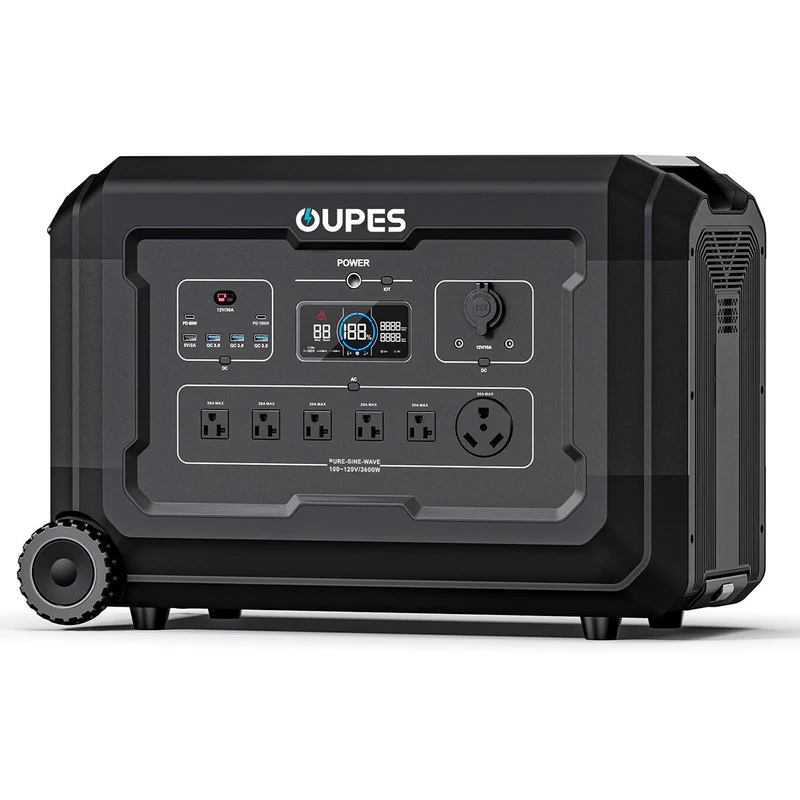
OUPES power systems are well-suited for low-wattage appliances like slow cookers.
Why the Combination Works
- Stable AC output
- Efficient battery usage
- Quiet, indoor-safe operation
| OUPES Model | Battery Capacity | Slow Cooker Use Case |
|---|---|---|
| OUPES Mega 1 | 1024Wh | Short cooking sessions |
| OUPES Mega 2 | 2048Wh | Full meal preparation |
| OUPES Mega 3 | 3072Wh | Extended outage cooking |
| OUPES Mega 5 | 5040Wh | Multi-day emergency use |
This makes slow cookers a smart choice when planning backup-power meals.
Frequently Asked Questions
1. Are slow cookers energy efficient?
Yes, they use far less power than ovens.
2. Do slow cookers use more power on high?
Not significantly over long cooking times.
3. Can a slow cooker run overnight?
Yes, that’s one of its main advantages.
4. Is it cheaper than using an oven?
Almost always.
5. Can I use a slow cooker during a blackout?
Yes, with adequate backup power.
6. Does size affect electricity use?
Larger units typically use more power.
7. Is it safe to use indoors?
Yes, slow cookers are designed for indoor use.
8. What’s the biggest misconception?
That long cooking time equals high energy cost.