




Table of Contents
- TL;DR / Key Takeaways
- Introduction
- Understanding Off-Grid Solar Kits
- Main Components of an Off-Grid Solar System
- Key Factors to Consider When Choosing a Solar Kit
- How to Size Your Off-Grid Solar System
- Comparison: Portable vs. Fixed Off-Grid Solar Systems
- Installation Tips for Remote Areas
- Maintenance and Longevity
- How OUPES Portable Solar Generators Support Off-Grid Living
- FAQ
TL;DR / Key Takeaways
- Off-grid solar kits provide energy independence in remote or rural locations without access to the power grid.
- Choosing the right system depends on energy needs, battery capacity, and solar panel efficiency.
- Portable solar generators are ideal for flexible, mobile power in cabins, RVs, or disaster zones.
- Consider LiFePO₄ batteries for longer lifespan and stable performance.
- Brands like OUPES offer scalable, user-friendly systems for off-grid applications.
Introduction
Living or working in remote areas presents one major challenge — access to reliable electricity. Whether it’s for a mountain cabin, an RV, or an emergency shelter, a dependable power supply is essential for lighting, refrigeration, communications, and tools. Off-grid solar kits have become the go-to solution, allowing users to generate and store their own clean, renewable energy without depending on public utilities.
This comprehensive guide explains what off-grid solar systems are, how to choose the right one, and how portable solar generators — such as those offered by OUPES — play a vital role in maintaining energy reliability in remote environments.
Understanding Off-Grid Solar Kits
An off-grid solar kit is a self-sufficient energy system designed to operate independently from the electrical grid. It captures sunlight via solar panels, converts it into usable electricity, and stores excess power in batteries for nighttime or cloudy-day use.
According to the International Energy Agency (IEA), more than 700 million people worldwide still live without grid access — off-grid solar solutions provide a sustainable alternative, especially in rural or disaster-prone regions.
Why Go Off-Grid?
- Energy independence: No reliance on utility companies or unstable grid systems.
- Cost savings: After setup, ongoing energy costs are nearly zero.
- Eco-friendliness: Reduces carbon footprint with renewable energy.
- Resilience: Continues functioning during power outages and natural disasters.
Main Components of an Off-Grid Solar System
1. Solar Panels
The heart of the system, solar panels capture sunlight and convert it into electricity. Monocrystalline panels are preferred for remote setups due to their higher efficiency and durability.
2. Charge Controller
This regulates the voltage and current coming from the panels to protect the batteries from overcharging. Modern systems often use MPPT controllers (Maximum Power Point Tracking) for superior efficiency in variable sunlight conditions.
3. Battery Bank
The battery stores generated power for later use. Lithium Iron Phosphate (LiFePO₄) batteries are increasingly popular for their long lifespan, thermal stability, and high discharge efficiency.
4. Inverter
Converts DC (direct current) power from batteries into AC (alternating current) power, which is used by most household devices.
5. Backup Generator (Optional)
For prolonged cloudy periods or heavy power demand, an additional backup source such as a portable power station ensures continuous operation.
Key Factors to Consider When Choosing a Solar Kit
1. Energy Consumption
Calculate your daily energy use in kilowatt-hours (kWh). Add up the power consumption of all devices you plan to run — refrigerators, lights, fans, communication devices, etc. The average off-grid home requires between 3–7 kWh per day.
2. Battery Capacity
Battery capacity determines how long you can power your home without sunlight. For remote areas, choose systems with at least 2–3 days of energy storage. LiFePO₄ batteries are recommended for their 10-year lifespan and 3,500+ charge cycles.
3. Solar Panel Wattage and Efficiency
The higher the panel wattage and efficiency, the faster your batteries will recharge. Opt for panels with ETFE coating — they resist corrosion, moisture, and extreme temperatures.
4. Inverter Power Rating
Match the inverter size to your maximum load. For example:
| Appliance Type | Power (Watts) | Recommended Inverter Rating |
|---|---|---|
| LED Lights & Small Devices | 100–300W | 500W+ |
| Refrigerator, Fan, TV | 500–1000W | 1500W+ |
| Power Tools, Water Pumps | 1000–3000W | 4000W+ |
5. Climate and Sunlight Hours
According to the National Renewable Energy Laboratory (NREL), average sunlight exposure ranges from 4–6 hours per day across most U.S. regions. If your area gets limited sunlight, consider higher panel wattage or additional battery storage.
6. Portability vs. Permanence
Decide whether your setup will be stationary (cabin, tiny home) or mobile (RV, remote worksite). Portable solar kits offer flexibility and easier installation for short-term or mobile applications.
How to Size Your Off-Grid Solar System
Step 1: Calculate Total Daily Energy Usage
List all devices and their wattage, multiply by the number of hours used per day, and sum them up. Example:
| Appliance | Wattage | Usage (Hours/Day) | Daily Consumption (Wh) |
|---|---|---|---|
| LED Light | 10 | 5 | 50 |
| Mini Fridge | 100 | 24 | 2400 |
| Laptop | 60 | 4 | 240 |
| Total | - | - | 2690 Wh (≈2.7 kWh) |
Step 2: Account for Sunlight and Inefficiency
Divide total daily energy needs by the average peak sunlight hours in your area to estimate required panel wattage.
Example: If you need 2700 Wh per day and get 5 hours of sunlight:
2700 ÷ 5 = 540W
To account for inefficiencies, increase this by 20–30%, resulting in about 700W of total panel capacity.
Step 3: Choose the Battery Size
Multiply your daily consumption by the number of backup days you want. For 2 days of backup: 2.7 kWh × 2 = 5.4 kWh battery storage capacity.
Comparison: Portable vs. Fixed Off-Grid Solar Systems
| Feature | Portable Solar System | Fixed Off-Grid Solar System |
|---|---|---|
| Installation | Plug-and-play, easy to move | Permanent installation with wiring |
| Cost | Lower initial cost | Higher setup cost but scalable |
| Mobility | Highly mobile; ideal for RVs, remote jobs | Stationary; best for homes or cabins |
| Maintenance | Minimal; modular components | Requires regular inspection |
| Power Capacity | Typically under 5 kWh | Can exceed 20 kWh |
| Ease of Use | User-friendly, plug-in design | Requires professional installation |
Installation Tips for Remote Areas
1. Site Selection
Choose an area with maximum sunlight exposure throughout the day — ideally facing true south (in the Northern Hemisphere).
2. Mounting and Angle
Tilt your panels according to your latitude for optimal year-round performance. Adjustable mounts are helpful in seasonal climates.
3. Cable Management and Protection
Use UV-resistant cables and weatherproof connectors. Avoid long cable runs to reduce voltage drop.
4. Safety Precautions
Always disconnect the system before performing maintenance, and ensure your inverter and batteries are properly ventilated.
Maintenance and Longevity
1. Panel Cleaning
Dust, pollen, and snow can reduce efficiency by up to 25%. Clean panels gently with water and a microfiber cloth every few weeks.
2. Battery Care
Keep batteries within the recommended temperature range (typically 32–95°F / 0–35°C). LiFePO₄ batteries, like those used in OUPES systems, are known for their stability and longevity.
3. System Monitoring
Modern systems include digital displays or mobile apps to track power generation and consumption. Regularly check voltage levels and output efficiency.
How OUPES Portable Solar Generators Support Off-Grid Living
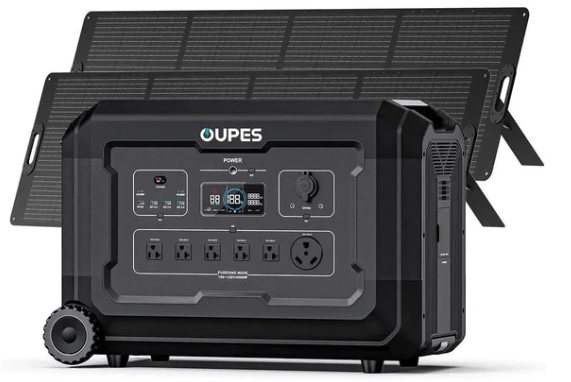
Portable solar generators — such as those from OUPES — combine panels, batteries, and inverters into one compact solution. They are ideal for powering lights, medical devices, tools, and small appliances in remote locations or emergency situations.
Advantages of Portable Power Stations
- Ease of use: Plug-and-play setup with multiple output ports.
- Reliability: Use high-quality LiFePO₄ batteries with 3,500+ charge cycles.
- Versatility: Recharge via solar panels, wall outlets, or car ports.
- Quiet and clean: Zero emissions, suitable for indoor and outdoor use.
For those living in or traveling through remote areas, portable systems complement fixed installations — offering flexibility, backup capability, and long-term sustainability.
FAQ
1. Can off-grid solar systems power an entire home?
Yes, properly sized systems can run household appliances, lighting, and electronics. The key is calculating your total daily energy use accurately.
2. How long do off-grid solar kits last?
With proper care, solar panels can last 25–30 years, and LiFePO₄ batteries last 10+ years or 3,500+ cycles.
3. Are portable solar generators enough for long-term off-grid living?
Portable systems are ideal for light to moderate use or backup. For continuous power, they work best alongside fixed solar arrays.
4. What’s the difference between MPPT and PWM charge controllers?
MPPT controllers optimize power flow from panels to batteries, achieving 20–30% higher efficiency than PWM, especially in cloudy or cold conditions.
5. How can I expand my off-grid system later?
Choose modular systems that allow additional panels or batteries to be connected easily — an approach supported by many OUPES power stations.