




Table of Contents
- TL;DR / Key Takeaways
- Introduction
- How Portable Solar Charging Works
- Key Factors Affecting Charging on Cloudy Days
- How to Optimize Solar Charging in Low-Light Conditions
- Comparison: Solar Efficiency in Different Weather Conditions
- The Role of Portable Solar Generators
- Why High-Efficiency Solar Systems Like OUPES Matter
- FAQ
TL;DR / Key Takeaways
- Solar panels still generate electricity on cloudy days — typically 10%–40% of their rated capacity.
- Cloud thickness, angle of sunlight, temperature, and panel quality all influence charging efficiency.
- Portable solar generators with efficient MPPT controllers perform better in low-light conditions.
- Positioning panels correctly and cleaning them regularly can significantly improve charging performance.
- OUPES power stations with advanced LiFePO₄ batteries store solar energy effectively, even under less ideal weather.
Introduction
Solar charging has revolutionized the way we power devices off-grid — from camping trips to emergency backup. But one question users often ask is: Can solar panels work on cloudy days? The answer is yes — but not at full capacity. While overcast skies can reduce sunlight intensity, your portable solar generator or power station can still operate efficiently if you understand the key influencing factors and how to optimize them.
This guide explores how portable solar systems perform under cloudy conditions, what factors affect charging efficiency, and how to maximize power output for dependable off-grid energy.
How Portable Solar Charging Works
Before diving into performance variables, it’s important to understand the fundamentals. Portable solar panels use photovoltaic (PV) cells to capture sunlight and convert it into electrical energy. The direct current (DC) produced by the panel is regulated by a charge controller (typically MPPT or PWM) before being stored in a portable power station or battery.
Components of a Portable Solar Charging System
- Solar panel: Captures sunlight and converts it to electricity.
- Charge controller: Regulates voltage to prevent battery overcharging.
- Battery or power station: Stores generated power for later use.
- Inverter (optional): Converts DC to AC for running household devices.
Even when sunlight is diffused by clouds, PV cells can absorb indirect radiation and continue producing electricity — just at a reduced rate.
Key Factors Affecting Charging on Cloudy Days
1. Cloud Density and Type
Not all clouds affect sunlight equally. According to the U.S. Department of Energy (DOE), heavy cumulus clouds can block up to 90% of direct sunlight, while thinner cirrus clouds only reduce it by about 20–30%. This means your charging output can range from 10% to 60% of rated power, depending on cloud cover thickness and movement.
2. Solar Irradiance Levels
Solar irradiance, measured in watts per square meter (W/m²), is the amount of sunlight reaching your panels. On a clear day, average irradiance is around 1000 W/m². On cloudy days, it drops to 100–400 W/m², directly reducing power generation.
3. Angle and Orientation of the Panels
The positioning of your solar panels affects how much light they can capture. During overcast conditions, it’s often better to tilt panels slightly more upright to capture diffused light from different angles.
4. Panel Efficiency and Technology
The type of solar cells used greatly influences cloudy-day performance:
| Solar Cell Type | Efficiency in Full Sun | Performance in Cloudy Conditions |
|---|---|---|
| Monocrystalline | 20–23% | Best performance; high efficiency under low light |
| Polycrystalline | 15–18% | Moderate efficiency; more affected by cloud cover |
| Thin-Film | 10–13% | Better in diffused light but requires more surface area |
Most portable solar panels today — including those used with OUPES power stations — employ high-efficiency monocrystalline cells with ETFE coatings, which perform better in weak sunlight.
5. Temperature Effects
While sunlight is essential, too much heat can reduce panel efficiency. Cooler cloudy days may offset lower irradiance by improving voltage output. In other words, your panels might operate more efficiently per photon when the weather is cooler.
6. Dirt, Moisture, and Surface Debris
Dust, water droplets, or tree sap can scatter sunlight and reduce absorption. Cleaning your panels before and after cloudy conditions can improve charging rates by up to 15%, according to the National Renewable Energy Laboratory (NREL).
7. Quality of Charge Controller
MPPT (Maximum Power Point Tracking) controllers are superior to PWM (Pulse Width Modulation) types, particularly in variable lighting. MPPT systems dynamically adjust voltage to extract maximum available power from fluctuating sunlight — a critical advantage during cloudy conditions.
How to Optimize Solar Charging in Low-Light Conditions
1. Adjust Panel Position Frequently
Since cloud cover shifts throughout the day, reorienting your solar panels every few hours can help capture more indirect sunlight. Use a stand or adjustable mount for easy angling.
2. Use Multiple Panels in Parallel
Connecting panels in parallel (rather than series) helps maintain stable voltage even when one panel receives less light. This is especially helpful when clouds cast uneven shadows.
3. Keep Panels Clean and Dry
Wipe panels gently with a soft cloth to remove dirt or condensation. Avoid abrasive cleaning materials that can damage the ETFE protective layer.
4. Use an Energy Buffer — Your Power Station
Pair your solar array with a high-capacity portable power station. It acts as an energy buffer, allowing panels to charge the battery slowly throughout the day, while you use stored energy steadily at night.
5. Leverage Solar Tracking and Smart Input
Advanced systems — like those in OUPES portable generators — integrate smart charging algorithms that automatically optimize input from solar panels in real-time. This ensures maximum energy harvest even under partial shade or intermittent sun.
Comparison: Solar Efficiency in Different Weather Conditions
| Weather Condition | Average Irradiance (W/m²) | Estimated Output Efficiency | Notes |
|---|---|---|---|
| Clear Sunny Day | 900–1000 | 90–100% | Optimal for fast charging |
| Partly Cloudy | 400–700 | 50–80% | Fluctuating input; MPPT highly effective |
| Overcast | 200–400 | 20–50% | Reduced performance; consistent low output |
| Rainy | 100–200 | 10–25% | Still functional, but minimal output |
| Nighttime | 0 | 0% | Must rely on stored battery power |
The Role of Portable Solar Generators
Portable solar generators — or solar-powered power stations — act as both an energy collector and storage hub. When paired with foldable solar panels, they provide an eco-friendly, silent, and reliable off-grid power solution.
Why They’re Ideal in Cloudy Conditions
- Store solar energy during daylight for nighttime use.
- Allow device charging even when sunlight is inconsistent.
- Operate silently and safely indoors (no fumes).
- Compatible with multiple solar input types for flexibility.
This makes them indispensable for camping, RVing, and home emergency backup — especially in regions with variable weather.
Why High-Efficiency Solar Systems Like OUPES Matter
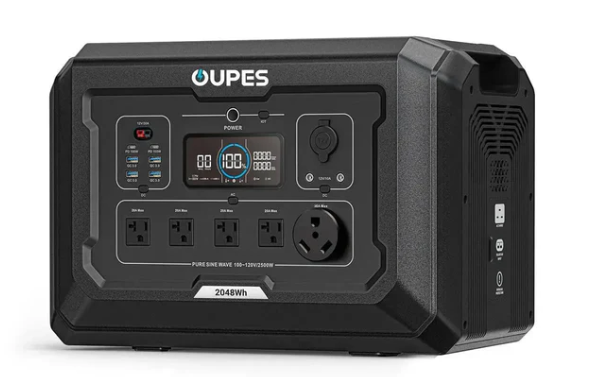
Modern solar systems such as OUPES portable power stations use high-efficiency LiFePO₄ batteries and advanced MPPT controllers, enabling steady charging even under diffused sunlight. These systems:
- Support up to 21–23% solar conversion efficiency.
- Offer seamless integration with multiple solar panels.
- Feature intelligent input regulation to adapt to fluctuating conditions.
- Maintain long-term battery health across 3,500+ cycles.
This makes them an excellent companion for users relying on solar power year-round — ensuring energy security even on cloudy or rainy days.
FAQ
1. Can solar panels charge during heavy rain?
Yes, but output drops significantly — typically to 10–20%. However, rain can help clean panels naturally, improving performance afterward.
2. Do portable solar panels work through glass windows?
They can, but with reduced efficiency (up to 50% lower) since glass blocks some wavelengths of sunlight required for PV conversion.
3. How much power can I expect on a cloudy day?
Most systems produce between 10%–40% of their rated output depending on cloud density, angle, and temperature.
4. Can I use a portable solar generator indoors?
Yes. Portable solar generators like those from OUPES are completely safe for indoor use since they emit no fumes and operate quietly.
5. Is it worth investing in solar panels if I live in a cloudy area?
Absolutely. Studies from the National Renewable Energy Laboratory (NREL) show that even in cloudy regions, solar systems can achieve 70–80% of their rated annual output when properly positioned and maintained.
6. How can I extend the lifespan of my portable solar system?
Store panels dry, clean them regularly, avoid overcharging, and use quality batteries like LiFePO₄ to ensure long-term reliability.