




Table of Contents
Understanding Space Heater Power Needs
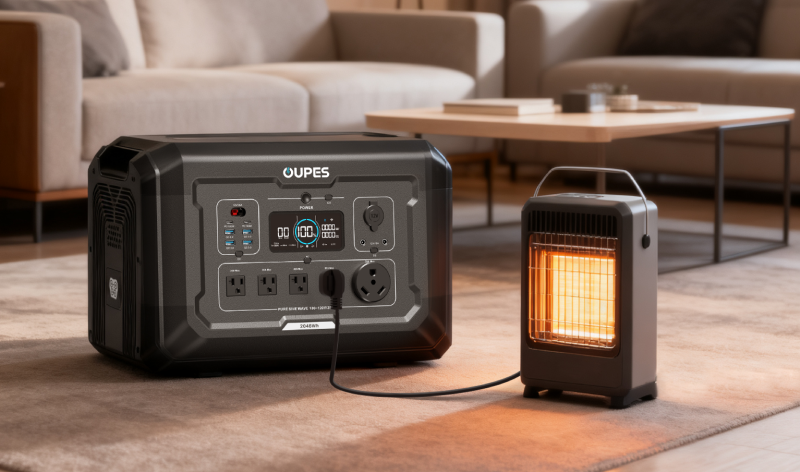
Space heaters are convenient for keeping small areas warm during cold weather or power outages. But they’re also some of the most power-hungry appliances you can plug in. Most electric space heaters draw between 1,000W and 1,500W, depending on their settings.
This means they consume energy very quickly — something to think about if you plan to run one on battery power. Before connecting a space heater to a portable power station, you need to understand how much power it requires and how long your system can handle it.
How Portable Power Stations Work
A portable power station is essentially a rechargeable battery system that provides AC and DC output for appliances and electronics. Unlike gas generators, it operates silently, doesn’t release fumes, and can often recharge from solar panels, making it ideal for off-grid or emergency use.
Most modern power stations use LiFePO₄ batteries — known for their long lifespan (over 3,000 charge cycles), stability, and safety. These units typically include:
- AC outlets for household devices like heaters or TVs
- DC ports for car accessories
- USB-A and USB-C ports for electronics
- Inverters that convert DC battery power into AC output
How to Calculate Heater Runtime
To see if your power station can run a space heater — and for how long — you need three pieces of information:
- The heater’s power draw (in watts)
- The power station’s output limit (in watts)
- The power station’s battery capacity (in watt-hours, Wh)
1. Identify the heater’s power draw
Most heaters are labeled 1,500W. That’s roughly 12.5 amps at 120 volts — a big load for portable systems.
2. Check the power station’s inverter output
To safely power a 1,500W heater, your power station should have an inverter rated for at least 1,800W continuous output. If the heater’s draw exceeds your inverter’s capacity, the station will shut off automatically.
3. Estimate runtime
You can calculate the approximate runtime using this formula:
Runtime (hours) = Battery Capacity (Wh) ÷ Heater Power (W) × Efficiency (≈0.85)
Example: A 2,000Wh power station running a 1,500W heater:
Runtime = 2000 ÷ 1500 × 0.85 ≈ 1.1 hours
That’s just over an hour of continuous heat before the battery needs recharging. Lowering the heater to 750W roughly doubles the runtime.
Can It Actually Work?
Technically, yes — you can run a space heater on a portable power station, provided the unit is powerful enough. However, it’s not the most efficient use of stored energy, as heaters consume high wattage continuously.
Typical Heater and Power Station Pairings
| Heater Power | Recommended Inverter Output | Runtime (2,000Wh Battery) |
|---|---|---|
| 750W (Low) | ≥1,000W | ≈2.2 hours |
| 1,000W (Medium) | ≥1,200W | ≈1.7 hours |
| 1,500W (High) | ≥1,800W | ≈1.1 hours |
These estimates assume a heater running at full power continuously. In practice, thermostats cycle the heater on and off, extending total runtime.
Key Things to Keep in Mind
1. Energy Efficiency
Space heaters convert nearly all electrical power into heat — which sounds efficient, but it also means they rapidly deplete stored energy. For off-grid or battery-powered setups, electric heating is often best reserved for short-term or emergency use.
2. Safety
Make sure your power station’s output rating comfortably exceeds your heater’s wattage. Avoid using low-quality extension cords and keep the setup away from moisture or flammable materials.
3. Battery Life
Running large loads frequently generates more internal heat and shortens the overall lifespan of a lithium battery. If you plan to use a heater often, consider a high-capacity system or supplement with insulation and passive heating methods.
4. Temperature Effects
Cold temperatures can reduce battery efficiency by 15–20%. To avoid power loss, keep your portable power station indoors or in a temperature-controlled space while in use.
Energy Use Comparison Table
Here’s how a space heater compares with other common devices powered by a 2,000Wh station:
| Device | Power Draw (W) | Estimated Runtime |
|---|---|---|
| LED Light Bulb | 10 | ≈170 hours |
| Laptop | 100 | ≈17 hours |
| Mini Fridge | 150 | ≈11 hours |
| Fan | 60 | ≈28 hours |
| Heater (Low) | 750 | ≈2.2 hours |
| Heater (High) | 1500 | ≈1.1 hours |
Practical Tips for Efficient Heating
- Use the lowest heat setting that keeps you comfortable.
- Heat only small, enclosed areas such as a tent, RV, or single room.
- Combine your heater with warm blankets, sleeping bags, or layered clothing.
- Recharge using solar panels during the day for nighttime use.
- Avoid powering multiple heavy appliances at the same time as your heater.
Example: Using an OUPES Power Station
The OUPES Mega Series portable power stations are designed to handle heavy household appliances, including space heaters — one of the most demanding winter essentials. Each model in the lineup uses a high-grade LiFePO₄ battery rated for over 3,500 cycles and features a pure sine wave inverter for stable, reliable output. Combined with fast dual charging and smart monitoring via Wi-Fi and Bluetooth, the Mega Series is built for real-world energy needs — from emergency backup to off-grid living.
How the Mega Series Handles a Space Heater
To understand their real-world heating performance, let’s compare the main specifications of each Mega model and see how long they can power a standard 1,500W space heater (high mode) or a 750W heater (low mode). The table below summarizes their capacities, inverter output, and approximate runtimes.
| Model | Battery Capacity | AC Output | AC + Solar Charging | Approx. Runtime (750W Heater) | Approx. Runtime (1500W Heater) |
|---|---|---|---|---|---|
| Mega 1 | 1024Wh (expandable to 5120Wh) |
2000W (4500W surge) | 2200W Max | ≈1.1 hours | ≈0.55 hours |
| Mega 2 | 2048Wh (expandable to 10.24kWh) |
2500W (5400W surge) | 3700W Max | ≈2.2 hours | ≈1.1 hours |
| Mega 3 | 3072Wh (expandable to 15.36kWh) |
3600W (7000W surge) | 3900W Max | ≈3.3 hours | ≈1.6 hours |
| Mega 5 | 5040Wh (expandable to 45.36kWh) |
4000W (7000W surge) | 3900W Max | ≈5.5 hours | ≈2.8 hours |
These runtime estimates assume the heater is running continuously at full load. In real use, most heaters cycle on and off based on temperature, which can extend total operating time by 30–50%.
Performance Insights
All OUPES Mega models can handle a typical 1,500W space heater, thanks to their high continuous output and pure sine wave inverters. The Mega 1 and Mega 2 are perfect for short-term heating during outages or while camping, while the Mega 3 and Mega 5 offer long-duration warmth suitable for off-grid cabins or large households.
Because each model supports dual AC + solar charging — up to 3,900W in the higher-end units — you can recharge the battery quickly even while it’s powering other appliances. This feature allows for simultaneous charging and discharging: the system continues to output power to your devices while recharging from solar panels or AC input. During this process, the station may slightly limit its maximum output power (not voltage) to maintain system balance and battery safety. The AC voltage remains stable at 120V, ensuring consistent performance.
Why This Matters for Winter Preparedness
In cold or storm-prone regions, losing power can quickly become more than an inconvenience — it’s a safety concern. Having a power station that can reliably run a heater, lights, and communication devices provides peace of mind. The OUPES Mega Series makes this practical by combining high-capacity batteries, durable LiFePO₄ chemistry, and flexible recharging options.
While electric heating remains energy-intensive, pairing it with solar input during the day or using it strategically for short periods can make all the difference during a winter emergency. In that sense, a well-equipped solar generator setup isn’t just convenient — it’s part of a resilient, sustainable lifestyle.
FAQ
1) Can a small power station run a space heater?
Not usually. Compact models under 1,000W output are insufficient for most space heaters, which require at least 1,500W continuous draw.
2) Is it safe to run a space heater on battery power?
Yes — as long as the power station’s inverter is rated above the heater’s draw and all cables are in good condition. Most high-end stations include overload and overheat protection.
3) Will frequent heater use damage the battery?
Occasional use won’t cause harm, but consistent high-wattage loads generate more heat and shorten the total charge cycle lifespan.
4) Are there better heating options for off-grid use?
Yes. Propane or catalytic heaters are more energy-efficient for continuous heating. Use your power station for supplemental or emergency warmth instead.
5) Can I recharge while the heater is running?
Some power stations, such as OUPES models, support simultaneous charging and discharging — meaning they can supply power to your devices while recharging from solar panels or AC input. However, during this process, the system may limit the maximum output power (not voltage) to maintain balance and battery safety. This ensures stable 120V output while preventing overload or excessive heat.
Conclusion
A portable power station can indeed power a space heater, but the practicality depends on your power station’s size, output capacity, and total battery energy. For short-term heating — during outages or while camping — it’s a viable solution. For long-term comfort, pairing battery power with insulation, passive heat, or solar recharging makes all the difference.
Systems like the OUPES Mega Series combine high output, long-lasting LiFePO₄ batteries, and rapid solar recharging, making them a dependable backup for winter emergencies and off-grid comfort.


Leave a comment
This site is protected by hCaptcha and the hCaptcha Privacy Policy and Terms of Service apply.