




Key Takeaways
A kilowatt-hour (kWh), often called “one unit of electricity,” is a measure of energy. It represents the amount of electricity used by a 1000W device running for one hour.
In real-world use, a 1kWh power station does not usually deliver 100% of its rated capacity because of inverter losses and battery protection mechanisms. In many practical scenarios, about 80% of the rated capacity is used as a more realistic reference.
With roughly 1kWh of energy, you can power a router for around 80 hours, a CPAP machine for about 20 hours, or a small refrigerator for roughly 8 hours. But runtime is only half of the picture. Whether a power station can actually run a device also depends on output power, not just capacity.
For users comparing portable power stations, home backup solutions, or camping power systems, understanding kWh is one of the most useful starting points.
Table of Contents
- What is a kilowatt-hour (kWh)?
- How electricity usage is calculated
- What devices can 1kWh power?
- Real-world runtime calculation
- Common device runtime reference table
- When is 1kWh enough?
- Why output power matters more than many users expect
- How to choose a 1kWh power station
- Understanding 1kWh through a real product
- FAQ
What Is a Kilowatt-hour (kWh)?
A kilowatt-hour (kWh) is a unit of energy used to measure how much electricity is consumed over time. It does not describe how powerful a device is, but how much energy it uses.
The U.S. Energy Information Administration defines one kilowatt-hour as the amount of electricity used when one kilowatt (1,000 watts) of power is consumed for one hour.
In simple terms, a kWh is a way to connect power and time:
- A 1000W appliance running for 1 hour uses 1kWh
- A 500W appliance running for 2 hours also uses 1kWh
- A 100W device running for 10 hours uses 1kWh
This is the same unit used on household electricity bills, which is why it is a practical reference when comparing power stations or estimating real-world usage.
For most users, however, the definition itself is not the most important part. What matters is how that energy translates into actual runtime:
- How long can it power your essential devices?
- Can it keep your refrigerator running during an outage?
- Is it enough for a weekend camping trip?
Understanding kWh becomes useful only when it helps answer these real-world questions.
How Electricity Usage Is Calculated
The basic runtime formula is:
Runtime (hours) = Battery Capacity (Wh) ÷ Device Power (W)
But in real-world use, the full rated capacity of a battery is not usually available as usable AC power. This is because energy is lost during DC-to-AC conversion, and battery management systems also protect the battery from being fully discharged.
For this reason, many practical runtime estimates use a simplified rule:
Usable energy ≈ Rated capacity × 80%
For example, a 1024Wh power station provides about:
1024Wh × 0.8 ≈ 819Wh usable energy
This is not an exact engineering value for every situation, but it is a useful real-world reference for users comparing runtimes across common devices.
What Devices Can 1kWh Power?
A common misunderstanding is that 1kWh is only enough for emergency lighting or phone charging. In reality, a 1kWh-class power station can support a much wider range of devices, from low-power electronics to many household appliances.
According to typical appliance power ranges published by the U.S. Department of Energy, common household devices span a wide range of power demands.
Low-Power Devices
- Routers
- Phones and tablets
- LED lighting
- Small electronics
Medium-Power Devices
- Laptops
- TVs
- Monitors
- Small refrigerators
High-Power Devices
- Coffee makers
- Microwaves
- Rice cookers
- Electric kettles
However, whether a 1kWh power station can run a device depends on two separate things:
- How much energy it stores
- How much output power it can deliver
A power station may have enough energy to run a microwave briefly, but if its output rating is too low, the microwave will not start at all. That is why users should never look at capacity alone.
Real-World Runtime Calculation
Using a more realistic usable energy estimate of 819Wh, we can calculate approximate runtimes for common devices.
These estimates are meant to help users understand real-world usage rather than laboratory-perfect values. Actual runtime will vary depending on inverter efficiency, starting surge, temperature, battery condition, and how consistently the appliance draws power.
Common Device Runtime Reference Table
| Device | Typical Power | Estimated Runtime |
|---|---|---|
| Router | 10W | About 81 hours |
| CPAP Machine | 40W | About 20 hours |
| Laptop | 60W | About 13 hours |
| Mini Fridge | 100W | About 8 hours |
| TV | 100W | About 8 hours |
| Coffee Maker | 800W | About 1 hour |
| Microwave | 1100W | About 0.7 hours |
| Electric Kettle | 1500W | About 0.5 hours |
These numbers show why 1kWh is such a practical size. It is large enough to support critical low-power devices for long periods, while still being capable of handling many high-power appliances for shorter but meaningful use.
When Is 1kWh Enough?
Short Power Outages at Home
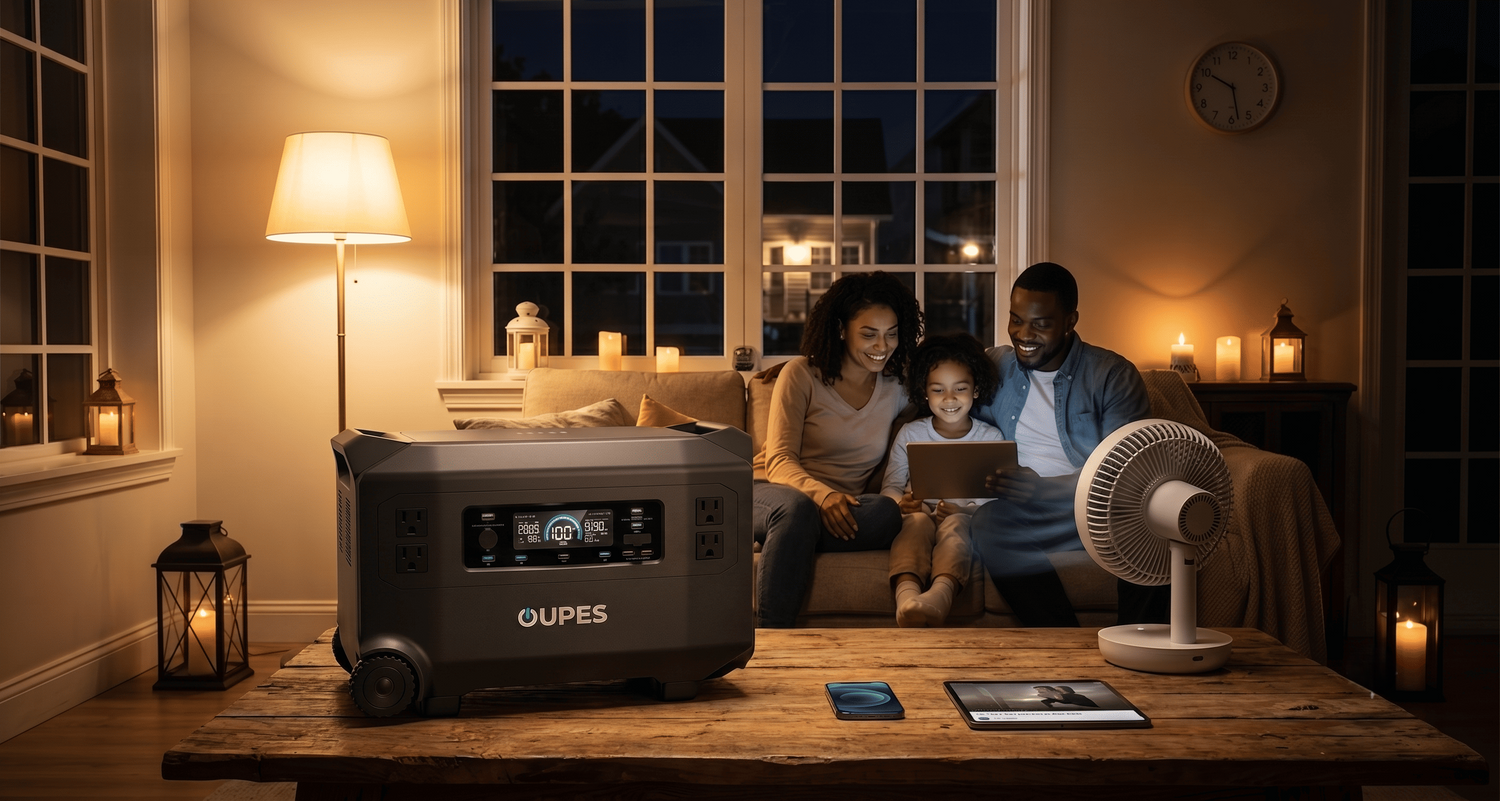
In a home outage, users usually do not need to power every appliance at once. The more realistic priority is keeping essential devices running, such as a router, lights, phone chargers, and sometimes a refrigerator.
In these situations, a 1kWh-class power station is often enough to cover several hours of critical electricity use.
Camping and Outdoor Trips
For outdoor use, many users want to charge phones, cameras, drones, and laptops, while also running lights, portable fridges, or small kitchen appliances.
A 1kWh power station sits in a practical middle ground. It offers far more usefulness than a small power bank, but remains more portable than larger backup systems.
Emergency Backup
For emergency preparedness, 1kWh is often considered the minimum practical backup level for supporting communication devices, medical equipment such as CPAP machines, and basic overnight power needs.
Why Output Power Matters More Than Many Users Expect
Capacity determines how long a power station lasts. Output power determines what it can actually run.
| Scenario | 500W System | 2000W System |
|---|---|---|
| Electric kettle | Cannot run | Can run normally |
| Microwave | Cannot run | Can run normally |
| Refrigerator startup | May fail | More stable |
This is why many users are disappointed by power stations that look large on paper but still cannot handle common appliances. Capacity alone does not define usability.
If a power station has around 1kWh of energy but only limited output, it may be useful only for small electronics. But if it combines roughly 1kWh with 2000W-class output, it becomes much more flexible for home, outdoor, and emergency use.
How to Choose a 1kWh Power Station
If you are comparing 1kWh-class portable power stations, there are four areas worth focusing on.
1. Output Power
For broader real-world usability, an output rating of around 2000W is much more practical than lower-power platforms.
2. Charging Speed
Fast AC charging, solar compatibility, and dual-input support can greatly improve convenience, especially during outages or outdoor use.
3. Port Configuration
The number of AC outlets, the availability of high-power USB-C ports, and the presence of DC outputs all affect how efficiently users can power multiple devices at once.
4. System Features
Features such as UPS support and firmware upgrades can improve long-term usability and day-to-day reliability.
Understanding 1kWh Through a Real Product
Once the concept of 1kWh becomes clear, the next step is understanding how that energy translates into real-world usability.
In practice, a 1kWh power station is not just about how much energy it stores, but how effectively that energy can be used. Two products with similar capacity can deliver completely different experiences depending on output power, charging speed, and system design.
For example, a 1kWh system paired with around 2000W of output changes how the device can be used. Instead of being limited to phones and small electronics, it becomes capable of running appliances like coffee makers, microwaves, or small refrigerators without constantly checking power limits.
Charging behavior also plays an important role. A system that can recharge quickly—especially within about an hour using AC input, or faster when combining AC and solar—feels much closer to a “usable power tool” rather than a device that needs long idle time between uses.
Port design and system features further shape the experience. Having enough AC outlets, high-power USB-C ports, and stable DC output means multiple devices can run at the same time without extra accessories. Features like UPS support and system-level updates add another layer of practicality, especially for home backup scenarios.
This is the context where products like the OUPES Mega 1 Lite make sense. With a battery capacity of around 1024Wh and a 2000W output platform, it aligns closely with what users typically expect from a 1kWh-class system: enough power to handle real appliances, fast enough recharging to stay practical, and flexible enough to adapt to different situations such as outages, outdoor use, or mobile work.
Rather than focusing on a single specification, this type of design shows how a 1kWh system can evolve from a basic energy source into a more complete, everyday power solution.

OUPES Mega 1 LITE Power Station
- Powerful Output: 2,000W AC (4,500W surge) via 9 ports; powers 99% of appliances.
- 46-Min AC Recharge: 0 to 100% in just 46 minutes via 1,400W input.
- Fast Solar Charging: Full charge in 69 minutes with 800W max solar input.
- OTA Updates: Remote firmware updates for optimized performance and new features.
Conclusion
A kilowatt-hour is not just a technical specification. It is a practical unit that directly connects to everyday questions: how long your internet can stay online, whether your refrigerator can keep running, or whether your weekend camping setup will have enough power.
For most users, 1kWh represents a useful balance between portability and real capability. And when that 1kWh is paired with strong output power, fast charging, and a practical port layout, it becomes much more than a backup battery. It becomes a flexible power solution for real life.
FAQ
1. Is 1kWh the same as 1000Wh?
Yes. 1kWh equals 1000Wh. Some power stations use 1024Wh because of battery structure and cell configuration.
2. Can 1kWh run a refrigerator?
Yes, but only if the power station has sufficient output power and enough surge capability to handle startup demand.
3. How long will 1kWh last?
It depends on the device. A low-power device may run for many hours, while a high-power appliance may use most of the energy within a short period.
4. Why is real runtime lower than theoretical runtime?
Because of inverter losses, battery protection systems, and other real-world operating conditions.
5. Is 1kWh enough for camping?
In many cases, yes. It is often enough for short trips, moderate appliance use, and charging multiple electronics.
6. Should I care more about capacity or power?
Both matter, but power determines whether your devices can run at all, while capacity determines how long they can run.


Leave a comment
This site is protected by hCaptcha and the hCaptcha Privacy Policy and Terms of Service apply.