




In RV power systems, solar storage, and off-grid setups, a battery often needs to deliver steady energy for long periods and repeat that charge-and-discharge pattern day after day. This is exactly what a deep cycle battery is designed to do.
This article explains what a deep cycle battery is, how it works, how it differs from a starting battery, where it’s commonly used, and why LiFePO4 (lithium iron phosphate) chemistry is increasingly popular for deep-cycling applications. A brief product example is included for context, followed by an FAQ.
Quick Navigation
- What Is a Deep Cycle Battery?
- How Does a Deep Cycle Battery Work?
- Deep Cycle Battery vs Starting Battery
- Common Applications of Deep Cycle Batteries
- Why LiFePO4 Is Widely Used in Deep Cycle Batteries
- A Practical Example of a LiFePO4 Deep Cycle Battery
- How to Know If You Need a Deep Cycle Battery
- FAQ
What Is a Deep Cycle Battery?
A deep cycle battery is a battery engineered to be discharged and recharged repeatedly while maintaining stable performance over a large number of cycles. The defining feature is that it can tolerate deeper, more frequent discharges than batteries designed primarily for short bursts of power.
In real-world terms, deep cycle batteries are built for energy delivery over time: they support sustained loads, repeated daily cycling, and higher depth-of-discharge use cases commonly found in storage and mobile power systems.
How Does a Deep Cycle Battery Work?
Deep cycle batteries prioritize repeatable energy delivery and cycle life. Instead of optimizing for extremely high peak current, they focus on efficient, consistent output across long runtimes and many charge cycles.
Key characteristics typically include:
- Cycle-life-oriented design: materials and internal design choices emphasize durability across many charge/discharge cycles.
- Stable output for sustained loads: better suited for devices and systems that draw power continuously or for extended periods.
- Energy utilization: deep cycle applications value usable energy and predictable runtime, not only the labeled capacity.
Deep Cycle Battery vs Starting Battery
Deep cycle batteries are often confused with starting batteries, but their design goals are different. Starting batteries (such as those used in many vehicles) are built to deliver a very high current for a short time. Deep cycle batteries are built to deliver moderate, steady power repeatedly over longer durations.
- Starting battery: short-duration, high-current output; typically shallow cycling; optimized for engine start events.
- Deep cycle battery: sustained output over time; frequent cycling; optimized for storage and continuous power delivery.
Because of this difference, many deep cycle batteries are not designed for start-up or high-surge applications. For example, some deep-cycle models are not intended for golf carts, pumps, lifts, or lawn equipment that may demand high surge current.
Common Applications of Deep Cycle Batteries
Deep cycle batteries are used wherever power must be delivered reliably for extended periods and the battery is expected to cycle frequently. Common use cases include:
- RV electrical systems: powering lights, DC loads, inverters, and daily onboard appliances.
- Solar and off-grid storage: storing energy during charging windows and supplying loads later.
- Marine systems and trolling motors: stable delivery and dependable cycling performance.
- Backup and emergency power: maintaining essential loads when grid power is unavailable.
Why LiFePO4 Is Widely Used in Deep Cycle Batteries
LiFePO4 (lithium iron phosphate) chemistry has become a popular choice for deep-cycle applications because it aligns well with the priorities of storage systems: longevity, safety, and consistent performance across repeated cycles.
Common advantages associated with LiFePO4 deep cycle batteries include:
- Long cycle life: designed for frequent cycling and deep discharge patterns over many years.
- Safety and stability: LiFePO4 chemistry is known for strong thermal stability when paired with proper protection systems.
- High usable energy: often delivers a larger share of usable capacity compared with traditional chemistries under similar operating conditions.
- Lower weight in many setups: helpful for RV, marine, and mobile systems where weight matters.
A Practical Example of a LiFePO4 Deep Cycle Battery
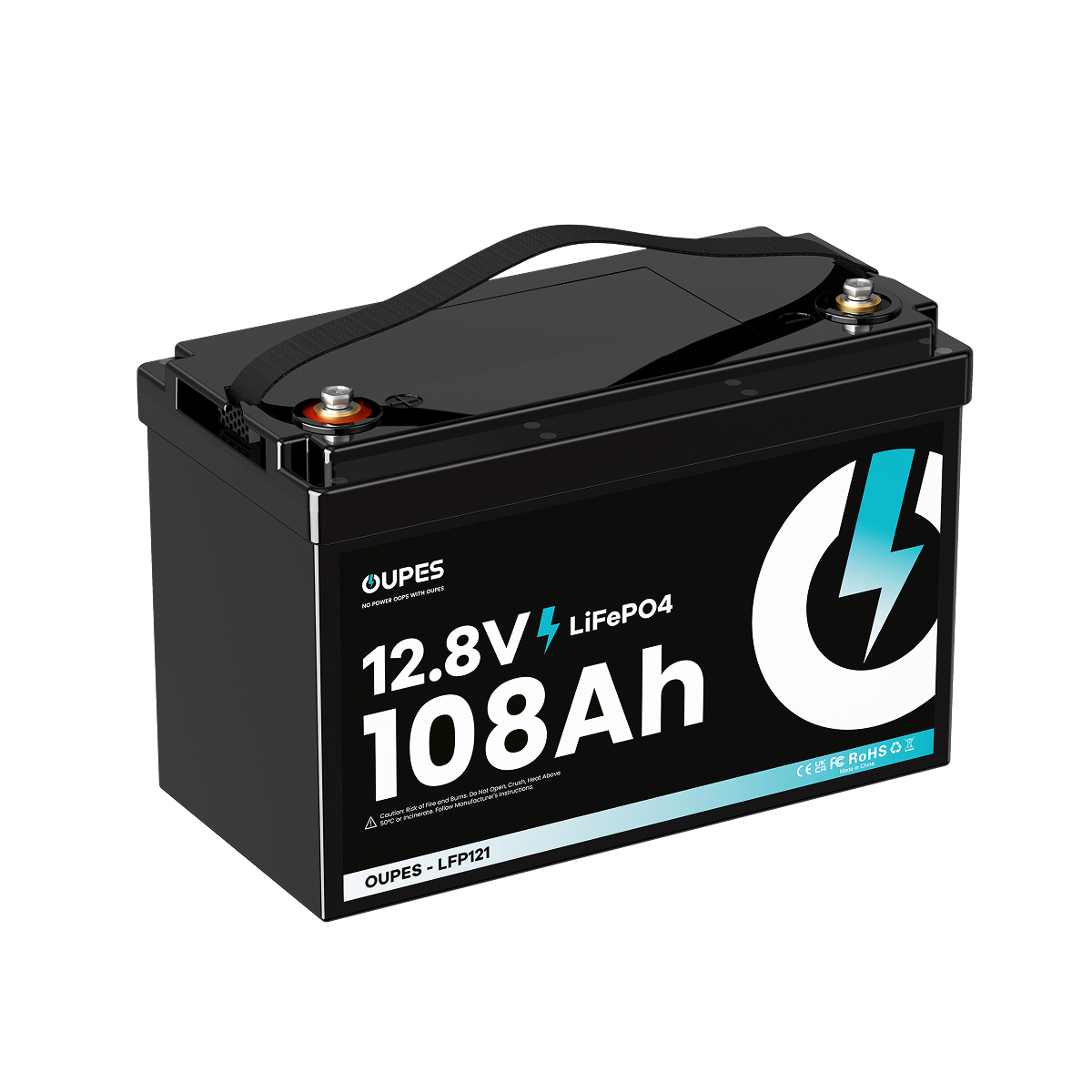
As a practical example, the OUPES LFP121 12V 108Ah LiFePO4 Lithium Deep Cycle Battery follows typical deep-cycle design priorities:
- EV-grade LiFePO4 cells: engineered for safe, durable, and consistent deep-cycle performance.
- 100A BMS protection: built-in battery management designed to protect against over-charge, over-discharge, over-temperature, over-current, and short circuits for stable operation.
- Weight and usable energy benefits: designed to reduce weight significantly (Group 31 equivalent and 21.27 lbs) while delivering high usable energy at 1C discharge.
- Flexible expansion: supports 4S, 4P, and 4S4P configurations, enabling systems up to 51.2V 432Ah (about 22kWh) for RV, off-grid, and solar setups when configured according to system requirements.
- Long service life: designed for a 10-year lifespan and 4,000+ cycles at 80% depth of discharge for frequent cycling.
Note: this type of battery is intended for deep-cycle energy storage and is not designed for start-up or high-surge applications such as golf carts, pumps, lifts, or lawn equipment.

OUPES LFP121 12V 108Ah LiFePO4 Lithium Deep Cycle Battery
- EV-Grade & 10-Year Life: Built with premium EV-grade LiFePO4 cells, offering 4,000+ deep cycles and a 10-year lifespan.
- 66% Lighter, 200% Power: Only 21.27 lbs (Group 31 equivalent)—reduces weight by 2/3 while delivering twice the usable energy of lead-acid batteries.
- 100A Smart BMS Protection: Integrated 100A Battery Management System provides 6-layer safety protection against overcharge, over-discharge, and temperature extremes.
- Scalable Power System: Supports 4S4P configurations to easily expand your setup up to 51.2V 432Ah (22kWh).
- Versatile & Reliable: Ideal for RVs, trolling motors, and off-grid solar; backed by a 5-year warranty and 24/5 support.
How to Know If You Need a Deep Cycle Battery
A deep cycle battery is typically the right choice if your power system matches one or more of these conditions:
- You need steady power over hours rather than a brief burst of current.
- Your battery will be cycled frequently (daily or near-daily charge and discharge).
- You are building an RV, solar, off-grid, or marine power system.
- You care about cycle life, safety protections, and predictable runtime under repeated use.
FAQ
Can a deep cycle battery be used as a starting battery?
In general, no. Deep cycle batteries are designed for sustained energy delivery, not short-duration high-surge start-up current. Using a deep cycle battery for start-up loads can reduce service life or trigger protection features on models with integrated BMS.
What devices and systems are best suited for deep cycle batteries?
Deep cycle batteries are commonly used for RV house power, solar and off-grid storage, marine systems (including trolling motors), and backup power setups where loads run for extended periods and the battery is cycled regularly.
Why do many people choose LiFePO4 for deep-cycle applications?
LiFePO4 is often selected for deep cycling because it supports long cycle life, strong safety stability when properly protected, and high usable energy for repeated charge-and-discharge patterns typical of storage systems.
Can a 12V deep cycle battery be expanded into a larger system?
Often yes. Many deep cycle batteries support series and parallel configurations to increase voltage and/or capacity. Always follow the manufacturer’s guidelines for wiring, balancing, and protection to ensure safe system operation.
What should I pay attention to when selecting a deep cycle battery?
Focus on the intended application (deep cycling vs start-up), usable capacity, cycle life rating, safety protections (such as BMS features for lithium batteries), and whether the battery supports the expansion configuration required by your system.


Leave a comment
This site is protected by hCaptcha and the hCaptcha Privacy Policy and Terms of Service apply.