




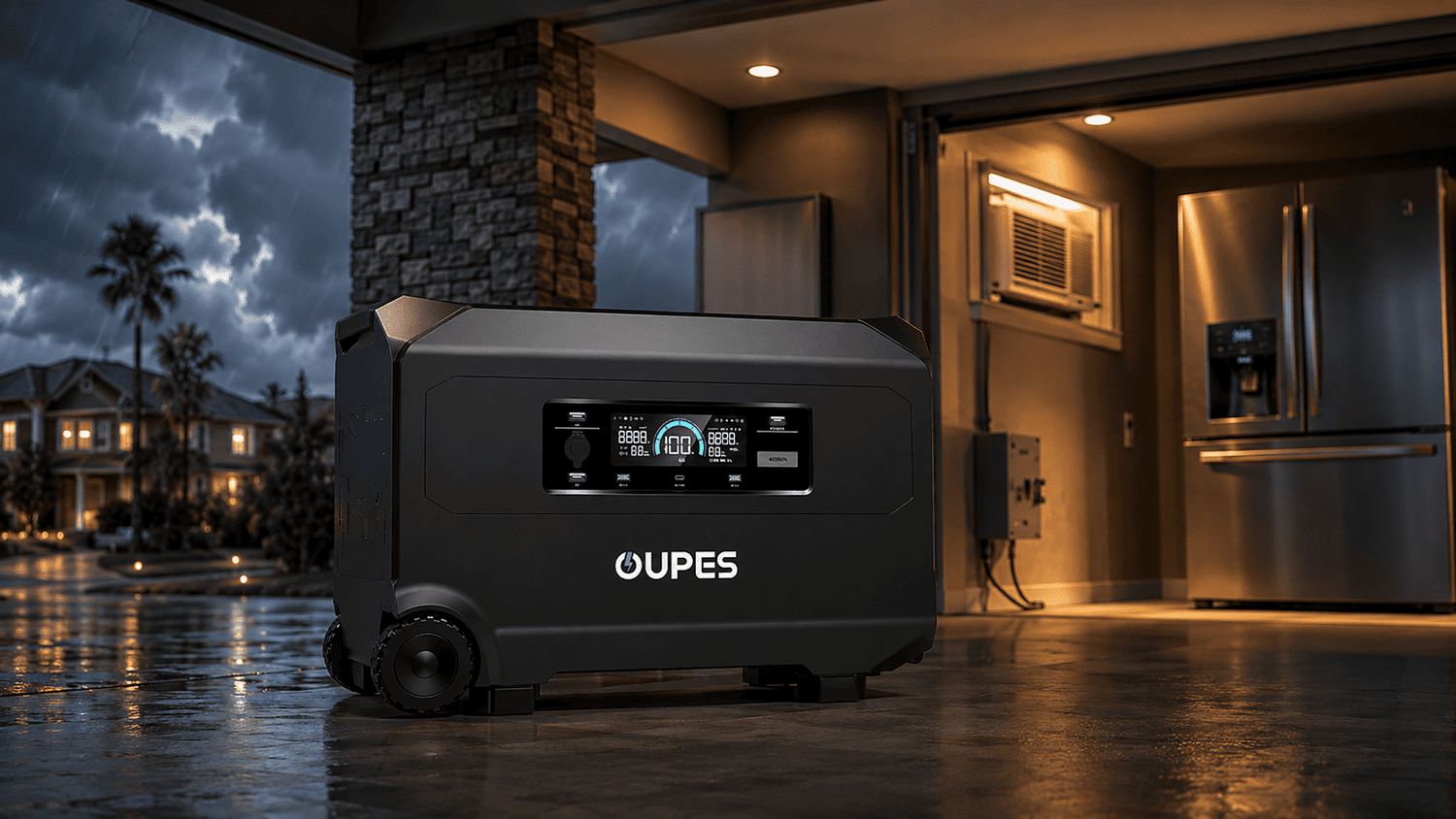
After hurricanes, heavy rain, or extreme weather causes a power outage, phones, lights, and Wi-Fi routers are usually not the most difficult electrical needs to address. The real challenge for a backup power system comes from high-wattage appliances such as refrigerators, air conditioners, washing machines, water pumps, microwaves, and electric water heaters.
These appliances not only have high running power requirements, but some compressor- and motor-driven equipment can also create startup loads several times higher than their normal operating wattage. Even when a portable power station has sufficient battery capacity, it may still be unable to start the intended appliance if its output voltage, continuous power, or surge capability is insufficient.
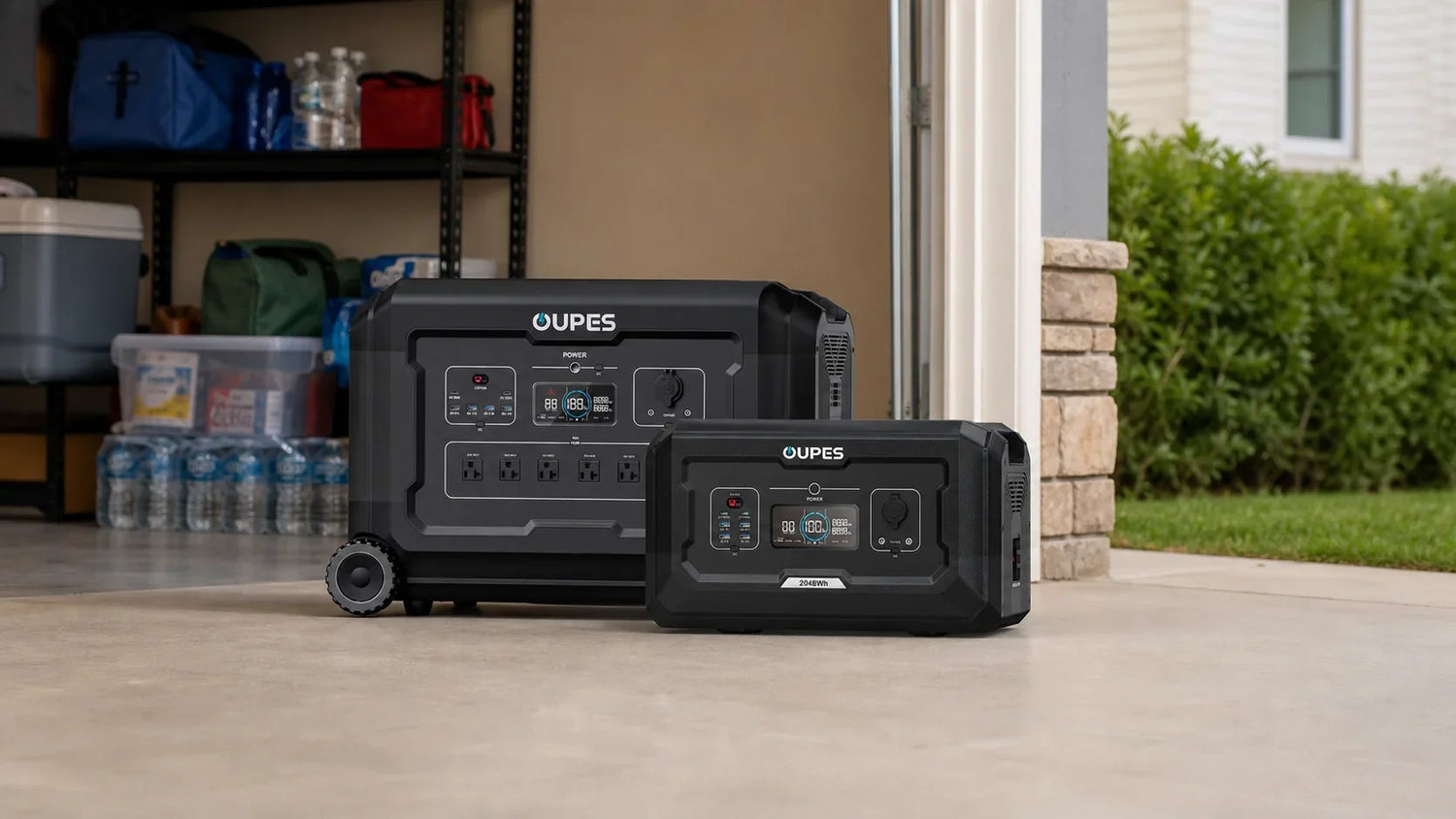
For users who need to support both 120V and 240V appliances, prepare for longer outages, or gradually expand their home backup capacity, Guardian 6000 V2 offers a solution that is closer to true whole-home backup. It provides 4,608Wh of base capacity, dual 120V and 240V output, up to 6,000W of rated 240V power, and up to 9,000W of surge capability. Its storage capacity can also be expanded to as much as 41.4kWh with G5 expansion batteries.
Understand the Difference Between 120V and 240V Appliances Before Choosing High-Wattage Backup Power
Most common household equipment in the United States operates at either 120V or 240V.
Phone chargers, refrigerators, microwaves, televisions, standard washing machines, and most window air conditioners normally use 120V outlets. Central air conditioners, electric dryers, electric water heaters, electric ranges, some well pumps, and certain garage or workshop equipment may require 240V power.
When determining whether a power station can operate an appliance, do not look only at its total output rating. You must also confirm the following factors:
| Factor to Check | What You Need to Confirm | Common Misunderstanding |
|---|---|---|
| Operating voltage | Whether the appliance requires 120V or 240V | Assuming every high-output power station supports 240V |
| Running power | The continuous power consumed during normal operation | Checking only battery capacity and ignoring inverter output |
| Startup power | The brief power demand when a compressor or motor starts | Looking only at the appliance's stable running wattage |
| Simultaneous load | The combined power of all appliances operating at the same time | Assuming appliances that can run separately can also run simultaneously |
| Battery capacity | How long the connected appliances can operate | Confusing watts with watt-hours |
Guardian 6000 V2 provides 6,000W of rated 240V output, 7,200W Boost Mode, and 9,000W surge power. However, its rated 120V output is 3,600W. This means that when multiple 120V appliances are operating together, the system must be planned around the 3,600W 120V limit rather than the headline 6,000W 240V rating.
Typical Running and Startup Power of High-Wattage Household Appliances
The following ranges can be used for emergency planning. Actual requirements may vary considerably by brand, capacity, efficiency rating, and operating mode. Always use the appliance nameplate, user manual, or measured consumption as the final reference.
Typical 120V Appliance Power Requirements
| Appliance | Typical Running Power | Planning Range for Startup or Peak Power | Emergency-Use Characteristics |
|---|---|---|---|
| Household refrigerator | 100-250W | 600-1,200W | The compressor cycles on and off. Open the door as little as possible. |
| Standalone freezer | 100-300W | 600-1,500W | A high-priority appliance during prolonged outages. |
| Microwave | 900-1,500W | 1,000-1,800W | High power but short operating time makes it useful for quick food heating. |
| Coffee maker | 800-1,200W | Usually close to running power | Can be used, but should not run at the same time as air conditioners or pumps. |
| Washing machine | 400-1,200W | 1,200-2,400W | Motor startup and spin cycles can produce higher loads. |
| Window air conditioner | 500-1,500W | 1,200-3,500W | Energy intensive. Cooling only one room is recommended. |
| Portable air conditioner | 800-1,500W | 1,500-3,500W | Both compressor startup and exhaust efficiency should be considered. |
| Sewage pump or sump pump | 800-1,500W | 2,000-4,000W | A high-priority load in flood-prone areas with significant startup demand. |
| Hair dryer | 1,000-1,800W | Usually close to running power | A nonessential load that should be limited during an outage. |
| Electric kettle | 1,000-1,500W | Usually close to running power | Operates briefly but quickly uses available output capacity. |
Typical 240V Appliance Power Requirements
| Appliance | Typical Running Power | Planning Range for Startup or Peak Power | Emergency-Use Characteristics |
|---|---|---|---|
| Central air conditioner | 2,000-5,000W or more | 5,000-10,000W or more | Compressor startup specifications must be confirmed. Some systems may require a soft starter. |
| Electric dryer | 3,000-5,000W | 5,000-7,500W | High continuous consumption makes it a low-priority appliance during outages. |
| Electric water heater | 3,000-4,500W | Usually close to running power | A resistive load that can drain the battery quickly. |
| Electric range or oven | 3,000-8,000W | Depends on the number of burners used simultaneously | Not ideal for extended use. A microwave can be used for short heating sessions instead. |
| Well pump | 1,000-2,500W | 3,000-6,000W or more | Motor startup demand is high and should be measured in advance. |
| Garage or workshop equipment | 1,000-5,000W | Depends on the motor or compressor | Nonessential equipment should be postponed during an outage. |
| 240V EV charging equipment | 3,800-11,500W or more | Usually close to rated power | EV charging should not normally be treated as a household emergency load. |
The U.S. Department of Energy identifies refrigeration, laundry, drying, heating, and cooling as important contributors to residential energy consumption, with heating and cooling typically representing the largest share. During an emergency, reducing the operating time of these appliances can extend backup runtime more effectively than simply increasing battery capacity. Read the U.S. Department of Energy guidance on household energy efficiency.
Why Can Operating Multiple High-Wattage Appliances at the Same Time Cause an Overload?
Many users see that Guardian 6000 V2 has a 6,000W output rating and simply add together the rated wattages of several appliances. In reality, household electrical loads continuously change, especially when refrigerators, air conditioners, pumps, and washing machines use compressors or motors.
For example, the following 120V appliances may be operating during a power outage:
| Appliance | Normal Running Power |
|---|---|
| Window air conditioner | 1,200W |
| Refrigerator | 200W |
| Freezer | 250W |
| Microwave | 1,400W |
| Router, lighting, and charging devices | 150W |
| Total | 3,200W |
A 3,200W running load remains below the 3,600W rated 120V output of Guardian 6000 V2. However, if the refrigerator or air conditioner compressor restarts at that moment, the instantaneous demand may quickly exceed the 120V output limit and trigger overload protection.
Main Risks of Operating Multiple High-Wattage Appliances
-
Multiple compressors starting at the same time
The air conditioner, refrigerator, and freezer may restart within a similar time window, causing instantaneous demand to rise far above their normal running power.
-
Ignoring the separate 120V output limit
The 6,000W rating of Guardian 6000 V2 applies to 240V output. Planning for 120V appliances must still be based on the 3,600W rated 120V output.
-
Treating surge power as continuous output
The 9,000W surge capability is intended to handle brief startup events. It cannot be treated as the system's long-term continuous output rating.
-
Ignoring the rate of battery depletion
Even when the inverter can support the load, continuously operating central air conditioning, an electric dryer, or an electric water heater can consume a large amount of battery energy in a short period.
-
Using unsuitable cables or adapters
High-wattage 120V and 240V appliances require compatible outlets, cables, circuit protection, and connection methods.
Safer Load Scheduling
| Operating Period | Recommended Appliances to Run | Appliances to Temporarily Turn Off |
|---|---|---|
| When the air conditioner starts | Air conditioner, limited lighting, and router | Microwave, washing machine, coffee maker, and electric water heater |
| When the water pump operates | Water pump, refrigerator, and basic communication equipment | Air conditioner, washing machine, and high-wattage kitchen appliances |
| When the microwave operates | Microwave, refrigerator, and lighting | Air conditioner, coffee maker, and electric kettle |
| During nighttime sleep | Refrigerator, CPAP, fan, and router | Washing machine, dryer, and kitchen appliances |
| During daytime solar charging | Essential equipment and selected flexible loads | Avoid exceeding available solar input and battery-system limits |
Why Is Guardian 6000 V2 Better Suited to Emergency Backup for High-Wattage Appliances?
Standard 1kWh or 2kWh portable power stations are well suited to phones, lighting, CPAP machines, refrigerators, and other essential equipment. However, when 240V appliances, high-startup motors, or multiple simultaneous loads are involved, these smaller systems are often limited by voltage, output, and battery capacity.
The key advantage of Guardian 6000 V2 is that it combines 120V and 240V output, high startup capability, and an expandable battery system in one platform.
| Guardian 6000 V2 Specification | Official Specification | Emergency-Backup Benefit |
|---|---|---|
| Base capacity | 4,608Wh | Supports refrigeration, communication, medical equipment, and selected high-wattage loads |
| Maximum expandable capacity | 41.4kWh | Allows additional G5 batteries to be added according to expected outage duration |
| Rated 240V output | 6,000W | Supports compatible 240V appliances and household equipment |
| 240V Boost Mode | 7,200W | Provides additional operating headroom for selected high-load equipment |
| Surge power | 9,000W | Helps manage brief startup demand from compressors, pumps, and motors |
| Rated 120V output | 3,600W | Supports common appliances such as refrigerators, microwaves, and window air conditioners |
| Battery chemistry | LiFePO4 | Suitable for frequent backup use and long-term cycling |
| Cycle life | More than 4,000 cycles to 80% capacity | Designed for long-term household emergency preparedness |
| EPS transfer time | Less than 20ms | Helps maintain operation of selected critical equipment |
| Maximum solar input | Dual MPPT, up to 2,100W per input | Supports high-power solar recharging |
| 240V AC charging | Up to 3,600W | Allows faster recharging when utility power is restored |
These specifications are based on the official Guardian 6000 V2 product page. Actual appliance compatibility still depends on voltage, plug type, continuous power, startup requirements, and connection method.
How Long Can Guardian 6000 V2 Run High-Wattage Appliances?
The following runtime estimates assume that 85% of the rated battery capacity is usable, allowing for inverter, standby, and cable losses.
Estimated usable energy from Guardian 6000 V2:
4,608Wh × 85% = 3,917Wh
With one G5 expansion battery, the combined rated capacity is 9,216Wh. Estimated usable energy is:
9,216Wh × 85% = 7,834Wh
Equivalent Continuous Runtime for Individual Appliances
| Average Appliance Load | Guardian 6000 V2 | Guardian 6000 V2 + G5 |
|---|---|---|
| 150W average refrigerator or freezer load | Approximately 26.1 hours | Approximately 52.2 hours |
| 800W window air conditioner | Approximately 4.9 hours | Approximately 9.8 hours |
| 1,200W air conditioner or kitchen appliance | Approximately 3.3 hours | Approximately 6.5 hours |
| 1,500W water pump or high-wattage appliance | Approximately 2.6 hours | Approximately 5.2 hours |
| 3,000W average central air-conditioner load | Approximately 1.3 hours | Approximately 2.6 hours |
| 4,500W electric water heater | Approximately 0.9 hours | Approximately 1.7 hours |
These are equivalent continuous runtimes. Refrigerators, pumps, and air conditioners normally cycle on and off, so the actual elapsed operating period may be longer. However, runtime may also be significantly shorter in extreme heat, with frequent refrigerator-door openings, or when equipment operates continuously at full load.
Runtime for Common Household Emergency Load Combinations
| Emergency Load Combination | Estimated Average Load | Guardian 6000 V2 | Guardian 6000 V2 + G5 |
|---|---|---|---|
| Refrigerator, router, lights, phones, and fan | 250W | Approximately 15.7 hours | Approximately 31.3 hours |
| Refrigerator, freezer, CPAP, fan, and communication equipment | 400W | Approximately 9.8 hours | Approximately 19.6 hours |
| Refrigerator, window air conditioner, lighting, and communication equipment | 1,200W | Approximately 3.3 hours | Approximately 6.5 hours |
| Two refrigeration appliances, intermittent air conditioning, and basic household loads | 1,500W | Approximately 2.6 hours | Approximately 5.2 hours |
| High-load household equipment combination | 3,000W | Approximately 1.3 hours | Approximately 2.6 hours |
In a real emergency, users should not operate every appliance continuously at full power. A more effective approach is to schedule refrigerators, air conditioners, pumps, and kitchen appliances at different times so that the average load remains lower.

OUPES Guardian 6000 V2 Power Station
- 240V/120V Dual Voltage (6,000W): Powers heavy appliances like central AC and dryers.
- 3,600W Solar Input: Fully recharges via solar in just 84 minutes.
- 4.6–41.4 kWh Expandable Capacity: Provides 1 to 7 days of home backup power.
- 4,000+ LFP Battery Cycles: Offers over 10 years of safe, daily use.
Choose a Guardian 6000 V2 Bundle Based on Expected Outage Duration
1. Several Hours of Backup: Guardian 6000 V2
Suitable for operating:
- Refrigerator and freezer
- Router and communication equipment
- CPAP machines and other medical devices
- LED lighting and fans
- Short microwave sessions
- Window air conditioner or water pump used on a scheduled basis
Guardian 6000 V2 provides 4,608Wh of base capacity, making it suitable for short outages or as an emergency source for high-wattage appliances.
2. Approximately Half a Day to One Day: Guardian 6000 V2 + G5
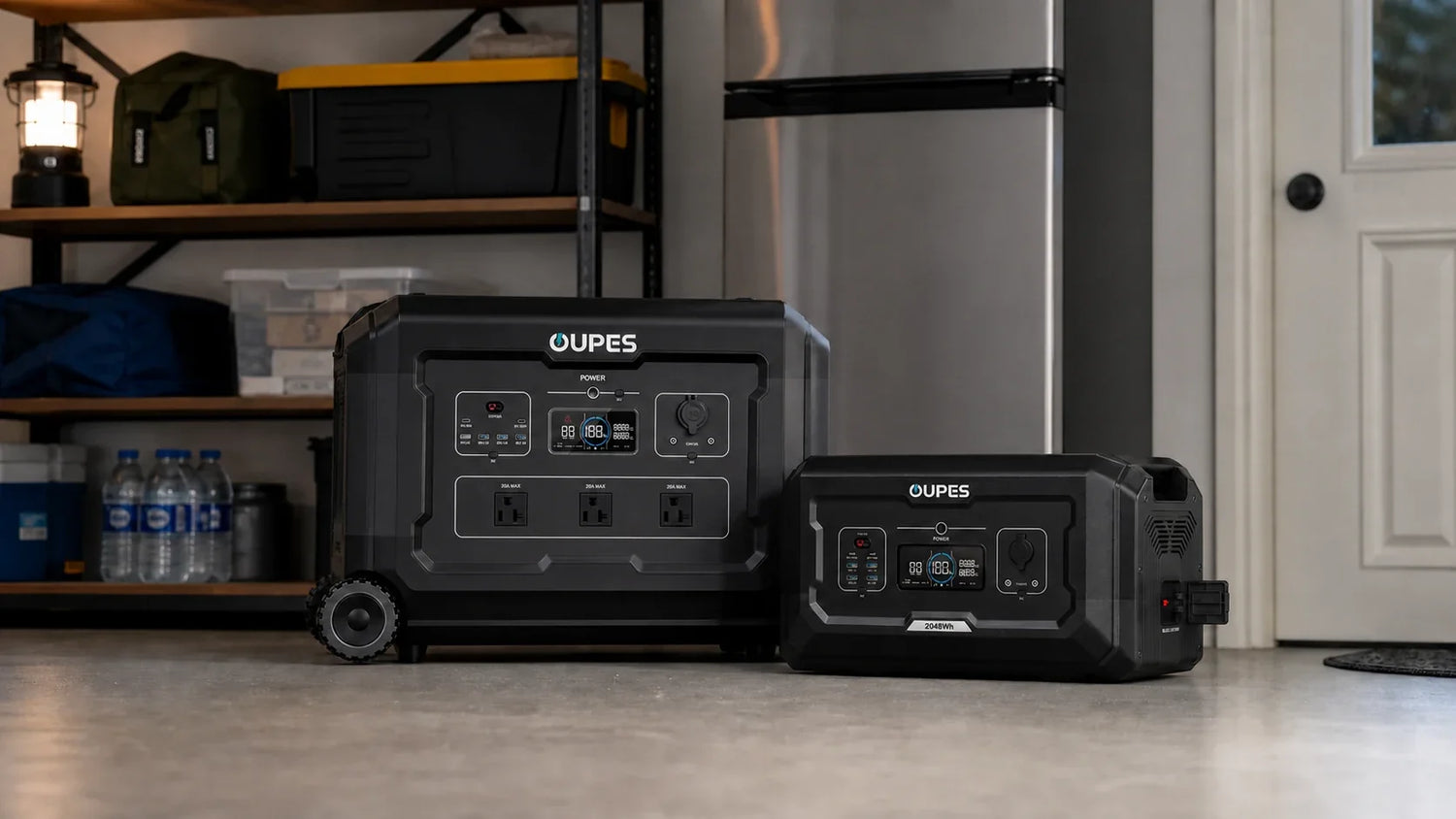
This bundle provides a combined capacity of 9,216Wh, significantly increasing nighttime and no-sunlight backup duration. The official bundle page positions it as a dual-voltage backup system for central air conditioners, dryers, pumps, and critical household equipment. View the Guardian 6000 V2 and G5 home backup bundle.
It is better suited to:
- Continuous refrigerator and freezer operation
- CPAP machines and other essential medical devices
- Intermittent window air-conditioner use
- Short operation of water pumps or well pumps
- Multiple communication and lighting devices
- Nighttime backup without solar energy
3. One to Several Days: Guardian 6000 V2 + G5 + Two 240W Solar Panels
This bundle provides 9,216Wh of energy storage and 480W of rated solar-panel capacity. It adds daytime recharging capability to a system that already has a larger nighttime energy reserve. View the Guardian 6000 V2, G5, and dual 240W solar-panel kit.
It is better suited to:
- Homes with reliable daytime sunlight
- Continuous refrigerator, freezer, and communication-equipment operation
- Nighttime use of fans, CPAP machines, and basic lighting
- Households facing uncertain outage duration
A 480W solar-panel rating does not mean that the system will receive 480Wh during every hour of daylight. Actual input depends on clouds, shade, solar angle, panel temperature, and available sunlight.
4. Multi-Day Preparedness: Guardian 6000 V2 + G5 + Four 240W Solar Panels
This bundle provides 9,216Wh of total battery capacity and 960W of rated solar-panel capacity, offering stronger daytime recharging under suitable weather conditions. View the Guardian 6000 V2, G5, and four-panel solar generator kit.
It is better suited to:
- Coastal and rural homes with elevated long-duration outage risk
- Households that need refrigerators, freezers, water pumps, and medical equipment
- Users who want daytime recharging and nighttime battery reserves
- Households planning to add more G5 batteries later
Guardian 6000 V2 Bundle Summary
| Outage Scenario | Recommended Bundle | Main Advantage |
|---|---|---|
| Several-hour outage | Guardian 6000 V2 | Supports 120V, 240V, and high-startup appliances |
| Overnight or approximately one day | Guardian 6000 V2 + G5 | Increases total battery capacity to 9,216Wh |
| One to several days with sunlight | Guardian 6000 V2 + G5 + 2 × 240W solar panels | Adds basic daytime solar recharging |
| Multi-day outage with higher average loads | Guardian 6000 V2 + G5 + 4 × 240W solar panels | Combines 9,216Wh of storage with 960W of rated solar capacity |
| Longer-term household emergency preparedness | Guardian 6000 V2 + multiple G5 batteries + a compatible solar array | Expandable system capacity up to 41.4kWh |
How to Make Guardian 6000 V2 Run High-Wattage Appliances Longer
Prioritize Refrigerators and Freezers
Reduce the number of times the doors are opened and plan which food items need to be removed in advance. Every door opening allows warm air to enter, forcing the compressor to operate longer.
Cool Only One Room
Instead of trying to cool the entire home continuously, select one shaded room with well-sealed doors and windows and use a window or portable air conditioner to concentrate cooling.
The U.S. Department of Energy recommends combining air conditioning with fans and raising the thermostat setting within a comfortable range to reduce cooling demand. Read the Department of Energy's summer home energy-saving guidance.
Schedule High-Wattage Appliances
Temporarily turn off the microwave, coffee maker, and washing machine when the air conditioner starts. Reduce other high loads while a water pump is operating. This lowers overload risk and reduces unnecessary peak losses.
Postpone Dryer and Electric Water-Heater Use
Electric dryers and water heaters may continuously consume between 3,000W and more than 5,000W. Even if Guardian 6000 V2 can support selected equipment in this range, these appliances can drain the battery quickly and should not normally be treated as long-term priorities during an outage.
Use a Microwave Instead of an Electric Range or Oven
A microwave has a high power rating, but it normally operates for only a short period. The U.S. Department of Energy also recommends using a microwave or small countertop appliance instead of a large oven to reduce energy use and indoor heat. Review the Department of Energy's efficient summer cooking recommendations.
Recharge During the Day and Preserve Capacity for Nighttime
When weather conditions are safe and sunlight is available, prioritize solar charging and schedule flexible tasks such as laundry, water pumping, and device charging during the day. Preserve nighttime battery capacity for refrigerators, medical devices, fans, and communication equipment.
Guardian 6000 V2 Home Backup Safety Precautions
- Place Guardian 6000 V2 in a dry, ventilated location away from standing water.
- Do not block the air intake or exhaust vents.
- Confirm whether each appliance requires 120V or 240V before connecting it.
- Do not treat the 9,000W surge rating as continuous output power.
- Plan the combined continuous load of multiple 120V appliances around the 3,600W limit.
- Use extension cords, plugs, and connection equipment rated for the required current and power.
- Never backfeed household wiring through a standard wall outlet.
- Connections to an electrical panel, transfer switch, or 240V circuit should be completed by a qualified electrician.
- Do not deploy solar panels while strong winds, lightning, flooding, or flying-debris hazards remain.
- Evacuate immediately when ordered. Backup power cannot protect a home from storm surge, flooding, or structural damage.
The Key Question for High-Wattage Appliance Backup Is Not Only “Can It Run?” but “How Long Can It Run?”
When choosing a household backup power system, asking only whether it can start a central air conditioner is not enough.
A more complete evaluation should include the following questions:
- Does the system support the appliance's required 120V or 240V voltage?
- Can its continuous output support all appliances operating at the same time?
- Can its surge capability handle compressor and motor startup?
- Can its battery capacity cover the expected outage duration?
- Can expansion batteries be added?
- Does the system have a safe and sustainable recharging method?
Guardian 6000 V2 combines 120V and 240V output with 4,608Wh of base capacity, 6,000W of rated 240V output, 9,000W of surge power, and G5 expansion capability. This creates a more complete emergency-power foundation for refrigerators, air conditioners, water pumps, washing machines, and other high-wattage household appliances. Explore Guardian 6000 V2 for high-wattage home backup.
For households preparing only for several hours of outage, Guardian 6000 V2 alone can support a broad range of critical loads. For overnight or multi-day backup, adding G5 expansion batteries and solar panels can increase nighttime energy storage while establishing a daytime recharging option.
Frequently Asked Questions
Can Guardian 6000 V2 run a central air conditioner?
It can support central air conditioners that remain within its voltage, continuous-power, and startup-power limits. Some systems may require a soft starter.
Can all 6,000W of Guardian 6000 V2 output be used for 120V appliances?
No. Its rated 120V output is 3,600W, while the 6,000W rating applies to 240V output.
Can Guardian 6000 V2 run a refrigerator and window air conditioner at the same time?
Usually, but you must include all other connected loads and confirm that simultaneous compressor startup will not cause an overload.
How long can one Guardian 6000 V2 run a refrigerator?
At an average 150W load and an estimated 85% usable capacity, runtime is approximately 26 hours. Actual results depend on compressor cycling, room temperature, and door openings.
Does a G5 expansion battery increase output power?
No. A G5 primarily increases stored energy and runtime. The inverter output limits of Guardian 6000 V2 remain unchanged.
Should I buy a G5 battery or solar panels first?
Choose a G5 first when dependable nighttime backup is the priority. Add solar panels when nighttime capacity is sufficient and a multi-day outage is possible.
Can Guardian 6000 V2 run an electric dryer?
Some compatible 240V dryers may operate within its power limits, but dryers consume substantial energy and should not normally be prioritized during an outage.
Can Guardian 6000 V2 be connected directly to a household electrical panel?
Approved transfer equipment and installation by a qualified electrician are required. Never backfeed household wiring through a wall outlet.

Leave a comment
This site is protected by hCaptcha and the hCaptcha Privacy Policy and Terms of Service apply.