




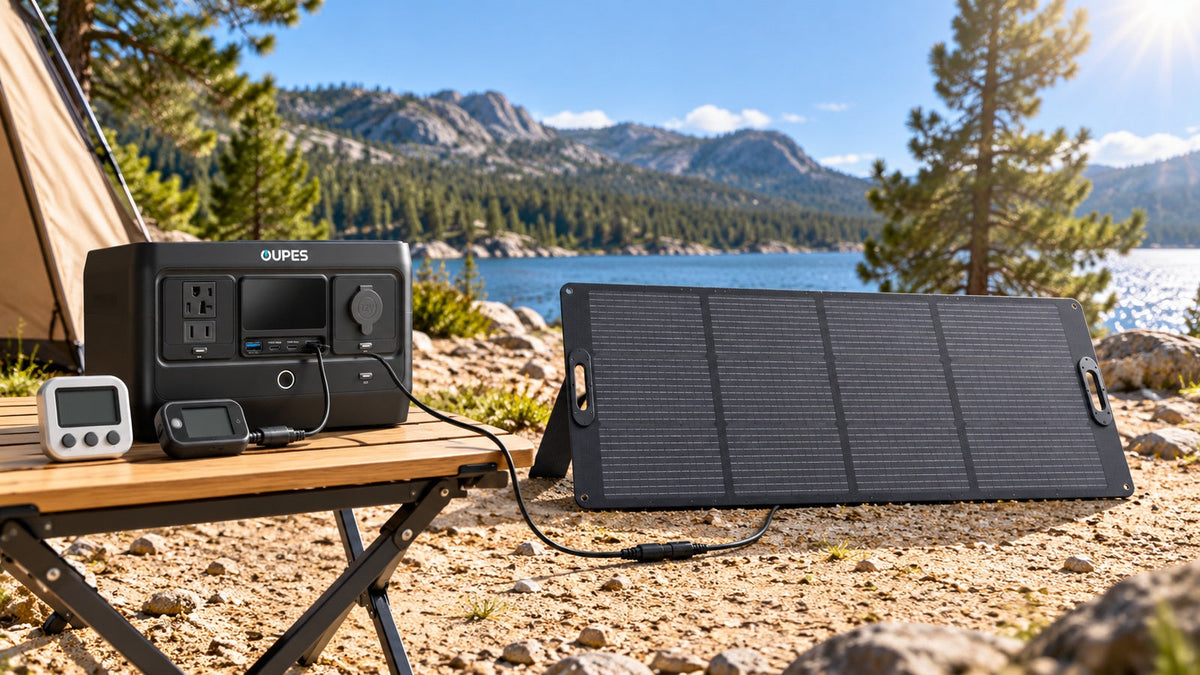
Higher actual solar input usually shortens charging time, but only until the power station's voltage, current and wattage limits are reached. Charging time also depends on battery capacity, starting state of charge, conversion losses, charging taper, weather and any appliances drawing power while the station charges.
Key Takeaways
- Maximum solar input is a ceiling, not a promise of constant power.
- Ideal time begins with energy needed divided by actual accepted watts.
- Panel nameplate watts rarely equal continuous field input.
- Voltage and current compatibility must be checked before array wattage.
- Active loads reduce the net watts available to refill the battery.
Start With the Charging-Time Formula
Ideal charging time (h) = energy needed (Wh) ÷ accepted charging power (W). If a 576Wh battery needs a full refill and accepts a steady 240W, the ideal lower-bound calculation is 576 ÷ 240 = 2.4 hours.
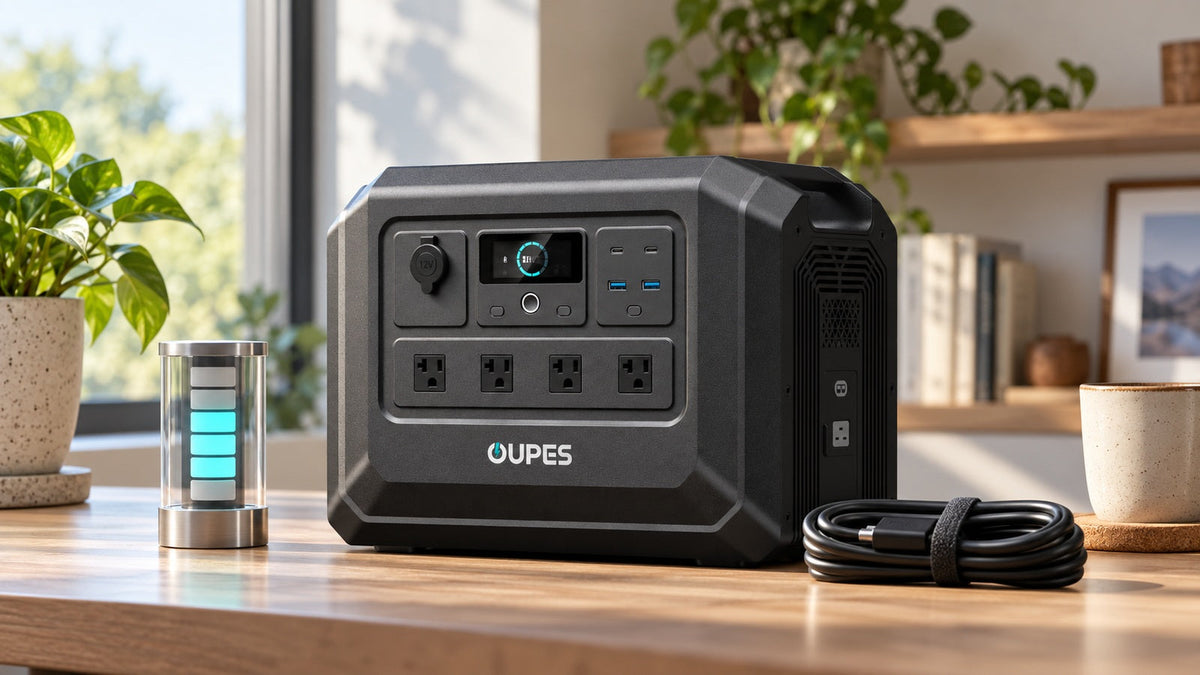
Real time is longer when the panel produces less than rated power, conversion losses occur or charging tapers near full. OUPES currently lists the Exodus 700 with up to 240W solar input and an advertised solar recharge around 2.6 hours under its stated conditions.
Understand the Three Solar Input Limits
| Limit | Why it matters |
|---|---|
| Voltage range and maximum Voc | Excess series voltage can exceed the input design |
| Maximum current | Parallel strings add current |
| Maximum watts | The controller cannot accept unlimited power |
An 800W array does not charge an input limited to 240W at 800W. The controller may clip available power, and an electrically incompatible array can remain unsuitable even when its total wattage seems low.
Why Real Solar Input Changes
Clouds, shade, panel angle, cell temperature, dirt, cable loss and the sun's position change output throughout the day. Peak-sun-hours summarize solar energy; they are not the number of daylight hours. Daily harvest can be estimated as array W × peak-sun-hours × system factor.
For example, 400W × 4 peak-sun-hours × 0.75 = 1,200Wh of illustrative daily harvest. That does not mean the station receives 400W for four clock hours.
Account for Appliances Used While Charging
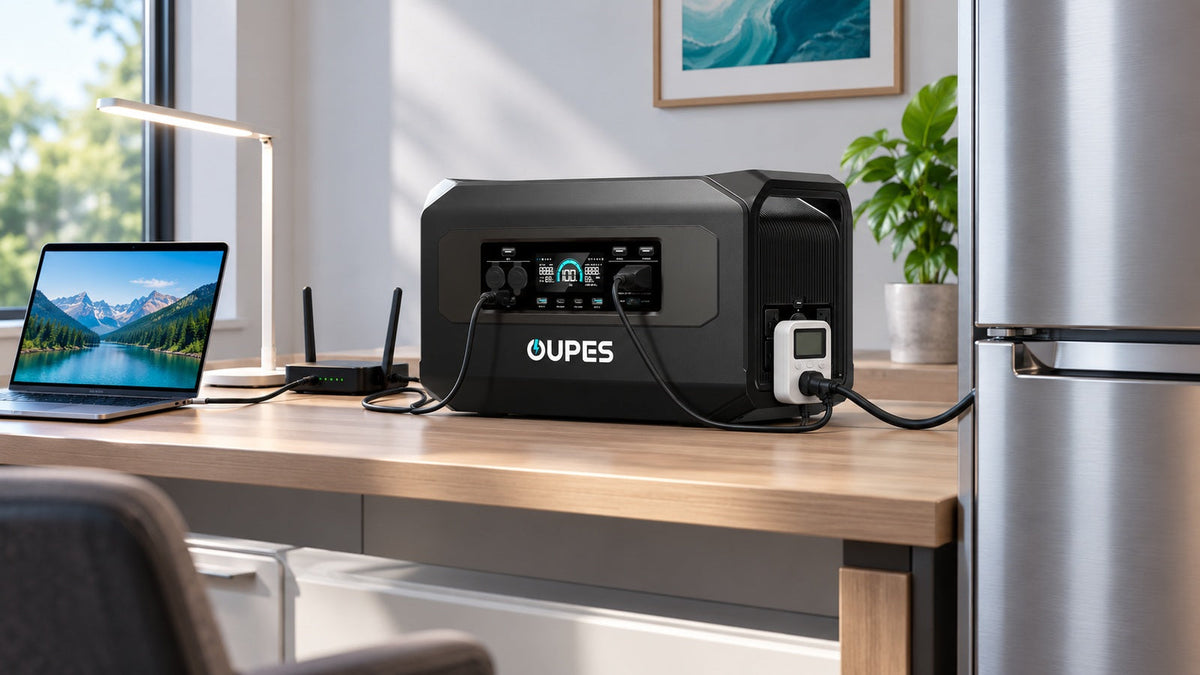
Net charging power is approximately accepted solar input minus battery-side demand from active loads and operating overhead. If the station accepts 300W while appliances use the equivalent of 180W, only about 120W remains for battery charging before other losses.
If loads exceed solar input, the state of charge continues to fall even though the display shows solar watts coming in. Measure energy across the day rather than looking at one sunny instant.
Choose Panel Wattage for the Daily Energy Goal
Work backward from required daily Wh. If loads consume 900Wh and the site expects four peak-sun-hours with a 75% system factor, array size is about 900 ÷ (4 × 0.75) = 300W. Add weather margin and then verify the complete voltage/current design.
Browse OUPES portable solar panels, but confirm each panel's Voc, Vmp, current, connector and series/parallel arrangement against the station manual.
Know When More Panel Wattage Stops Helping
Once actual available power reaches the station's accepted maximum, extra panel watts may improve morning or cloudy production but will not raise peak accepted input. Charging taper near full can also reduce power even in strong sun.
Faster charging should be balanced with portability, deployment space, cable management and cost. The useful target is enough daily harvest to replace daily consumption with reserve—not the largest array on paper.
Measure a Full Solar Day
Record input watts at several times, total Wh accepted, starting and ending state of charge, active loads and weather. A midday peak alone cannot show whether the array replaces daily consumption.
Repeat the measurement in the least favorable season you expect to use the system. If the battery ends each representative day lower than it began, increase harvest, reduce loads or provide another approved charging method.
Frequently Asked Questions
Does twice the panel wattage cut charging time in half?
Only when the station can accept the power and both arrays deliver proportionally more energy under the same conditions.
Why do I see less input than the panel rating?
Sun angle, temperature, shade, cable loss and controller limits all reduce field input.
Can I exceed the station's watt rating with panels?
Array design must remain within all documented voltage and current limits; do not infer safety from wattage alone.
What is charging taper?
The battery control system may reduce input near full charge or at temperature and voltage limits.
Do peak-sun-hours equal daylight hours?
No. They express equivalent full-intensity solar energy.
Can solar run loads and charge at the same time?
Some stations support it, but active loads reduce net charging and the manual controls.
Why does shade on one panel matter?
Shade can reduce a string's current and change the array operating point.
Is a 240W panel always right for a 240W input?
Not automatically. Voltage, current, connector and cold-weather Voc must also match.
How should I estimate a one-day refill?
Calculate missing Wh, divide by expected daily harvest, and include losses, taper and weather margin.

Leave a comment
This site is protected by hCaptcha and the hCaptcha Privacy Policy and Terms of Service apply.