


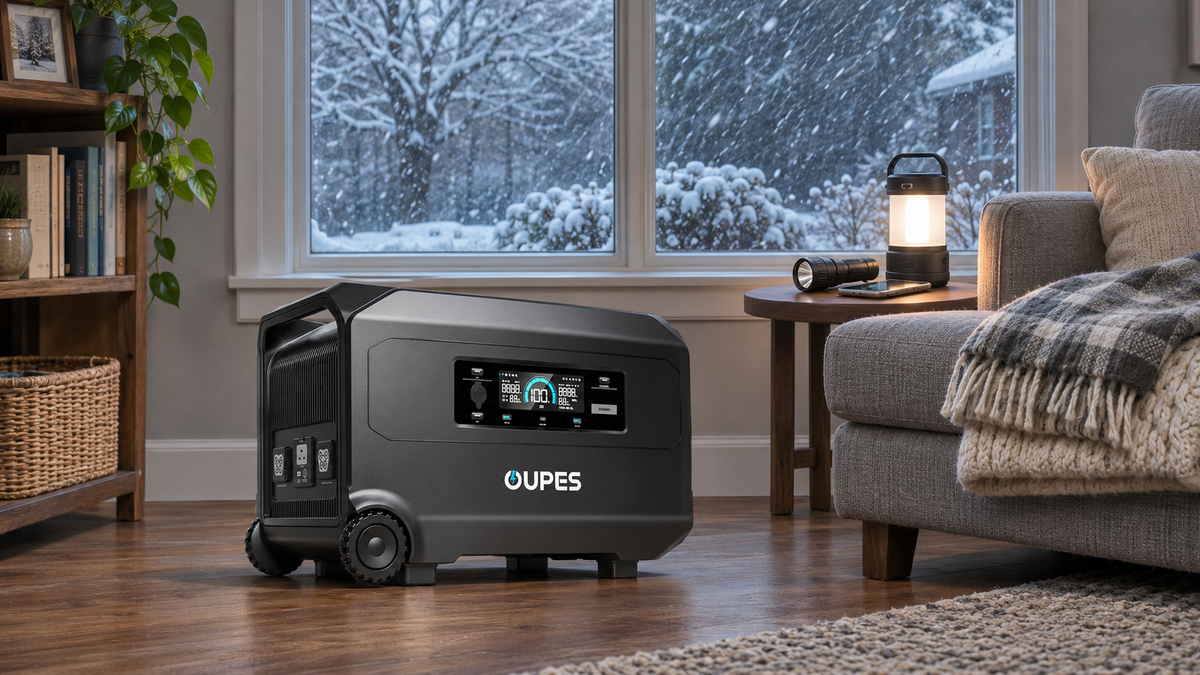
When freezing rain coats power lines and snow blocks roads, a winter storm can bring everyday life to a sudden halt. A power outage means more than dark rooms: heating systems may stop working, refrigerators lose cooling, phones need charging, and your family needs updates on weather conditions and power restoration.
Preparing in advance helps you know what to do when the lights go out. Start with a household emergency supply list, make plans for warmth and communication, and arrange backup power for essential devices.
1. Prepare Your Household Before the Storm
Follow Alerts and Agree on a Family Communication Plan
Monitor local weather alerts, outage notices from your utility, and community emergency updates. Save important phone numbers on your phone and keep a paper copy as well.
If family members may be in different locations, agree on how to contact each other and where to meet. Phones, power supplies, and networks can all be affected, so avoid relying on a single communication method.
Keep Emergency Supplies Easy to Find
Gather flashlights, batteries, drinking water, ready-to-eat food, essential medications, warm clothing, and blankets. Charge phones and power banks, and check your smoke and carbon monoxide alarms.
If anyone in your household depends on electrically powered medical equipment, contact the equipment supplier or healthcare provider in advance to arrange backup power and relocation options as part of a separate emergency plan.
Test Your Backup Equipment in Advance
Check your backup power station, lighting, and necessary cables before the storm arrives.
Connect the devices you intend to support, confirm that they start normally, and record their actual power draw and energy consumption. Familiarizing yourself with the setup is more useful than searching for switches, adapters, and instructions during an outage.
If you are purchasing new equipment, confirm delivery dates and leave enough time for charging and a trial run.
2. What Should You Prioritize During an Outage?
Warmth: First Assess Whether Your Home Is Still Safe
During a winter outage, pay close attention to your family’s condition and the indoor temperature, especially for infants, older adults, and anyone more sensitive to cold.
Prepare layered clothing, blankets, and sleeping bags, and gather in a suitable room. If indoor temperatures continue to fall, follow local emergency guidance and move to a safe, warm location when needed.
Follow the manufacturer’s instructions when using alternative heating equipment. The CDC’s winter storm safety guidance warns against using a stove to heat your home and explains that fuel-burning heaters require appropriate ventilation and safety precautions.
Backup power can provide electricity, but it does not replace a complete winter heating and shelter plan.
Communication and Lighting: Stay Connected and Light Essential Areas
Prioritize phones, essential lighting, and devices used to receive information. Concentrating lighting in the rooms your family uses, bathrooms, and walkways can help conserve stored energy.
The CDC recommends battery-powered flashlights or lanterns where possible to reduce the fire risk associated with candles.
If you plan to power your home internet equipment, include both the router and modem or optical network terminal. Keep another way to receive information, such as cellular service or a radio, because powered equipment at home does not guarantee that your internet provider’s service will remain available.
Food Storage: Limit Door Opening and Monitor Temperature
Keep refrigerator and freezer doors closed as much as possible. An appliance thermometer helps you assess the temperature during an outage instead of judging food safety by appearance or smell alone.
According to the CDC’s power outage guidance, a refrigerator generally keeps food safe for about four hours without power if the door stays closed. After that, use food temperatures and official food safety guidance to determine what can be kept.
If you plan to run a refrigerator from backup power, check its compressor starting requirements and test its actual energy consumption beforehand.
Heating and Cooking: Account for High Short-Term Loads
Space heaters, electric kettles, and induction cooktops can use substantial energy in a short period.
For example, a heater running continuously at 1,500W consumes approximately 1,500Wh per hour. A power station’s ability to run it does not necessarily make it suitable for extended operation.
Plan essential heating tasks for short periods when appropriate, while reserving energy for lighting, communication, and refrigeration. Fuel-burning stoves and generators must follow their outdoor-use and ventilation requirements and must not be brought indoors for emergency use. See the CDC’s winter storm safety guidance for more information.
3. How Much Backup Energy Do You Need?
List your essential devices, then calculate their power consumption and operating time. The following example illustrates an eight-hour backup energy budget:
| Device | Assumed Average Power | Operating Time | Estimated Energy Use |
|---|---|---|---|
| Router and modem or optical network terminal | 20W | 8 hours | 160Wh |
| LED lighting | 20W | 5 hours | 100Wh |
| Phone charging | Estimated total charging energy | — | 40Wh |
| Refrigerator | 60W averaged over operating cycles | 8 hours | 480Wh |
| Total | — | — | 780Wh |
These figures are examples. Confirm actual power and energy consumption through equipment documentation or measurements. A refrigerator’s average power draw does not replace a check of its starting power requirements.
The basic formula is:
Energy consumption (Wh) = Average power (W) × Operating time (hours)
Using 80% of a power station’s rated capacity as a planning estimate for available energy, the setup above would require approximately:
780Wh ÷ 80% = 975Wh of rated capacity.
A power station in the 1,024Wh range can therefore be a starting point for evaluation, but the remaining margin is limited. For longer outages, additional devices, or a larger reserve, increase capacity or adjust your power usage plan.
The 80% figure is an initial planning assumption. Actual runtime also depends on conversion losses, inverter standby consumption, ambient temperature, and battery condition.
Check output power separately. Even with enough stored energy, the power station must support the combined running load, starting requirements, and connection limits of your devices.
4. Plan Backup Power Around Your Household’s Needs
A household backup plan can begin with a few essential devices or expand to cover more loads for longer periods. Decide what you need to support before choosing capacity, output power, and connection methods.
For Lighting, Communication, and Basic Devices
If your main needs are phone charging, LED lighting, and networking equipment, start by evaluating a configuration with around 1kWh of capacity.
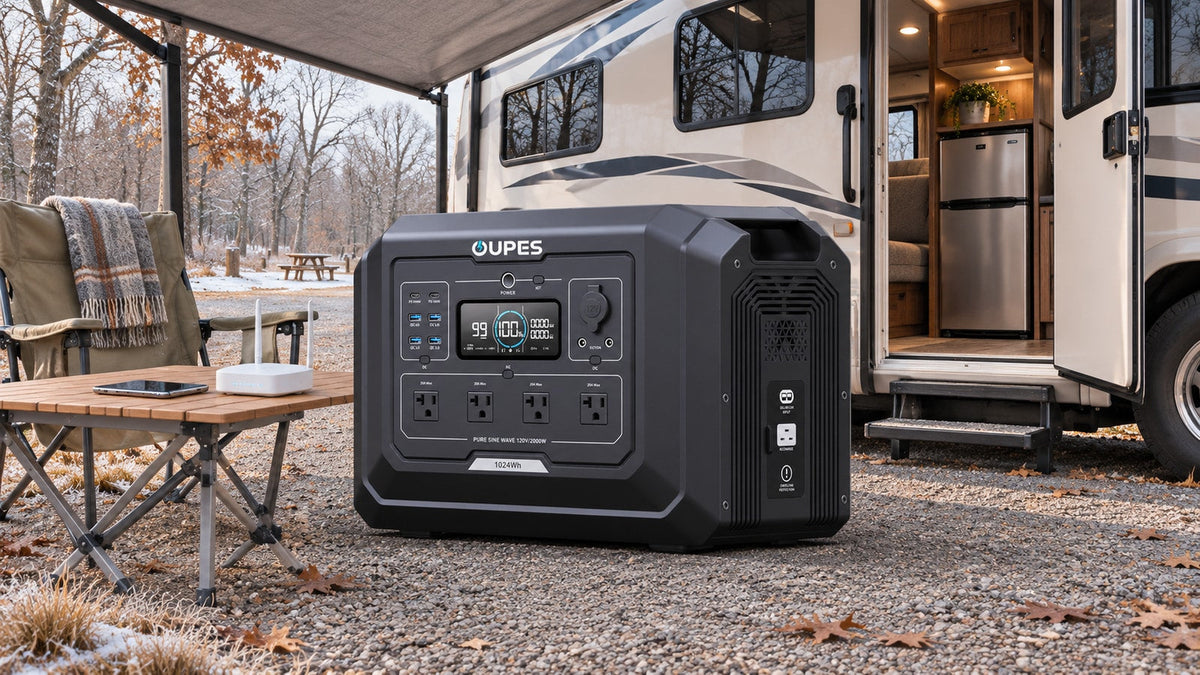
For example, the OUPES Mega 1 Lite offers 1,024Wh of capacity and 2,000W rated AC output, making it an option for basic emergency power. Adding a refrigerator requires a separate check of starting power and the overall energy budget.
If you want the option to increase stored energy later, explore the OUPES Mega 1. It provides 1,024Wh of base capacity and 2,000W output, with a compatible B2 expansion battery configuration offering 3,072Wh of total capacity.

OUPES Mega 1 LITE Power Station
- Powerful Output: 2,000W AC (4,500W surge) via 9 ports; powers 99% of appliances.
- 46-Min AC Recharge: 0 to 100% in just 46 minutes via 1,400W input.
- Fast Solar Charging: Full charge in 69 minutes with 800W max solar input.
- OTA Updates: Remote firmware updates for optimized performance and new features.

OUPES Mega 1 Power Station
- 1,024Wh Capacity | 2,000W AC Pure Sine Wave Inverter (4,500W Surge)
- LiFePO4 Battery with 3,500+ Life Cycles to 80%
- Expandable Up to 5.12kWh with B2*2
- 13 Outputs For Multiple Devices
- Fastest Charging Speed: Fully charge in 36 mins
For Larger Energy Reserves or 240V Equipment
If your household backup plan involves more equipment or 240V loads, assess voltage, output power, and connection arrangements together.
The OUPES Guardian 6000 V2 offers 4,608Wh of base capacity and dual-voltage output: 3,600W at 120V and 6,000W at 240V. Configurations with a G5 expansion battery are also available to increase stored energy.
When evaluating a water pump or other household equipment, check its voltage, starting load, and wiring requirements individually. The 6,000W rating at 240V must not be treated as the available power through a standard 120V outlet. For fixed household circuits, have a qualified electrician confirm suitable transfer equipment and installation requirements.

OUPES Guardian 6000 V2 Power Station
- 240V/120V Dual Voltage (6,000W): Powers heavy appliances like central AC and dryers.
- 3,600W Solar Input: Fully recharges via solar in just 84 minutes.
- 4.6–41.4 kWh Expandable Capacity: Provides 1 to 7 days of home backup power.
- 4,000+ LFP Battery Cycles: Offers over 10 years of safe, daily use.
If you are planning a future purchase, you can also follow the Mega 2 V2, with preorders scheduled to open on November 17. Refer to the official product page for specifications and delivery details. Households needing backup power soon should first confirm that equipment can arrive in time.
5. Recharging in Cold Weather and Extended Outages
Check Charging and Discharging Temperatures Separately
When using battery equipment in winter, check the specified charging, discharging, and storage temperature ranges separately.
The ability to discharge at a particular low temperature does not mean the battery can also charge at that temperature. Do not assume cold-weather suitability simply because a product is intended for outdoor activities. Follow the instructions for the specific model.
If equipment is moved from a cold environment into a warm room, check for condensation. Charge it only when it is dry and within the permitted temperature range, following the manufacturer’s instructions. Do not warm the unit directly with a space heater or wrap it in blankets while it is operating.
Charge Before the Storm Rather Than Relying on Last-Minute Options
When a storm warning is issued, use available grid power to charge your equipment in advance. During an extended outage, check energy levels and adjust loads before the battery runs out.
Compatible solar panels can provide supplemental charging when conditions allow, but winter daylight hours, cloud cover, snow, and panel placement affect actual input. A panel’s rated wattage does not represent the charging power you can continuously expect during a storm. Do not enter hazardous weather to set up panels.
6. What to Check After Power Returns
Once you confirm that power has returned to normal, restore equipment use gradually according to the manufacturer’s instructions and recharge your backup power station.
Check cables, connections, and the unit for moisture or damage. Evaluate refrigerated food based on temperature and outage duration; renewed cooling does not automatically make food safe again.
Finally, record what happened: which devices mattered most, how much energy they used, and what supplies were missing. Use that information to update your checklist and decide whether to add capacity or change your power priorities.
7. Frequently Asked Questions
What should a household prepare first before a winter storm?
Start with warmth, drinking water, food, medications, lighting, and communication, then plan backup power for essential devices. If anyone depends on medical equipment, arrange a separate emergency and relocation plan in advance.
What size power station do I need for a winter outage?
It depends on your equipment’s energy consumption and the runtime you need. Calculate the estimated energy use of each device, use 80% of rated battery capacity as an initial planning assumption, and leave a reserve. Also confirm that output power meets running and starting requirements.
Can a portable power station run a space heater for an extended period?
Assess power compatibility and runtime separately. Electric resistance heaters consume substantial energy and can quickly drain stored power. For example, a continuous 1,500W load requires approximately 3,000Wh for two hours, before accounting for conversion losses.
Does a gas heating system still need electricity during an outage?
Some gas heating systems need electricity for controls, ignition, or blower motors. Check the equipment documentation and have an HVAC or electrical professional confirm the backup power arrangement. Using natural gas as fuel does not guarantee that the system will operate during an outage.
Can the Guardian 6000 V2 directly power every appliance in my home?
You need to assess voltage, running and starting wattage, simultaneous loads, battery capacity, and installation requirements. Support for 120V and 240V output does not mean every appliance can operate through any connection, nor does it guarantee extended whole-home operation.
Does an expansion battery increase output power?
An expansion battery primarily adds stored energy and extends runtime. Available output power remains subject to the specifications of the main unit and its configuration. Batteries from different series or versions should not be assumed compatible.
Can I plug a backup power station into a wall outlet to power household circuits?
Do not backfeed power through a standard wall outlet. To supply fixed household circuits, use suitable transfer equipment and have a qualified electrician confirm the installation and operating procedure.
Can solar panels recharge a power station in winter?
Yes, when sunlight and equipment conditions permit, but actual input depends on weather, snow cover, daylight hours, and panel angle. Treat solar as a supplemental option and charge your power station before the storm arrives.
Prepare in Advance So You Know What to Do During an Outage
Winter storm preparation can start with a simple checklist: how your family will stay warm, where you will get information, how food will be kept safe, and which devices need to keep running.
Then choose suitable backup power for those essential devices and complete a trial run. Clear power priorities, an understanding of equipment limits, an energy reserve, and a relocation plan can help you care for your family more confidently when the power goes out.


Leave a comment
This site is protected by hCaptcha and the hCaptcha Privacy Policy and Terms of Service apply.