


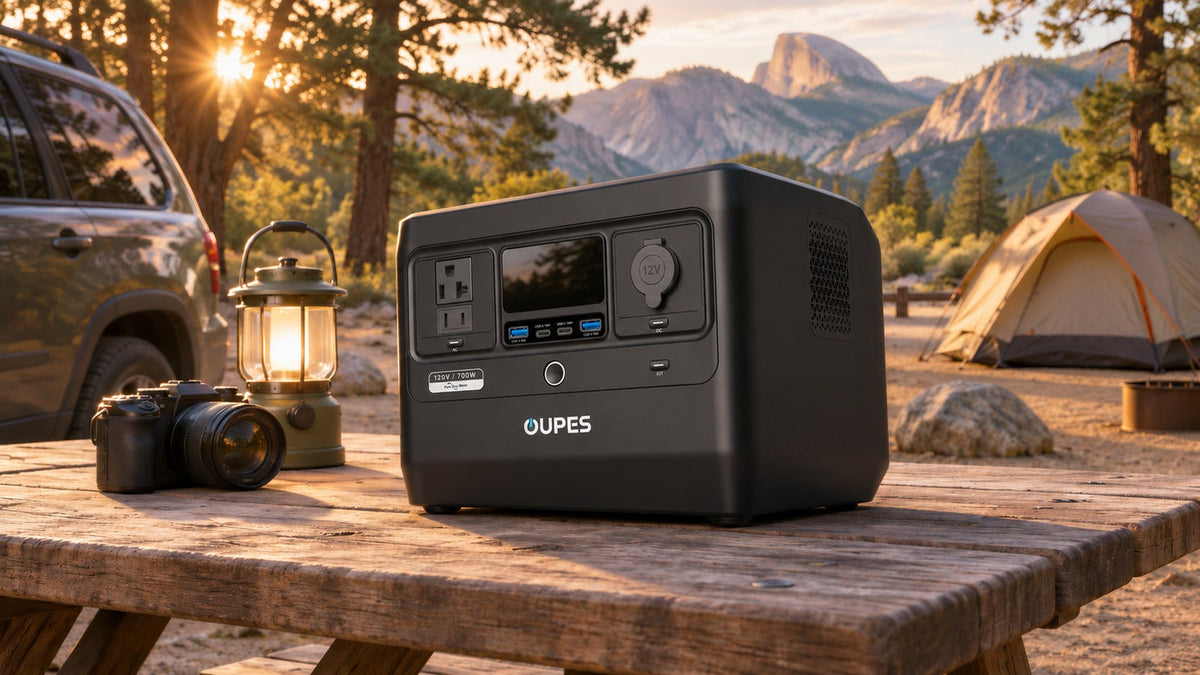
For a day in a national park, fully charged devices and a small power bank may be enough. An overnight camp adds lighting, longer phone use, camera charging, and possibly a fan or cooler; that is when a portable power station becomes more useful. List each device, estimate its watts and hours of use, and add the watt-hours before choosing a battery. Do not buy by trip length alone: a day with photography equipment can use more electricity than a simple overnight stay.
Key Takeaways
- Day trips and overnight camps have different energy budgets. Start with the actual device list, not a generic battery-size rule.
- For the demonstration below, a simple day trip uses 49Wh. An overnight camp with a small fan uses 229Wh; these are assumptions to replace with your own device ratings.
- Battery capacity, continuous output, weight, charging options, and park rules all matter. Solar recharging should be treated as uncertain until you know the campsite's sun exposure and restrictions.
- For the November 11, 2026 Veterans Day fee-free event, eligible U.S. residents may receive waived park entrance fees; camping, reservations, and other fees can still apply.
Check the park and trip conditions first
The National Park Service's 2026 fee-free schedule includes Veterans Day on November 11. The 2026 entrance-fee waiver applies to eligible U.S. residents. Camping, reservations, and special-use permits may still carry fees, and a fee-free entrance day does not create a campsite reservation. Check the specific park's current hours, alerts, campground status, and permit rules before leaving.
Electricity access also varies. A developed campground may offer an electrical hookup; a primitive site or trail usually will not. Even where a hookup exists, confirm its availability at your reserved site. The NPS trip-planning guidance also recommends checking current conditions and alerts. Your backup plan should work if the site has no outlet and cellular coverage is weak.
Decide whether this is a walk-in day trip, a car-based visit, or an overnight camp. A large battery that is convenient on a picnic table may be impractical to carry miles down a trail.
Build a small day-trip load list
Keep essential devices charged before departure. For many visitors, the only mid-day demand is a phone. Photographers may also need a camera battery charger; families may use a small light as the day ends. The following example assumes you use the listed devices for only part of the trip.
| Day-trip device | Assumed power | Assumed use | Energy |
|---|---|---|---|
| Phone charging | 12W | 2 hours | 24Wh |
| Camera battery charger | 20W | 1 hour | 20Wh |
| Small LED lantern | 5W | 1 hour | 5Wh |
| Example total | 49Wh |
Energy is watts × hours, so 12W × 2 hours = 24Wh for phone charging in this example. With an illustrative 75% usable-energy factor and a 20% planning reserve, 49Wh × 1.20 ÷ 0.75 is about 78Wh of nominal battery capacity. A suitable small power bank may cover this kind of day; a full power station is useful when you have AC-only chargers, several people, or heavier camera equipment. Check a power bank's actual output ports and airline rules if your trip involves flying.
Calculate the extra energy for one night
An overnight stay changes the load because lights and comfort devices may run for hours. This example includes a small 20W fan but no electric cooking, space heater, or refrigerator. Replace every assumed value with your device's label or a measurement.
| Overnight device | Assumed power | Assumed use | Energy |
|---|---|---|---|
| Phone charging | 12W | 2 hours | 24Wh |
| Camera battery charger | 20W | 1 hour | 20Wh |
| LED lantern | 5W | 5 hours | 25Wh |
| Small fan | 20W | 8 hours | 160Wh |
| One-night example total | 229Wh |
At the same 75% illustrative usable-energy factor, and with a separate 20% reserve, the nominal target is 229Wh × 1.20 ÷ 0.75 ≈ 366Wh. If the same loads run for two nights without recharging, the target doubles to about 733Wh. The 75% factor already represents usable energy and conversion losses in this demonstration; do not subtract those losses again. Fan cycling, a brighter lantern, colder conditions, or additional people can change the result.
A camping fridge deserves its own calculation based on measured daily watt-hours and startup demand. A high-wattage electric kettle, griddle, or space heater can overwhelm this light-camp budget quickly. Do not add them to the same plan without recalculating both output watts and energy.
Choose battery capacity, output, and carrying weight
A battery's Wh rating describes stored energy; its W rating and outlet limits describe what can run at once. Select capacity from the daily energy budget, then check that the unit's continuous output supports the largest simultaneous load. Motor-driven devices may also have a startup surge. Do not treat a peak-output rating as a continuous rating.
| Trip | Likely power approach | Main trade-off |
|---|---|---|
| Short walk or simple day visit | Precharged devices and a compatible power bank | Lowest carry weight; limited AC power. |
| Car-based day visit with camera gear | Small portable station if AC charging is needed | More ports and energy, but more weight. |
| One night with lights and a small fan | Portable station sized from the Wh calculation | Confirm real runtime and leave a reserve. |
| Two or more nights without outlets | Larger capacity, a verified recharge plan, or reduced loads | Solar output and campsite access are uncertain. |
The example one-night load needs about 366Wh nominal after the stated allowances. The 288Wh OUPES Exodus 350 is therefore below this example's planning target, even though its 350W output may cover the low simultaneous wattage. The 576Wh Exodus 700 leaves more nominal capacity margin for one night. Neither conclusion guarantees runtime; it only compares published capacities against explicit assumptions.
Plan recharging without assuming a sunny campsite
For a short day trip, charging at home before departure is often simpler than carrying a solar panel. For overnight or multi-day trips, check whether vehicle charging, a campsite hookup, or a compatible portable solar panel is available. A panel's advertised watts are a test-condition rating, not the power it will deliver all day.
A simple planning formula is daily solar energy ≈ panel rating (W) × peak-sun hours × system factor. For example, a hypothetical 100W panel, three effective peak-sun hours, and a 60% system factor would yield about 180Wh for that day. Those are demonstration assumptions; shade, clouds, panel angle, temperature, input limits, and battery charge level can make the real result much lower. Confirm the panel's open-circuit voltage, current, connector, and cable compatibility with the exact power-station model before connecting it.
Follow the specific park's rules for equipment placement. Do not spread panels or cables across paths, block other visitors, or leave equipment unattended in an exposed area.
Pack the power equipment as carefully as the rest of the trip
- Charge the station and all small devices before leaving, then test the cables and adapters you plan to carry.
- Keep the station on a stable, dry surface with clear ventilation; protect it from rain, standing water, and direct heat according to its manual.
- Use short, suitable cables and check each outlet's rating. Do not overload an AC strip because a station has several ports.
- Keep the device near your car or campsite if its weight makes trail carrying impractical. Respect park quiet hours and site rules.
- Carry offline maps, a flashlight, and a non-electric backup plan for essential communication or navigation.
Consider an OUPES setup only after the energy calculation
For the worked one-night example, the currently listed OUPES Exodus 700 has 576Wh nominal capacity and 700W continuous AC output. It is available as a unit-only configuration and in solar-panel variants on the U.S. product page. The unit-only configuration is the straightforward choice when the trip is short and you can recharge at home. A solar variant is worth considering only when campsite rules, sun exposure, and the verified included panel make recharging practical. The panel is not included with the unit-only option.

OUPES Exodus 700 Portable Power Station
- 576Wh nominal LiFePO4 battery capacity.
- 700W continuous AC output; check each connected device.
- 13.9 lb unit weight for car-based trips.
- Unit-only and solar-panel configurations are listed separately.
If your measured overnight load is much smaller, compare a lighter option rather than automatically carrying 576Wh. If you need a fridge, multiple nights, or a larger group, recalculate from actual watt-hours and consider a larger portable power station instead of assuming a small unit can stretch indefinitely.
Frequently asked questions
Is a power station necessary for a national park day trip?
Often no. If your devices start fully charged and the energy budget is small, a suitable power bank may be more convenient. A station helps when you need AC outlets or must charge several devices.
Does a free-entrance day include a free campsite?
No. The 2026 Veterans Day program concerns qualifying entrance fees. Camping, reservations, and other charges may still apply; verify the specific park and booking.
Will a 576Wh battery deliver exactly 576Wh to my devices?
No. The label is nominal capacity. Conversion losses, standby consumption, temperature, and device behavior reduce usable energy, so calculate with an allowance and test your actual setup.
Can I rely on a solar panel for a shaded campsite?
Do not assume rated output in shade. Estimate a conservative harvest, check park rules and electrical compatibility, and have enough charged battery capacity for the essential loads.
What if my campsite has an electrical hookup?
Confirm that your reserved site actually includes it and check the outlet type and allowed use. Keep a separate plan for a day away from camp or an unavailable hookup.
Can I carry the station on a long hike?
That depends on its weight, trail length, and your other gear. For a walk-in trip, minimize the load first; a small compatible power bank may be the better fit.

Leave a comment
This site is protected by hCaptcha and the hCaptcha Privacy Policy and Terms of Service apply.