




A $1,500 budget can cover a capable portable home-backup base unit for selected essentials, but the right choice depends on simultaneous watts, 24-hour energy and whether panels, expansion batteries or transfer equipment must fit the same budget. Prioritize refrigeration, communications, lighting and specific medical or pumping needs before optional cooking and comfort loads.
Key Takeaways
- Define essential loads and hours before comparing products.
- Use daily Wh for battery sizing and startup watts for inverter sizing.
- Keep the complete configuration—including panels and accessories—under the budget.
- A base unit under $1,500 does not imply whole-home coverage.
- Prices and availability were checked September 30, 2026.
Create an Essential-Load Plan
Rank loads by consequence: medical and accessibility equipment, refrigeration, communications, safe lighting and flood protection often come first. Record voltage, running W, startup W and hours.
High-heat appliances can consume a large share of a battery quickly. Plan short cooking windows or alternatives rather than assuming every household routine continues unchanged.
Calculate a Daily Energy Target
Assume a refrigerator averages 60W for 24 hours (1,440Wh), router uses 20W for 24 hours (480Wh), lights use 10W for six hours (60Wh), and phones/laptops require 320Wh. Total is 2,300Wh.
With 90% usable fraction and 85% efficiency, nominal capacity is 2,300 ÷ 0.765 ≈ 3,007Wh before contingency. A smaller battery can still work with recharging or a shorter coverage window.
Check Output, Startup and Connections
Add simultaneous running watts and the largest motor startup event. Confirm each receptacle and voltage. A 3kWh battery cannot power a 240V well pump unless the station and connection support 240V and the motor-start demand.
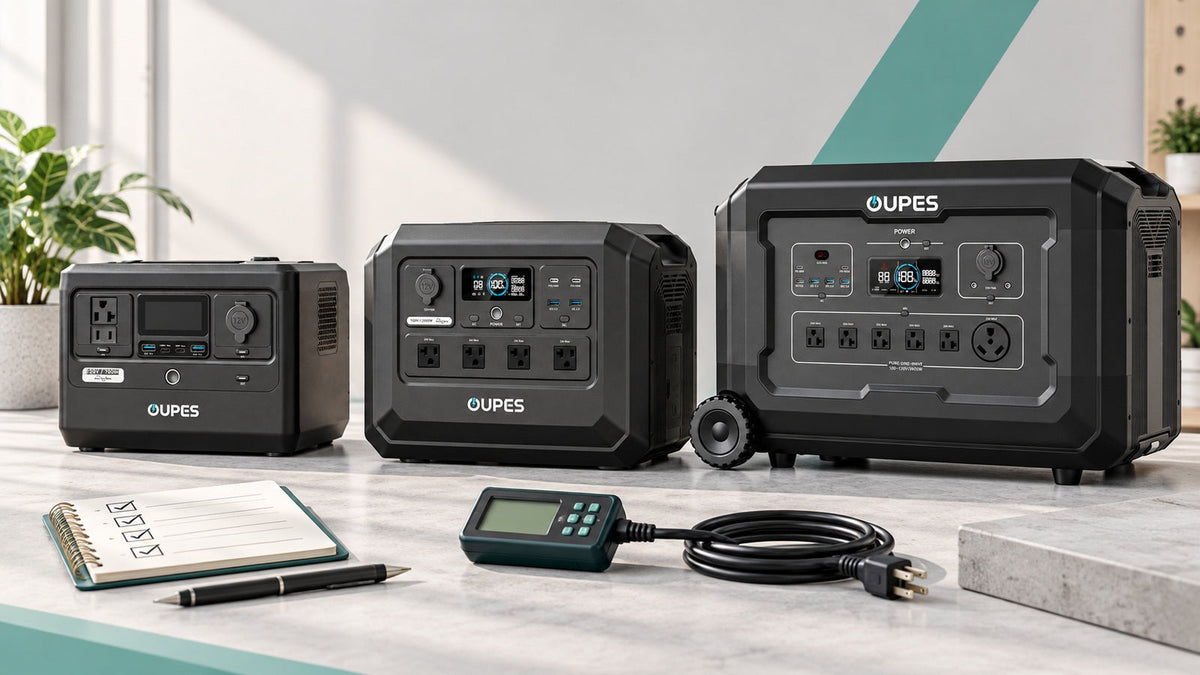
Compare Current OUPES Base Units
Official U.S. pages showed $599 for Mega 1 Lite, $699 for Mega 2 Pro and $1,299 for Mega 3 base units when checked. Codes, shipping and bundles may change.

OUPES Mega 1 Lite
- 1,024Wh rated capacity.
- 2,000W continuous AC output and 4,500W surge.
- Up to 800W solar input.
- A lower-cost high-output option when the measured energy target remains near 1kWh.

OUPES Mega 2 Pro
- 2,048Wh base capacity.
- 2,500W continuous AC output with 3,600W boost.
- Expandable up to 10.24kWh with compatible B2 batteries.
- A 2kWh expandable base for broader essential loads; verify current preorder timing.

OUPES Mega 3
- 3,072Wh base capacity.
- 3,600W continuous AC output and 7,000W surge.
- Expandable up to 15.36kWh with compatible B2 batteries.
- A 3kWh base that better matches a substantial one-day energy budget.
Budget for the Next Recharge
A 3kWh-class battery can still run out in one day if loads are large. Calculate solar harvest, AC charging time and the availability of a safe circuit. A 600W array with four peak-sun-hours and a 75% factor yields an illustrative 1,800Wh per favorable day.
Compare home backup configurations using the complete cost. A base station plus enough panels may exceed $1,500.
Decide What to Leave Out
If the budget cannot cover every load, protect the longest-running essentials and schedule high-power tasks. A microwave used for ten minutes may be manageable; a space heater running for hours may dominate the energy plan.
Test the selected loads together before outage season. Record startup behavior, energy consumed over several hours and recharge time. Keep a written operating order for the household.
Create a Household Operating Card
List which loads may run together, which appliance must be switched off before a pump or microwave starts, the minimum reserve, and the next charging action. Place the card with the station so another household member can operate it consistently.
Include phone numbers for product support, the electrician responsible for transfer equipment, and any medical-device provider. A clear plan is part of the backup system.
Frequently Asked Questions
Can $1,500 provide whole-home backup?
It can cover selected loads; whole-home needs depend on energy, power, voltage and integration.
Is a 3kWh station enough for 24 hours?
Only if measured load-side energy fits after losses and reserve or recharging replaces the deficit.
Should solar panels be inside the budget?
Yes when solar is required for the plan.
Can I power a furnace?
Many furnaces are hardwired and have startup and control requirements. Get the exact system evaluated.
Can I backfeed through an outlet?
No. Never energize home wiring through a wall receptacle.
Which loads should come first?
Prioritize health, refrigeration, communications, lighting and property protection based on household needs.
Does an expansion battery raise inverter output?
Usually it raises capacity, not output, unless documentation says otherwise.
How often should I test the setup?
Test before outage season and after major load, firmware or configuration changes.
Why can the complete price exceed the base unit?
Panels, batteries, cables, tax, delivery and transfer equipment add cost.


Leave a comment
This site is protected by hCaptcha and the hCaptcha Privacy Policy and Terms of Service apply.