




A good 1kWh portable power station should do more than meet a capacity target. It must have enough continuous output for the appliances you plan to use, enough usable energy for the required runtime, and a charging system that fits your schedule. For most buyers, this size works best for home essentials, mobile work, RV or camping use, and short outages. It is not designed to replace full-home power or support high-draw heating and cooling for long periods.
Key Takeaways
- Watt-hours describe stored energy; watts describe the load a power station can supply.
- Plan with usable energy and a reserve, rather than assuming every rated watt-hour reaches your appliances.
- Check startup demand, outlet limits and voltage separately from runtime.
- Charging access, carrying weight and the right USB or AC ports can matter more than a small difference in capacity.
Who Should Choose a 1kWh Portable Power Station?
A 1kWh model is a strong middle-ground choice when small power banks are too limited but a larger 2–3kWh system would add unnecessary cost and weight. It is especially practical for charging laptops and mobile devices, running network equipment and lighting, supporting selected appliances during a short outage, or powering a carefully planned campsite or mobile workspace.
Start with a list of devices and the hours you need them. A phone, laptop and several LED lights create a very different load from a heater, microwave and refrigerator. Separate equipment that must remain on from equipment that can be used briefly or left off.
One kilowatt-hour equals 1,000 watt-hours. A 1,024Wh product belongs to the same capacity class, but capacity does not reveal how much AC power the inverter can supply. Treat watt-hours as the runtime budget and watts as the appliance-compatibility limit. That distinction prevents two costly mistakes: choosing enough battery energy with too little output, or choosing high output with too little runtime.
| Your main need | What to check first | Likely decision |
|---|---|---|
| Laptop, communications and lights | Total energy over the required hours | A practical starting class if the measured budget fits |
| A refrigerator during a short outage | Compressor startup and measured energy consumption | Potentially suitable; the specific refrigerator determines the answer |
| Brief use of a higher-power appliance | Continuous output, startup and minutes of operation | Possible on a compatible inverter, with limited battery duration |
| Long electric heating or cooling sessions | Sustained power and total daily energy | Consider more stored energy, another safe plan or a smaller supported load |
Do not size a system from its largest advertised number alone. A higher-output power station can provide more appliance flexibility without providing proportionally longer runtime.
How Much Output Power Do You Need?
Read the appliance's electrical input rating, not a microwave's cooking output or an appliance's marketing name. Add the watts of devices that will operate together. Then check motor or compressor startup requirements, which may exceed the running load. A surge rating is useful only when its supported duration and operating conditions match the appliance.
For example, suppose your measured steady loads total 180W and you want to add a 1,200W appliance. The combined running requirement is 1,380W before any startup allowance. A power station with a 1,000W continuous limit fails that requirement even if it holds exactly 1kWh. Operating the appliance separately may reduce the simultaneous load, but it does not change the appliance's own requirements.
For U.S. equipment, confirm the required voltage and frequency as well as the plug type. A 120V outlet cannot supply a 240V appliance simply because the battery is large. Multiple sockets also share the inverter's overall limit; they are not separate full-power supplies. Check individual port ratings and use cords appropriate for the device and conditions.
How to Calculate Realistic Runtime
Use measured consumption when available. A nameplate helps with electrical compatibility, but a cycling refrigerator or variable-speed device may not consume its nameplate watts continuously. Measure a representative period instead of assuming that one display reading describes the whole day.
Device energy (Wh) = average power (W) × operating time (h).
Estimated runtime (h) = rated battery capacity (Wh) × delivered-energy factor ÷ average connected load (W).
The following planning example uses a 1,024Wh battery and an 80% delivered-energy factor to account for conversion losses and protected battery capacity. That provides an estimated 819.2Wh for connected loads. Actual runtime varies with load level, idle consumption, temperature, operating mode and battery condition, so use the result as a sizing estimate rather than a guaranteed runtime.
| Average load | Calculation | Estimated runtime |
|---|---|---|
| 50W | 1,024 × 0.80 ÷ 50 | 16.4 hours |
| 100W | 1,024 × 0.80 ÷ 100 | 8.2 hours |
| 300W | 1,024 × 0.80 ÷ 300 | 2.7 hours |
| 1,000W | 1,024 × 0.80 ÷ 1,000 | 0.82 hour, or about 49 minutes |
Now apply that to a work session: a hypothetical 60W laptop for six hours uses 360Wh, 20W of network equipment for six hours uses 120Wh, and a 10W light for four hours uses 40Wh. Total load-side energy is 520Wh. Keeping 20% of the estimated delivered energy in reserve leaves about 655Wh available for the planned session, so this example fits.
Add a hypothetical 1,500W heater for one hour and the heater alone requires 1,500Wh. It exceeds the entire example battery budget. Buying more inverter output would not solve that energy shortfall. Either shorten the task, choose more capacity, or change the plan.
How to Compare Charging Options
For use near reliable outlets, compare AC charging capability with the time between trips or outages. Also consider whether the outlet and circuit can support charging alongside other equipment. A maximum charging specification does not mean every household circuit should supply that rate under all conditions.
For solar use, check the power station's permitted input voltage and current, the panel's open-circuit voltage, the connector and the required cable. Connector fit alone does not establish electrical compatibility. Check whether the panel and necessary cables are actually included in the chosen configuration.
A 200W array receiving four equivalent peak-sun hours with an illustrative 0.75 overall harvest factor would produce about 600Wh: 200 × 4 × 0.75. Those are assumed conditions, not a forecast. Shade, season, cloud, orientation and input limits may reduce the result, so do not plan a 1,000Wh daily load around that example without another charging opportunity.
Which Practical Features Matter Most?
Match the outputs to your devices. A suitable USB-C port can simplify laptop charging, but its supported voltage profiles, cable and wattage must also match the laptop. Count devices that need AC adapters, and leave space for their plugs. Consider where the power station will sit and whether its controls remain accessible.
Check the complete carried weight, including solar panels and accessories. A product that works well on a floor at home may be awkward to carry upstairs or between campsites. Review charging and operating temperature limits in the current manual, and provide dry placement with clear ventilation.
If future expansion matters, verify an explicit expansion-battery specification before buying. A generic charging port is not proof of expansion support. An added battery, where supported, increases stored energy; it does not automatically increase AC output. Also review warranty eligibility and service arrangements instead of treating a headline warranty length as the whole policy.
Our Recommended 1kWh Option: OUPES Mega 1 Lite
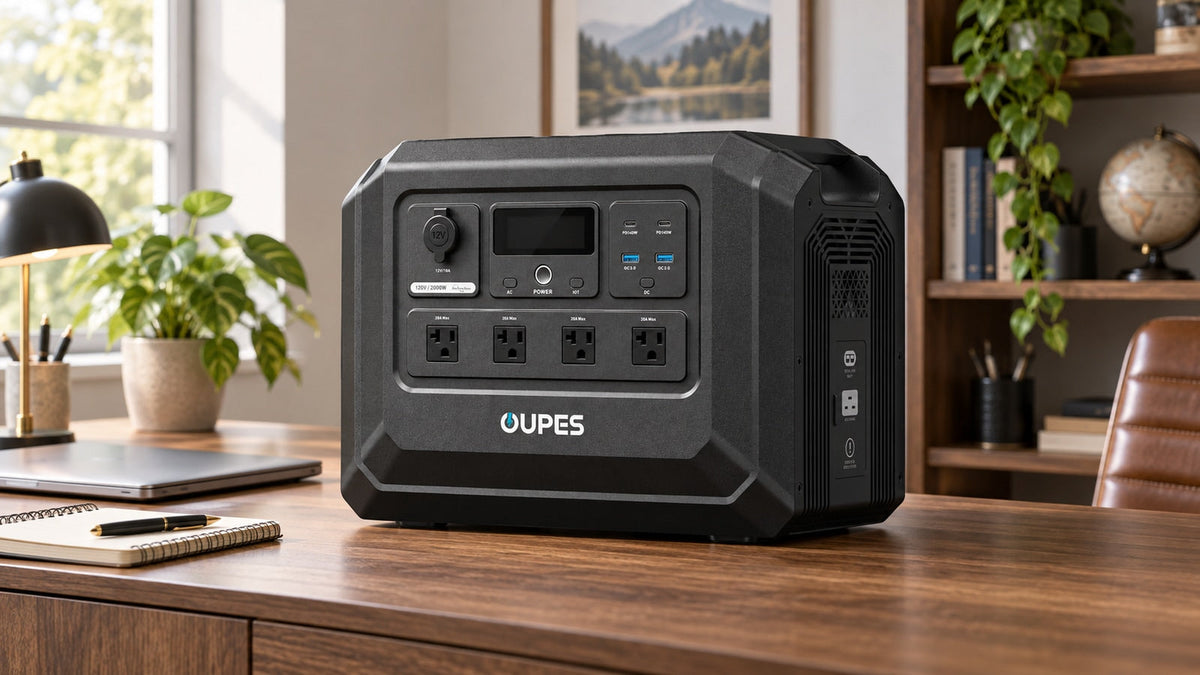
For buyers who want a portable 1kWh system with stronger appliance flexibility, Mega 1 Lite is the most balanced OUPES option in this class. It combines a 1,024Wh battery with 2,000W rated AC output, giving it more output headroom than many lower-power 1kWh platforms while keeping the listed unit weight at 26.8 lb.
It is best suited to short home-backup sessions, mobile work, selected kitchen appliances, camping and other situations where fast recharging and manageable weight matter. Buyers planning multi-day refrigeration, continuous air conditioning or electric heating should move to a larger capacity class instead of relying on optimistic runtime estimates.

OUPES Mega 1 Lite
- 1,024Wh rated battery capacity.
- 2,000W rated AC output.
- Two USB-C ports, rated up to 140W per port.
- 1,400W maximum AC charging input.
Choose Mega 1 Lite after checking the continuous and startup power of your appliances. If your energy budget already exceeds 1kWh before adding a reserve, step up to a larger system. If you mainly charge phones, cameras and one laptop, a smaller unit may provide better portability and value.
Frequently Asked Questions
Does a 1kWh power station provide 1,000W of output?
Not necessarily. The battery's Wh rating and inverter's W rating describe different capabilities. Read both, along with startup and individual outlet limits.
Can it run a refrigerator overnight?
It may, but “overnight” is not a usable specification on its own. Measure energy over the intended hours, verify startup compatibility and include the other connected loads. Do not use a single running-watt reading as an all-night energy measurement.
How long will a 1kWh power station run a 100W device?
Using an 80% delivered-energy estimate, a 1,024Wh battery provides about 819Wh for the connected load, or roughly 8.2 hours at a constant 100W. Real runtime may be shorter or longer depending on conversion losses, idle draw, temperature and the device's changing consumption.
Can a 1kWh power station run a microwave or coffee maker?
It can run a compatible appliance when the appliance's actual electrical input and startup demand stay within the station's limits. These appliances use energy quickly, so they are best operated for short periods rather than treated as continuous loads.
Is a 1kWh power station large enough for camping?
For many weekend camping plans, yes. Calculate the energy required by lighting, refrigeration, electronics and other equipment, then compare it with available charging opportunities. Longer trips or high-draw appliances may require solar recharging or more battery capacity.
Should I buy a solar panel with the power station?
Add a panel when you regularly use the system away from AC power and have a suitable place to deploy it. Confirm voltage, current, connector and cable compatibility. For occasional use near reliable outlets, spending the budget on the right station may be more practical.
Is 2,000W output excessive for a 1kWh battery?
No. Higher output expands the range of compatible appliances, while capacity still determines runtime. A high-power appliance can run successfully but discharge a 1kWh battery quickly, so output and energy must always be evaluated together.
Can I treat its backup switching feature as medical-grade protection?
No. Verify the connected equipment's requirements with its manufacturer and, for prescribed medical equipment, your care team. A switching-time specification alone does not establish medical suitability or guaranteed uninterrupted operation.
What should I check immediately before ordering?
Confirm the exact U.S. configuration, current price and availability, included charging accessories, and the manual's operating limits. Keep your load list beside the product specifications so every important requirement has a clear answer.


Leave a comment
This site is protected by hCaptcha and the hCaptcha Privacy Policy and Terms of Service apply.