




The best portable power station under $500 is the one that covers your essential loads without using the entire budget on capacity you cannot use. Start with appliance wattage and required runtime, then compare charging speed, ports, weight and the final checkout total. For lighter loads and maximum budget flexibility, Exodus 700 is the stronger value choice. If you need 1kWh capacity and higher AC output, Mega 1 Lite becomes the better fit when its current station-only offer remains within budget.
Key Takeaways
- A $500 budget can mean the station alone or a complete usable setup. Decide which before comparing offers.
- Higher wattage does not automatically mean more runtime; check watts and watt-hours separately.
- Discount-code prices are conditional. Recheck the selected configuration and final total before buying.
- A solar-ready power station does not necessarily include a panel, and a panel does not increase battery capacity.
Set the Real Purchase Budget
Start with the final amount you can spend, not the largest discount badge. A complete setup may include the power station, a panel, a compatible solar cable or adapter, an appropriate extension cord and sales tax. Count only accessories you actually need, but do not assume a photographed accessory is included.
For a simplified budget with no shipping charge and an assumed 8% sales tax, the maximum pretax purchase is $500 ÷ 1.08, or about $462.96. This is an arithmetic example, not a statement of your local tax rate. A $489 advertised offer would total $528.12 under that assumption, so it would miss a strict $500 checkout ceiling.
Check whether the price requires a code, applies to the exact variant, or depends on a promotion. Also check return and warranty terms before treating a lower price as a better value. You should be able to explain the final cost without relying on a discount that has not appeared in the cart.
Calculate the Power and Runtime You Need
List your essential devices, their required voltage, running watts and intended hours. For motors and compressors, check startup requirements too. A unit may have enough battery energy for the day and still be unable to start the device you bought it for.
Energy needed (Wh) = average load (W) × operating time (h).
Suppose your measured or deliberately assumed loads are a 50W laptop for four hours, a 10W LED light for five hours and phone charging requiring 30Wh. The total is 200 + 50 + 30 = 280Wh at the devices. These numbers describe a worked example, not typical consumption promised for every laptop or phone.
Using an illustrative 80% delivered-energy factor, a 576Wh battery provides 460.8Wh for planning. Reserving 20% of that estimate leaves about 369Wh for scheduled use, which covers the 280Wh example. Replace the laptop with a 1,000W appliance running for one hour and that appliance alone needs 1,000Wh. It also requires a compatible inverter; extra sockets or a peak rating do not remove either constraint.
| Task | First priority | Reason to reconsider a budget unit |
|---|---|---|
| Phones, lights and a laptop | Usable energy and suitable USB-C/AC connections | Your required hours exceed the calculated energy budget |
| Short refrigerator backup | Measured consumption and verified compressor startup | The motor cannot start or you need substantially longer coverage |
| Brief use of a cooking appliance | Continuous output and actual input watts | The appliance exceeds the inverter rating |
| Repeated outdoor use without an outlet | Panel compatibility and realistic daily recharge | The full compatible kit exceeds the budget or expected solar harvest is insufficient |
Compare OUPES Options Under $500
The comparison below uses the official U.S. product configurations available at the time of publication. Promotional pricing and inventory can change, so use the product page and cart as the final price and availability check.
| Configuration | Regular listed price | Promotional price shown | Best fit |
|---|---|---|---|
| Exodus 700, station only | $399 | $319, code auto-applied as advertised | Leaves the most room here for tax and necessary accessories |
| Exodus 700 + 100W solar panel | $579 | $459, code auto-applied as advertised | Fits a $500 pretax kit budget only while the discount applies |
| Mega 1 Lite, station only | $599 | $489 with code | A conditional sub-$500 station price, with little room for other costs |
Do not substitute an old search-result price for the current product page. If the listed price and the promotional text differ, treat the lower amount as conditional until the checkout confirms it. Do not assume codes stack. For a strict all-in limit, reserve money for tax before deciding that an offer qualifies.
The comparison also separates two buying decisions: a smaller battery with money left for recharging equipment, and more battery capacity without an included solar panel. Neither is automatically better. Your access to outlets and the duration of your planned use decide which tradeoff matters.
Should the $500 Budget Include a Solar Panel?
A solar panel is useful when you have suitable outdoor sunlight and repeated energy needs. It can be a poor first purchase if you primarily charge at home before short trips. In that case, paying for adequate battery capacity may solve more of your immediate problem.
The advertised Exodus 700 plus 100W panel offer above is an example of a kit that can fall below $500 before tax. With the illustrative 8% tax rate, $459 becomes $495.72 before any other charges. That leaves very little margin for extras, so inspect the actual package contents and required connections.
Solar energy arrives over time. A hypothetical 100W panel receiving four equivalent peak-sun hours with a 0.75 overall harvest factor supplies about 300Wh: 100 × 4 × 0.75. Those conditions are assumptions. Shade, cloud, temperature, orientation and charging losses can change the result substantially; a 100W nameplate is not a promise of 100W throughout the day.
Compare that potential harvest with your daily load. A 280Wh day might be close under the example conditions, while a 600Wh day would consume stored energy faster than the example array replaces it. Verify the station's input limits, panel voltage and current, connector and cable requirements rather than choosing by nominal panel watts alone.
Prioritize the Features That Affect Daily Use
Look first at the features that determine whether the product can do the job: output compatibility, battery energy, charging access and suitable ports. Then compare carrying weight, controls and service terms. An app is useful, but it cannot make an undersized inverter start a demanding appliance.
For electronics, check that the USB-C output and cable support the device's charging requirements. For home use, consider fan noise and where you can leave ventilation clear. For camping, include the panel's weight and size in the carrying plan. Battery chemistry and cycle-life claims deserve attention, but cycle counts stated under specified test conditions are not promises of a fixed number of calendar years.
Do not buy on the assumption that any extra battery will connect later. Expansion requires explicit model compatibility. Avoid improvised adapters or wiring to stretch a budget: a physically fitting connector can still be electrically unsuitable. Keep portable power equipment dry and follow its manual for charging, temperature and placement.
Our Recommendations by Use Case
Best value under $500: OUPES Exodus 700
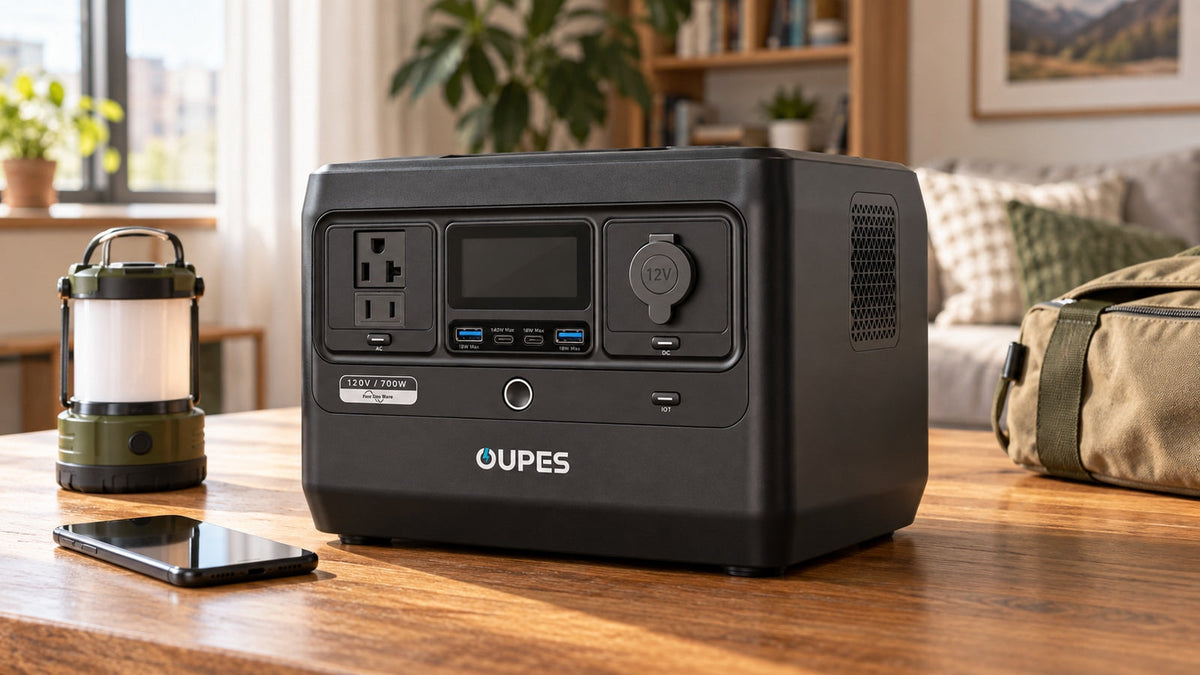
Exodus 700 is our primary recommendation for buyers who want a compact station for laptops, phones, cameras, lighting, small outdoor equipment and other compatible loads. Its 576Wh capacity and 700W rated AC output cover a practical range of everyday uses, while the lower purchase price leaves more room for tax or a solar-panel configuration. Check compressor appliances separately because startup demand can exceed their normal running watts.

OUPES Exodus 700
- 576Wh rated capacity.
- 700W rated AC output.
- 13.9 lb listed weight.
- Station-only and solar-kit configurations available separately.
Best step-up choice near $500: OUPES Mega 1 Lite
Mega 1 Lite is the better choice when the load plan requires roughly 1kWh of capacity or more AC output. The station-only promotional price can place it below $500 before tax, but it leaves little room for accessories and does not include a solar panel. Buyers with a strict all-in budget should confirm the cart total before choosing this option.

OUPES Mega 1 Lite
- 1,024Wh rated capacity.
- 2,000W rated AC output.
- Station-only offer; solar panels are separate.
If neither configuration meets your essential requirements within the total budget, reduce optional loads or wait until you can fund a suitable system. Buying a unit that cannot operate the one appliance you need is not a saving.
Frequently Asked Questions
Is a 500W power station the same as a $500 power station?
No. One number is an output rating; the other is a price. Neither tells you the stored energy in Wh. Check all three independently.
Does “solar generator” mean a panel is included?
Not always. Inspect the exact configuration and included-item list. A station can support solar charging while being sold without a panel.
Should I spend the whole budget on the largest battery?
Only if its output, connections and charging plan also fit. Leave room for essential accessories and tax. A smaller system that meets a measured task can be more useful than a larger one you cannot recharge where you use it.
What capacity should I expect for less than $500?
Capacity varies with product positioning and current promotions. In the options covered here, 576Wh offers more room in the budget, while a promotional station-only offer can move a 1,024Wh model close to the $500 threshold. Compare the final configuration rather than capacity alone.
Is 700W enough for a refrigerator?
It depends on the refrigerator's running input and compressor startup demand. Measure the appliance or check its documentation before purchase. A 700W inverter may suit some refrigerators and fail to start others, even when the expected energy use fits the battery.
Can I run a microwave with a power station under $500?
Only when the microwave's electrical input stays within the power station's continuous and startup limits. Many microwave input ratings exceed 700W. A higher-output model may run the appliance, but its battery can still discharge quickly.
Is the advertised discount guaranteed?
No. Promotional prices may require a code, apply only to a selected configuration or change without notice. Confirm the exact item, discount and final total in the cart before ordering.
Should I choose more capacity or a solar panel?
Choose more capacity when you need longer runtime before the next charging opportunity. Choose a compatible panel when repeated off-grid recharging matters and you have reliable sun exposure. A panel helps replenish energy; it does not increase the battery's stored capacity.
Are taxes included in the $500 examples?
No. Product-page prices are generally shown before location-specific tax unless the checkout states otherwise. Use your local rate and any required accessories to calculate the actual all-in cost.
Can one budget station power a whole home?
Plan for selected compatible devices. Whole-home loads, 240V equipment and building connections require a different level of system design. Never connect a power station's output to a household wall receptacle to energize home wiring.


Leave a comment
This site is protected by hCaptcha and the hCaptcha Privacy Policy and Terms of Service apply.