




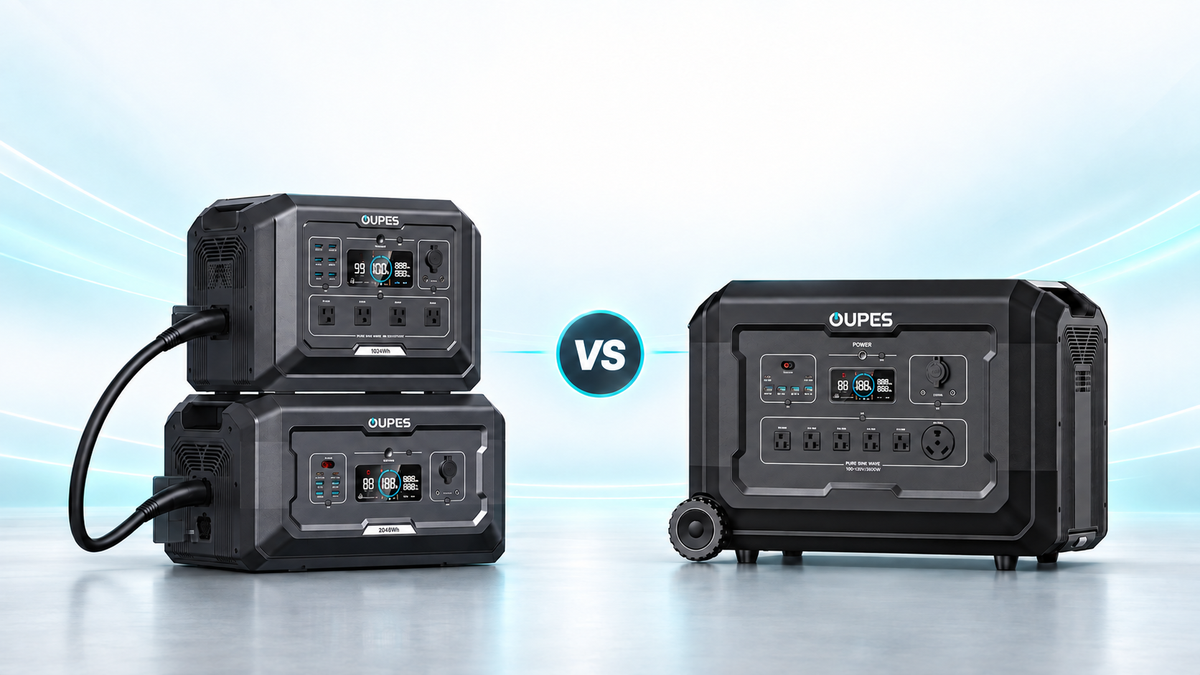
When you compare the OUPES Mega 1 with a B2 extra battery and the OUPES Mega 3, the first number you notice is the same: both solutions provide 3,072Wh of battery capacity. In day-to-day use, however, they serve different priorities.
Mega 1 + B2 uses a modular two-unit design. It is particularly practical for current Mega 1 owners who need longer runtime without replacing their power station. Mega 3 combines the same 3,072Wh capacity with a 3,600W AC inverter, a TT-30R outlet, higher integrated charging input, and substantially more room for future battery expansion.
Quick answer: Choose Mega 1 + B2 if you already own Mega 1, your simultaneous AC load stays within 2,000W, and your main goal is longer runtime. Choose Mega 3 if you are starting with a new system, expect loads above 2,000W, need a TT-30R connection, or plan to expand beyond 5.12kWh.
Mega 1 + B2 vs. Mega 3 Specifications at a Glance
| Specification | Mega 1 + B2 | Mega 3 |
|---|---|---|
| Battery capacity | 1,024Wh + 2,048Wh = 3,072Wh | 3,072Wh |
| Rated AC output | 2,000W | 3,600W |
| Surge output | 4,500W | 7,000W |
| Battery chemistry | LiFePO4 | LiFePO4 |
| Cycle life | 3,500+ cycles to 80% capacity | 3,500+ cycles to 80% capacity |
| UPS/EPS | Under 20ms, 2,000W maximum | Under 20ms, 2,200W maximum |
| AC outlets | 4 × NEMA 5-20R | 5 × NEMA 5-20R + 1 × TT-30R |
| Main-unit solar input | 800W maximum | 2,100W maximum |
| AC + solar input | 2,200W maximum | 3,900W maximum |
| Weight of current setup | 69.6 lb / 31.5 kg combined | 83.3 lb / 37.8 kg |
| Maximum capacity | 5.12kWh with two B2 batteries | 15.36kWh with six B2 batteries |
Both systems store the same amount of energy in the compared configuration. Mega 3 provides more AC output, an RV-focused outlet, and greater expansion potential. Mega 1 + B2 offers a lighter combined setup that can be separated into two easier-to-handle components.
Same 3,072Wh Capacity, Different Power Capability
Battery capacity and output power answer two different questions. Watt-hours indicate how much energy a system can store, while watts indicate how much power it can deliver at one time. The National Renewable Energy Laboratory's energy storage fundamentals likewise treats power and energy capacity as separate system ratings.
Mega 1 uses a 2,000W pure sine wave inverter. Connecting a 2,048Wh B2 increases total capacity from 1,024Wh to 3,072Wh, but it does not change the inverter inside Mega 1. The system therefore remains rated for 2,000W continuous AC output and 4,500W surge output.
Mega 3 also stores 3,072Wh, but its inverter provides 3,600W rated AC output and 7,000W surge output. That additional power matters when several appliances may run at the same time or when equipment has a high starting demand.
For example, a 1,500W appliance and a 900W appliance create a combined load of approximately 2,400W. That exceeds the continuous output rating of Mega 1 + B2, even though the system has enough stored energy. The same load remains within Mega 3's 3,600W output rating, leaving approximately 1,200W of headroom.
Before choosing a system, list the appliances you expect to use simultaneously and check their rated wattage. Refrigerators, pumps, air conditioners, and motor-driven tools may also require additional power during startup, so their surge requirements should be included in the calculation.
How Does Runtime Compare at the Same Load?
Because both configurations have a rated capacity of 3,072Wh, their expected runtime should be broadly similar when the load, conversion efficiency, battery condition, and operating environment are comparable.
Estimated AC runtime = battery capacity × conversion efficiency ÷ appliance wattage
Using 85% as a consistent illustrative AC conversion factor produces the following estimates:
| Continuous load | Illustrative runtime at 3,072Wh |
|---|---|
| 100W | Approximately 26.1 hours |
| 500W | Approximately 5.2 hours |
| 1,000W | Approximately 2.6 hours |
| 2,000W | Approximately 1.3 hours |
These figures illustrate the comparison rather than guarantee a specific runtime. Temperature, standby consumption, conversion losses, battery condition, and the operating cycle of the connected appliance all affect the result. Refrigerators and air conditioners, for example, cycle on and off instead of drawing their nameplate power continuously.
Within Mega 1's output range, runtime is unlikely to be the deciding factor between these two 3,072Wh systems. Port selection, carrying method, recharge setup, and future expansion are more likely to determine which one fits your use.
Already Own Mega 1? Decide Whether You Need More Energy or More Power
For a current Mega 1 owner, the first step is to identify the limitation you are experiencing. If Mega 1 already operates every appliance you need but does not run them for long enough, adding a B2 is a direct capacity upgrade. It adds 2,048Wh and brings the system to 3,072Wh while allowing you to continue using your existing power station and Cleanergy app.
B2 is more than a closed battery pack. It includes USB-A, 100W USB-C, DC5521, Anderson, and car outlets, so it can independently power compatible USB and DC equipment. It does not have standalone AC outlets; standard 120V AC appliances still rely on the inverter in the connected OUPES power station.
If the problem is that your combined AC load exceeds 2,000W, adding battery capacity will not resolve it. In that situation, moving to a higher-output power station such as Mega 3 is the more appropriate response.
Mega 1 + B2 is a strong fit when:
- You already own Mega 1 and its 2,000W output covers your appliances.
- Your priority is longer runtime for refrigeration, internet, lighting, computers, or entertainment equipment.
- You prefer to add capacity without replacing the main power station.
- You regularly move the system and want to carry the power station and battery separately.
- Your expected long-term capacity requirement does not exceed 5.12kWh.

OUPES Mega 1 + B2 Extra Battery
- 3,072Wh combined capacity with 2,000W rated AC output.
- LiFePO4 batteries rated for 3,500+ cycles to 80% capacity.
- Two-piece design with a combined weight of approximately 69.6 lb.
- Expandable to 5.12kWh with two B2 extra batteries.
Buying Your First 3kWh Power Station? Consider the Longer-Term Load
If you are starting without an existing power station, Mega 3 provides 3,072Wh and a 3,600W inverter in one enclosure. This reduces the number of components and battery cables that need to be arranged in a home, RV, trailer, garage, or off-grid setup.
The higher output also gives the system more flexibility as your needs change. A backup plan may begin with a refrigerator, router, lights, and mobile devices, then later include a microwave, coffee maker, electric kettle, space heater, pump, or power tool. Mega 3's 3,600W rated output and 7,000W surge rating provide more room for those combined and startup loads.
Mega 3 also includes a TT-30R 120V/30A outlet. For an RV that uses a compatible TT-30 connection, this can simplify the power setup. Always confirm the RV's input type and manage the total demand of the appliances operating inside it.
Mega 3 is a strong fit when:
- You are purchasing your first power station in the 3kWh capacity class.
- Your simultaneous appliance load may exceed 2,000W.
- You need a built-in TT-30R outlet for a compatible RV setup.
- You prefer one integrated unit for routine use and management.
- You may expand the system beyond 5.12kWh in the future.

OUPES Mega 3 Portable Power Station
- 3,600W rated AC output and 3,072Wh battery capacity.
- 7,000W surge output for demanding startup loads.
- Five NEMA 5-20R outlets plus one TT-30R outlet.
- Expandable to 15.36kWh with up to six B2 extra batteries.
Which System Makes More Sense for Home Backup?
A useful home backup plan begins with essential loads rather than every appliance in the house. Identify the equipment that must remain available throughout an outage, then add the high-power appliances you expect to use occasionally.
If your list focuses on a refrigerator, router, lighting, phones, laptops, television, or similar essentials, and the simultaneous load remains below 2,000W, either configuration can provide 3,072Wh. For someone who already owns Mega 1, adding B2 is a practical way to extend backup time.
If your plan also includes a microwave, electric kettle, coffee maker, space heater, pump, or several kitchen appliances operating together, Mega 3's 3,600W output provides more flexibility. The additional headroom can reduce the need to switch one appliance off before starting another.
Both models specify a UPS/EPS transfer time under 20ms, but the power limits in this mode deserve attention. Mega 1 is rated for up to 2,000W in UPS/EPS use, while Mega 3 is rated for up to 2,200W. If computers, networking equipment, or other devices will remain connected continuously, plan the load around the UPS/EPS rating rather than Mega 3's standard 3,600W AC output.
RV and Outdoor Use: Modular Portability or an Integrated Setup?
For outdoor use, portability depends on more than total system weight. The weight of each component and how often it must be loaded into a vehicle can matter just as much.
Mega 1 weighs 27.8 lb, and B2 weighs 41.8 lb. Their combined weight is approximately 69.6 lb, but each unit can be carried separately. The modular arrangement also lets you adjust the equipment to the trip: take Mega 1 alone for a short outing, then add B2 when you expect a longer stay or higher energy use.
Mega 3 weighs 83.3 lb as one unit. It requires more effort to move, but the integrated design reduces battery cabling and keeps a fixed RV, trailer, garage, or workshop setup more compact. Its TT-30R outlet and higher AC output can also better support an RV configuration with greater simultaneous demand.
If you load and unload your power system frequently, Mega 1 + B2 offers more carrying flexibility. If the power station will remain in a mostly fixed position and you value a TT-30R connection or higher AC output, Mega 3 is likely the better match.
Solar Input and Recharging Flexibility
Mega 1 supports up to 800W of solar input at the main unit and up to 2,200W through combined AC and solar charging. B2 supports up to 2,100W of solar input through its own input system, adding flexibility for a modular off-grid configuration. The effective charging arrangement depends on how the main unit, battery, solar array, and cables are connected.
Mega 3 accepts up to 2,100W of solar input, 1,800W of AC input, and 3,900W through combined AC and solar charging in one unit. If you have a larger solar array or need to recharge within a limited grid-power or daylight window, this integrated input capacity is easier to plan around.
Actual solar production varies with sunlight, panel angle, temperature, shade, and cable loss. Before connecting an array, confirm that its voltage and current remain within the input range specified for the power station or battery.
How Much Expansion Will You Need Later?
Mega 1 supports up to two B2 batteries for a maximum capacity of 5.12kWh. That range can cover many essential home backup, weekend RV, and moderate off-grid requirements.
Mega 3 supports up to six B2 batteries for a maximum capacity of 15.36kWh. This gives users a longer upgrade path when the goal is to increase home backup duration or build a larger solar-supported system over time.
You do not need to buy unused capacity today, but it is worth considering how your energy needs may change over the next few years. If your intended system is likely to exceed 5.12kWh, starting with Mega 3 can reduce the possibility of replacing the main power station later.
Mega 1 + B2 or Mega 3: The Final Buying Decision
Choose Mega 1 + B2 when you already own Mega 1, its 2,000W output covers your equipment, and your main objective is to increase capacity from 1,024Wh to 3,072Wh. Its two-piece configuration also suits users who carry the system frequently or want to adjust capacity from one trip to another.
Choose Mega 3 when you are buying a new system, your combined load may exceed 2,000W, or you need a TT-30R outlet, higher integrated solar input, and a longer expansion path. It is better positioned for high-power home backup, RV use, and larger off-grid systems.
Before deciding, answer these three questions:
- Could the appliances running at the same time exceed 2,000W?
- Do you need a TT-30R RV outlet or prefer one integrated unit?
- Could your future capacity requirement exceed 5.12kWh?
If you answer yes to any of these questions, Mega 3 will generally provide more room for future needs. If all three answers are no and you already own Mega 1, adding B2 is the more direct way to gain runtime.
Compare More OUPES Portable Power Stations
Frequently Asked Questions
Does adding B2 increase Mega 1 output to 3,600W?
No. B2 increases total battery capacity to 3,072Wh, but Mega 1 remains rated for 2,000W continuous AC output and 4,500W surge output.
Which runs longer, Mega 1 + B2 or Mega 3?
Both have a rated capacity of 3,072Wh. Under the same load and similar operating conditions, their expected runtime should be broadly comparable. Actual results depend on conversion losses, temperature, battery condition, standby consumption, and appliance duty cycles.
Can B2 be used without a power station?
B2 can power compatible equipment through its USB and DC outputs and supports solar input. It does not provide standalone AC outlets, so standard 120V AC appliances require a compatible OUPES power station.
Is Mega 3's full 3,600W output available in UPS mode?
No. Mega 3 is rated for 3,600W during standard AC output, while its UPS/EPS mode is rated for a maximum of 2,200W. Size continuously connected UPS loads according to the 2,200W limit.
Which setup is easier to move?
Mega 1 + B2 separates into a 27.8 lb power station and a 41.8 lb battery. Mega 3 is a single 83.3 lb unit. The modular setup is generally easier to load and unload, while Mega 3 requires fewer components once positioned.


Leave a comment
This site is protected by hCaptcha and the hCaptcha Privacy Policy and Terms of Service apply.